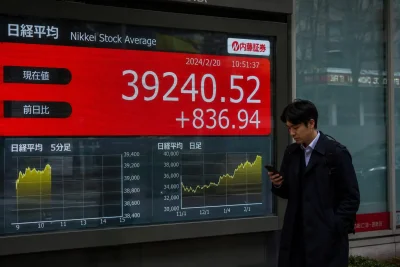
Shares of Mitsubishi UFJ Financial Group advanced in Tokyo trading on Friday, February 8, 2026, closing the session with a notable gain of 2.5% at 2,951.5 yen. The stock reached the day's high after an earlier dip to 2,803 yen, indicating a firm rebound that captured investor attention. The movement reflects a broader reassessment of the Japanese banking sector's prospects amid shifting monetary and fiscal policy landscapes.
Strategic Shift in Bond Portfolios
The financial institution has indicated a potential strategic pivot toward increasing its holdings of Japanese government bonds (JGBs), a move predicated on the view that long-term interest rates are showing signs of stabilization. This comes despite the bank reporting substantial unrealized losses on its bond portfolio, which stood at 200 billion yen at the end of the 2025 fiscal year. These paper losses, which reflect the mark-to-market decline in bond values due to rising yields, remain a critical point of vulnerability but also a potential source of future gains should yields retreat.
Takayuki Hara, managing director and head of MUFG's CFO office, articulated this cautious approach during a recent briefing, stating, "With long-term interest rates showing signs of peaking, I think we'll cautiously rebuild our JGB position." This sentiment is echoed by other major financial groups, including Sumitomo Mitsui Financial Group, suggesting a sector-wide recalibration. Analysts note that a 10-year JGB yield stabilizing near 2.5% could present an attractive re-entry point for banks seeking higher returns on their investment portfolios.
Monetary Policy and Political Crosscurrents
The investment calculus for banks is intricately linked to signals from the Bank of Japan. BOJ board member Kazuyuki Masu recently reinforced the central bank's commitment to further interest rate hikes to prevent inflation from sustainably exceeding its 2% target. While market observers like Rinto Maruyama, an FX and rates strategist at SMBC Nikko Securities, noted that Masu's comments were not overwhelmingly hawkish, they nonetheless "underscore the BOJ’s resolve" to continue normalizing policy. This trajectory implies higher funding costs for banks, a factor that could pressure net interest margins even as it potentially improves lending profitability.
Simultaneously, the immediate market outlook is being shaped by political developments. Japan held a national election on Sunday, February 10, 2026. Opinion polls suggested Prime Minister Sanae Takaichi's coalition was poised to secure approximately 300 seats in the 465-seat lower house. A key campaign pledge to eliminate the 8% sales tax on food has introduced fiscal uncertainty, with analysts estimating a potential annual revenue shortfall of 5 trillion yen. Takaichi has publicly stated she would resign if her coalition fails to maintain its lower-house majority, adding a layer of political risk to the economic equation.
The confluence of these factors sets up a critical test for markets as trading resumed on Monday, February 11. Investors are closely monitoring the election results, their implications for fiscal policy and bond issuance, and the yen's exchange rate. A decisive election outcome triggering expectations of looser fiscal policy could spur a renewed spike in government bond yields, which would directly pressure bank balance sheets through another round of unrealized losses on their JGB holdings. Conversely, a faster pace of BOJ tightening could elevate funding costs, creating a complex environment where higher rates present both opportunity and risk.
Broader Market Context and Data Points
In offshore trading, MUFG's American Depositary Receipt (ADR) settled at $19.14 in the U.S. market, gaining 89 cents from the previous close, providing a positive lead for Tokyo's Monday open. The week ahead also features a busy schedule for Japanese government debt issuance, including a 6-month Treasury bill auction on February 9 and a 10-year inflation-linked bond sale the following day. The Bank of Japan's next policy meeting is scheduled for March 18-19, leaving a window for market sentiment to evolve based on incoming data and the new political mandate.
The fundamental risk for Mitsubishi UFJ and its peers is clear: volatility in the bond market remains the primary driver of near-term performance. A scenario combining expansive fiscal policy and aggressive monetary tightening presents a particularly challenging mix, as the benefits of wider lending margins may be offset by escalating funding costs and balance sheet pressures. As the market digests the election results, the interplay between the yen, JGB yields, and bank stocks will be the defining narrative for the Japanese financial sector in the coming sessions.