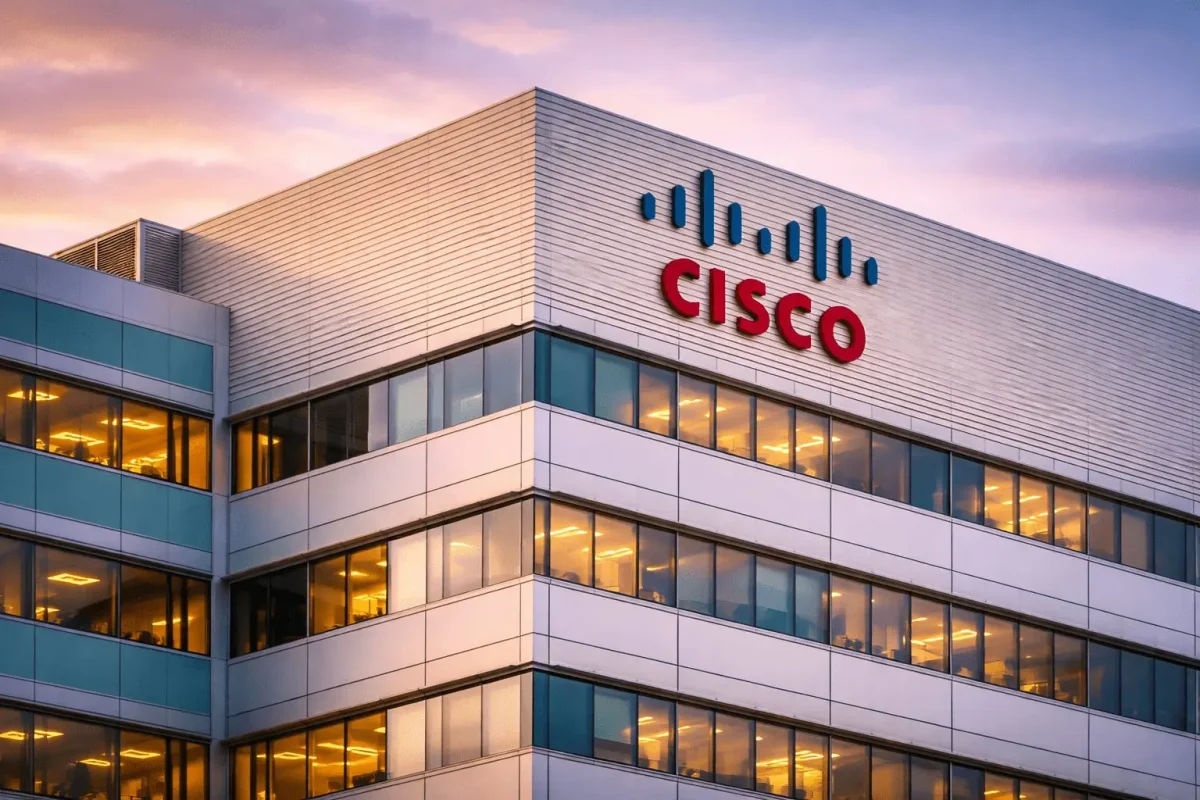
Shares of Cisco Systems, Inc. (CSCO) experienced a sharp decline of nearly 10% in Thursday's trading session, closing at $77.27. The selloff followed the company's second-quarter earnings release, where investors focused intently on mounting pressure to profitability margins, overshadowing a positive revision to the full-year revenue outlook.
Margin Compression Overshadows Revenue Strength
For the quarter ended January 24, 2026, Cisco reported revenue of $15.3 billion, with non-GAAP earnings per share coming in at $1.04. While the top-line figure demonstrated resilience, the critical metric of adjusted gross margin contracted to 67.5%, falling short of analyst consensus estimates which had anticipated approximately 68.14%. Management attributed this compression directly to escalating global memory chip costs, a supply-chain headwind linked to the industry-wide scramble to build out artificial intelligence infrastructure.
Looking forward, the guidance provided further cause for concern. Cisco projected its third-quarter revenue to land between $15.4 billion and $15.6 billion. However, it forecast non-GAAP gross margins to slide further into a range of 65.5% to 66.5%. Concurrently, the company raised its fiscal 2026 revenue forecast to a band of $61.2 billion to $61.7 billion. This juxtaposition of a raised revenue target alongside a declining margin outlook created a "beat-and-raise" scenario that ultimately failed to satisfy the market, highlighting investor prioritization of profitability in the current environment.
Strategic Implications and Competitive Landscape
The margin pressure raises significant questions about Cisco's positioning within the critical AI infrastructure ecosystem. As a leading provider of the core networking hardware—such as switches, routers, and data center optics—that underpins large-scale AI deployments, Cisco's financial performance is often viewed as a bellwether for the sector. The current cost dynamic casts doubt on which players in the value chain will ultimately absorb the rising expenses of scaling AI, potentially squeezing vendors situated between hyperscale cloud customers and component suppliers.
CEO Chuck Robbins addressed these challenges on the earnings call, noting that Cisco has already initiated price increases and is renegotiating contract terms with customers to help offset the inflationary pressures. "Compressed margins definitely took some shine off the report," observed Jake Behan, head of capital markets at Direxion, encapsulating the market's reaction. The situation sharpens the focus on Cisco's competitive execution in the data-center networking arena, where it contends with rivals like Arista Networks (ANET) and Juniper Networks (JNPR) for business from major cloud service providers.
The fundamental risk for Cisco is straightforward: if memory prices remain elevated or continue to climb, the company may face an increasingly difficult choice between protecting its profitability margins and maintaining sales volumes. Any disruption in customer contract negotiations or an unexpected pullback in orders from hyperscalers could rapidly impact quarterly earnings.
Investor Focus Shifts to Execution and Strategy
Beyond the immediate financials, the market is keenly assessing Cisco's ability to convert its substantial AI-related order backlog into recognized revenue and whether its pricing actions can keep pace with rising input costs without causing delays in product shipments. This execution challenge is paramount for sustaining investor confidence.
Adding to the week's significance, Cisco is currently hosting its Cisco Live event in Amsterdam, running through February 13. Investors and analysts are tuned in for updates regarding AI order flow, the company's evolving pricing strategy, and management's outlook on supply-chain expense trends. These are the key issues currently steering the investment thesis for the stock. In a separate corporate action, Cisco's board authorized a one-cent increase to its quarterly dividend, raising it to $0.42 per share.
The pronounced market reaction underscores a shift in sentiment where top-line growth alone is insufficient. For Cisco and its peers in the hardware sector, demonstrating an ability to navigate cost inflation and protect profitability is now critical. The coming quarters will test the efficacy of Cisco's strategic responses and its capacity to balance growth with margin integrity in a challenging procurement environment.