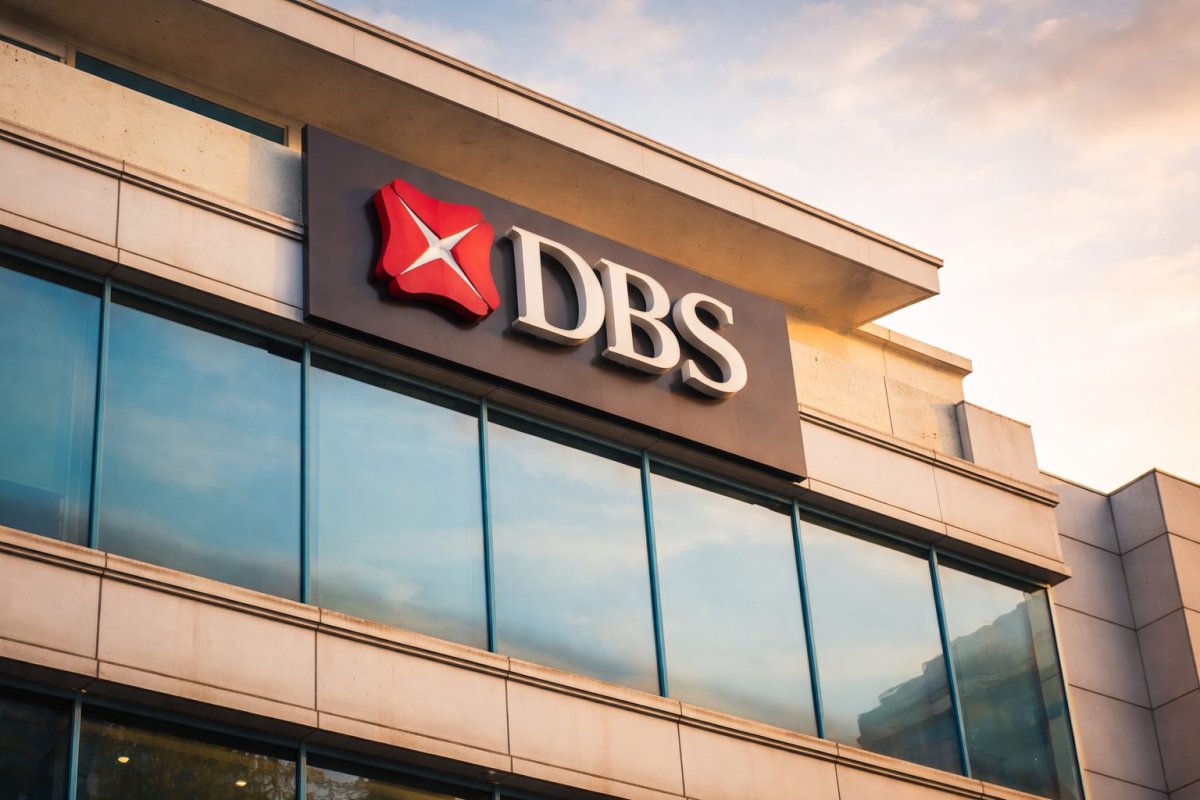
DBS Group Holdings Ltd. saw its share price decline in Monday's trading session following the release of its fourth-quarter financial results, which fell short of market expectations. The Singapore-based banking giant reported a net profit of S$2.26 billion for the quarter, representing a 10% year-over-year decrease. This figure missed the consensus analyst estimate of approximately S$2.55 billion. Concurrently, a key profitability metric, the net interest margin (NIM), contracted to 1.93%, down from 2.15% in the prior-year period.
Market Reaction and Peer Performance
In response to the earnings report, DBS shares traded lower, shedding 1.1% to S$58.63 by midday after an initial drop of as much as 1.9%. The market's reaction underscores investor concern over the dual pressures of declining profits and compressed margins. In contrast, shares of its local rivals, United Overseas Bank and Oversea-Chinese Banking Corp, edged higher during the same session, gaining 0.8% and 0.7% respectively. Investors are now keenly awaiting the financial results from these peers, scheduled for release on February 24 and 25.
Dividend Strategy Amid Profitability Challenges
Despite the earnings miss, DBS reaffirmed its commitment to shareholder returns. The bank's board declared a final ordinary dividend of 66 cents per share, supplemented by an additional capital return dividend of 15 cents per share for the quarter. Furthermore, the bank outlined a plan to continue distributing similar capital return dividends through the 2026 and 2027 financial years, barring unforeseen circumstances. The ex-dividend date has been set for April 8, with payment to follow on April 17.
The focus on dividends highlights a strategic effort to support the stock's valuation. However, analysts note that sustained dividend payouts are inherently linked to the underlying health of earnings. The bank's return on equity (ROE) also retreated, falling to 13.5% from 15.8% a year earlier, signaling a reduction in the efficiency of profit generation.
Broader Economic Context and Forward Guidance
The contraction in net interest margin is largely attributed to a shifting interest rate environment. As benchmark rates decline, the spread between what banks earn on loans and pay on deposits typically narrows. DBS management acknowledged this headwind, noting that funding costs can remain elevated if competitive intensity for deposits persists. This dynamic creates a complex operating landscape for the banking sector as it navigates the latter part of 2026.
In her commentary, CEO Tan Su Shan advised clients to prepare for a potentially turbulent year ahead. The bank maintained its full-year outlook, projecting a slight dip in net profit for the current year compared to 2025. Analysts from CGS International pointed to softer markets trading income as a primary driver behind the quarterly earnings shortfall.
Risk Factors and Sector Implications
Looking forward, the primary risk scenario for DBS and the broader banking sector involves the pace of monetary policy easing. Should central banks implement rate cuts more rapidly than currently anticipated, net interest margins could face further significant pressure. Additionally, any deterioration in credit quality, particularly within property-related exposures, could lead to higher provisioning costs. Such a development would potentially complicate capital management and dividend distribution strategies.
As Singapore's largest lender, DBS often sets the tone for the city-state's financial sector earnings. The latest results place a spotlight on how quickly the transition to a lower-rate regime will impact bottom-line performance across the industry. The coming weeks, with reports from UOB and OCBC, will provide a more complete picture of the sector's resilience.
Investors are now tasked with balancing the attractive yield provided by the announced dividends against the fundamental challenges of margin compression and moderated profit growth. The bank's ability to manage costs and navigate credit cycles will be critical in sustaining its shareholder return policy over the announced multi-year horizon.