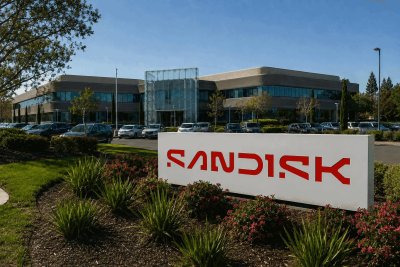
Shares of SanDisk Corporation experienced notable upward movement during Friday's trading session, climbing approximately 3.3% to $641.87. This gain followed a period of heightened volatility linked to a substantial secondary share offering by its former parent company, Western Digital. The stock oscillated between an intraday low of $613.06 and a high of $646.60 as the market processed the implications of the transaction.
The Mechanics of the Block Trade
Western Digital announced this week that it had successfully raised roughly $3.17 billion by selling a portion of its equity position in SanDisk. The deal, structured as a secondary offering, involved the sale of existing shares at a price of $545 each. It is critical to note that SanDisk itself does not receive any proceeds from this sale; the capital flows directly to Western Digital. The transaction was facilitated through a debt-for-equity exchange arrangement with affiliates of JPMorgan Chase & Co. and BofA Securities.
According to Western Digital's Chief Financial Officer, Kris Sennesael, the company intends to fully monetize its remaining SanDisk holdings before the one-year anniversary of the corporate separation. Following this initial sale, Western Digital continues to hold approximately 1.7 million SanDisk shares, which it plans to divest in the future.
Market Dynamics and the "Share Overhang"
The immediate market reaction underscores a current theme where supply dynamics, rather than fundamental company performance, can dictate short-term price action. When a major shareholder liquidates a large block of stock, it introduces a sudden increase in supply. Buyers typically demand a discount to absorb these shares, which can exert downward pressure on the stock price even in the absence of negative news regarding the underlying business.
This phenomenon, often termed a "share overhang," has been a focal point for traders. The primary concern is whether the offering clears the market efficiently and if Western Digital will schedule follow-on sales that could loom over the stock for an extended period. The trading tape for SanDisk on Friday reflected this uncertainty, displaying wide intraday price ranges and elevated volume as participants sought a new equilibrium price.
Strategic Rationale and Analyst Perspective
The capital raise is a strategic move by Western Digital aimed squarely at balance sheet improvement. Proceeds are designated for debt reduction, a priority for the data storage company. Analysts have viewed the transaction positively from a credit perspective. Amit Daryanani of Evercore ISI noted that the sale represents a "material acceleration of WDC's deleveraging efforts." He further suggested that a cleaner balance sheet could eventually provide Western Digital with expanded options for capital returns to its shareholders.
The positive sentiment extended to Western Digital's own stock, which also posted a gain of about 3.3% on the day. The trade had ripple effects across the broader storage and memory sector, with shares of Micron Technology rising approximately 2.7%.
Looking Ahead: Catalysts and Risks
The near-term trajectory for SanDisk shares is likely to be influenced more by mechanical and technical factors than operational results. Investors and traders will closely monitor regulatory filings for any indications of additional stake sales by Western Digital. The timing and method of disposing the remaining 1.7 million shares will be a key catalyst.
However, the risk remains twofold. If Western Digital lines up another sale promptly, or if broader market volatility causes buyers to retreat, the persistent overhang could continue to weigh on SanDisk's share price. Conversely, a clean absorption of the current block and a communicated, orderly plan for the remaining shares could help alleviate this pressure.
In summary, while SanDisk's business fundamentals were not the driver of Friday's activity, the financial engineering by its former parent has introduced a period of technical adjustment. The market's next moves will depend heavily on the pace at which Western Digital completes its exit and how smoothly the substantial block of shares is digested by institutional and retail investors.