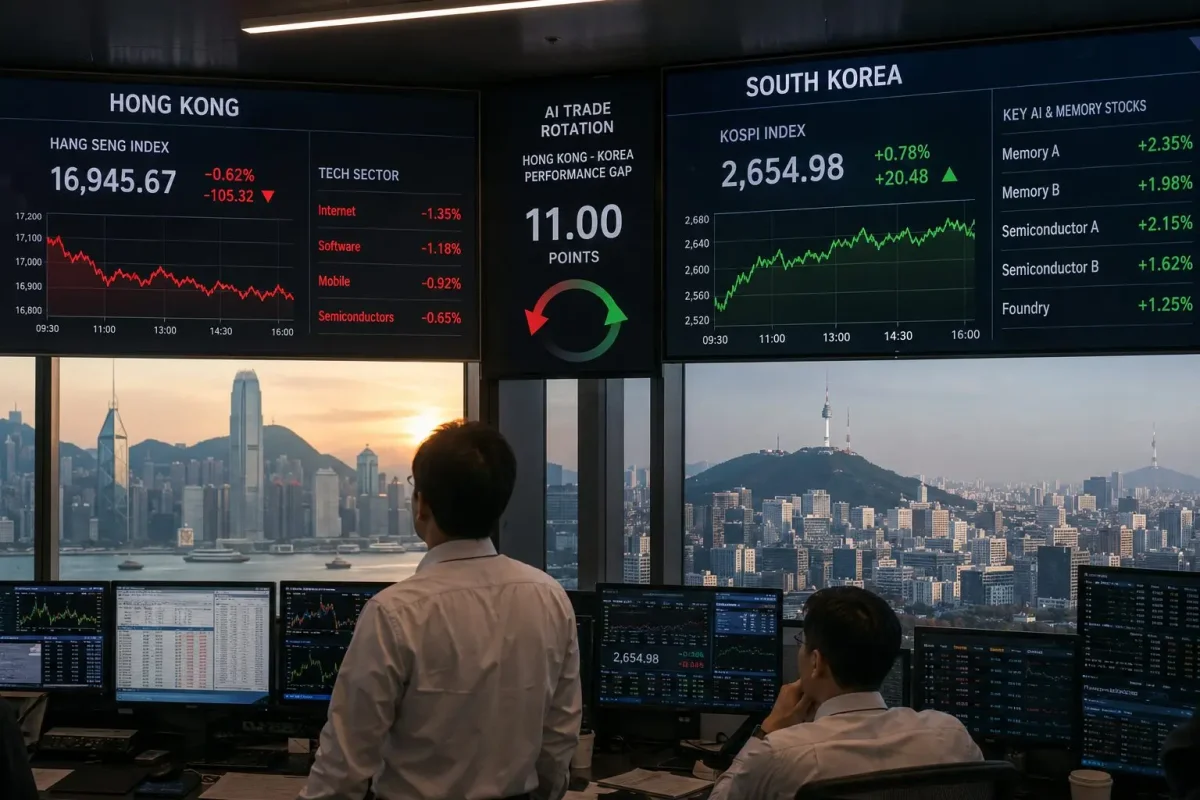
Singapore, July 10, 2026 – Asian markets ended the week with a stark divergence that underscores a rotation within the artificial intelligence trade. Hong Kong's Hang Seng Index rose 3.5% for the week, while South Korea's KOSPI fell 7.6%, creating an 11.1-percentage-point gap that suggests a shift in investor sentiment away from crowded positions.
The divergence was even more pronounced within the technology sector. The Hang Seng Tech Index climbed 4.95%, while SK Hynix (KRX:000660) dropped 10.1% and Samsung Electronics (KRX:005930) lost 7.9%. This performance gap of 15.05 and 12.85 percentage points, respectively, highlights a rotation out of the most concentrated AI plays in Korea.
Taiwan's markets were closed Friday due to Typhoon Bavi, leaving Taiwan Semiconductor Manufacturing Co. (TPE:2330) and the island's chip complex without price discovery. This absence is significant because Korea's market is heavily top-heavy: Samsung and SK Hynix together represented 66.62% of the MSCI Korea Index as of June 30, meaning a handful of stocks can dictate the benchmark's direction.
Seoul's Friday rebound offered little comfort. The KOSPI rose as much as 5.7%, but a buy-side sidecar—a five-minute pause in program purchases—was triggered for the third time this week. Samsung gained 2.52%, while Hynix slipped 0.27%. Vishnu Varathan, head of economics and strategy at Mizuho Bank, noted that the listing showed "enduring, if not entrenched, AI optimism."
That optimism appeared more clearly in primary-market demand. SK Hynix priced American depositary receipts at $149, raising about $26.5 billion even as its Korean stock closed 0.3% lower. Hynix trades at about 5.8 times forecast earnings, compared with roughly 7 times for U.S. peer Micron Technology (NASDAQ:MU). Thomas Hayes, chairman of Great Hill Capital, remarked, "Global semiconductors is the most crowded trade in the world right now."
Hong Kong's relative strength also had a financing backdrop. Chinese technology companies have raised HK$159.34 billion ($20.33 billion) in the city this year to fund AI, semiconductor, and advanced-manufacturing expansion, giving the move a capital-formation base beyond Friday's index rebound. However, mainland China's falling market showed the demand was selective.
Japan's Nikkei 225 rose 1.2% after Finance Minister Satsuki Katayama said the government wants pension funds, including the 293.6 trillion yen ($1.8 trillion) Government Pension Investment Fund, to allocate "substantially" more to Japanese assets. The yen and government bonds rallied. Sim Moh Siong, FX strategist at OCBC, said, "I am not sure if this is a silver bullet," though the proposal could steady sentiment.
India offered a modest earnings counterpoint. Tata Consultancy Services (NSE:TCS) reported quarterly sales of 722.75 billion rupees, ahead of the 720.30 billion-rupee consensus, while annualized AI revenue reached $2.6 billion. CEO K. Krithivasan expressed optimism about a spending recovery, but Anshul Jethi at LKP Securities called the performance only "marginally better."
The rotation could break quickly. A weak U.S. trading debut for Hynix, a sharp catch-up move when Taiwan reopens, or another oil-driven rise in inflation could push investors back out of crowded chip positions. Brent crude was heading for a gain of about 5% this week as renewed U.S.-Iran fighting raised supply concerns.
Next week brings three key tests. TSMC is scheduled to release delayed June sales on Monday, July 13, and second-quarter results on Thursday, July 16. U.S. June consumer-price data are due Tuesday, July 14, at 8:30 a.m. ET, while the Bank of Korea meets on July 16. Within four sessions, investors will get fresh readings on chip demand, inflation, and the cost of holding Korea's concentrated AI trade.