Advanced Micro Devices (AMD) saw its shares climb nearly 18% in premarket trading on Wednesday after the company issued a revenue outlook that exceeded Wall Street expectations, sparking a broader rally in the semiconductor sector. If these gains hold, AMD could reach a new all-time high, reflecting investor optimism about its expanding role in artificial intelligence infrastructure.
AMD forecasted second-quarter revenue of approximately $11.2 billion, plus or minus $300 million, surpassing the $10.52 billion consensus estimate from analysts surveyed by LSEG. The chipmaker also guided for an adjusted gross margin near 56%, signaling that robust demand for AI server chips is offsetting rising supply and development costs. First-quarter results showed revenue of $10.3 billion, a 38% year-over-year increase, with adjusted earnings per share of $1.37.
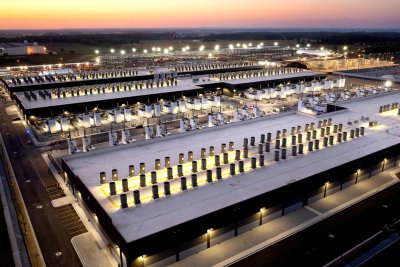
The data-center segment emerged as the primary growth driver, with revenue surging 57% to $5.8 billion, fueled by strong demand for AMD's EPYC server processors and Instinct graphics processing units (GPUs). CEO Lisa Su described data centers as the "primary driver" of AMD's revenue and profit growth, highlighting increased customer engagement with its MI450 Series and Helios systems. She also revised the server CPU addressable market forecast to more than 35% annual growth, projecting it to exceed $120 billion by 2030, a significant upgrade from the 18% pace predicted last November.
AMD's upbeat outlook lifted other chip stocks in premarket trading. Intel (INTC) gained 6%, Arm Holdings (ARM) rose 11%, and Qualcomm (QCOM) added about 4%. This rally reflects a shift in investor focus beyond Nvidia's (NVDA) dominance in graphics chips toward a broader AI story. Matt Britzman, senior equity analyst at Hargreaves Lansdown, noted that "AMD's story is no longer just about having a GPU pipeline to challenge Nvidia," as both CPUs and GPUs are gaining traction with increasing AI workload complexity.
The bullish sentiment positions AMD to compete more effectively against Nvidia, the leader in AI accelerators, and Intel, which is striving to regain market share in server CPUs and chip fabrication. Unlike Intel, AMD does not manufacture its own chips, relying on partners like Taiwan Semiconductor Manufacturing Co. (TSM). This dependency could pose risks if supply constraints emerge.
Jake Behan, head of capital markets at Direxion, commented that the quarter confirmed genuine demand for AI compute. However, he cautioned that investors are now watching whether AMD can convert that demand into high-margin revenue. The stock has already rallied about 66% year-to-date before Wednesday's premarket gains, and its forward earnings multiple now exceeds Nvidia's, despite Nvidia commanding a larger share of the AI market.
Operational challenges remain. High-bandwidth memory, critical for AI data centers, continues to be in short supply, pressuring the broader chip industry. AMD executives flagged rising memory and component costs as potential headwinds for PC shipments in the second half of the year. Additionally, the company expects gaming revenue to decline more than 20% compared to the first half.
Despite these risks, the market is betting that AMD is carving out a larger role as a major supplier for the next phase of AI infrastructure. The key question is whether orders, supply chains, and margins can meet the expectations now priced into the stock.