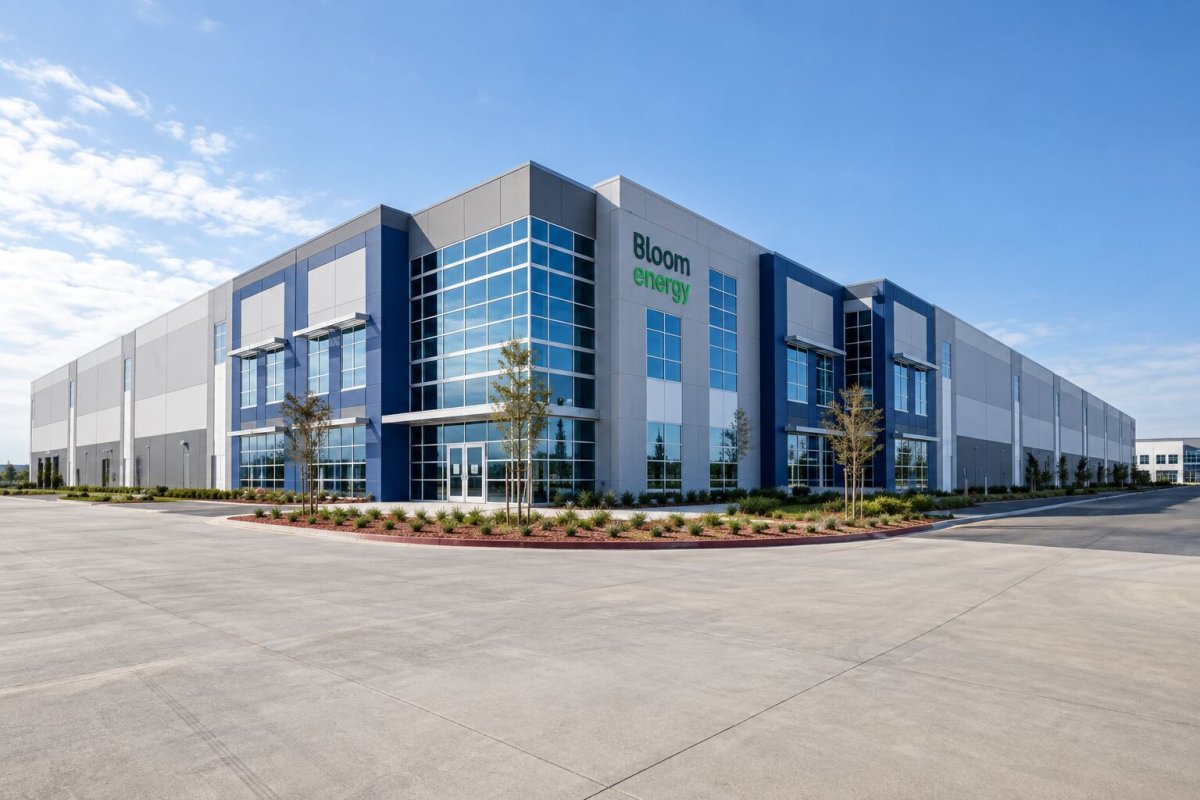
Bloom Energy (BE) officially joins the S&P 500 index before Monday's market open, but the milestone was marked by a notable selloff. On Friday, September 18, the fuel-cell technology company's shares closed at $265.63, down $15.13, or 5.39%, after trading in a range of $265 to $285.10. The trading volume surged to 73.3 million shares—4.8 times the three-month daily average—indicating significant repositioning by index funds and other institutional investors.
The decline on Friday came despite the positive news of the index inclusion, which was announced on September 4. On that day, Bloom Energy closed at $252.87, and the stock jumped 9.6% to $277.22 the next session. However, by Friday's close, the shares were still 5% above the September 4 level, suggesting that much of the anticipated demand had already been priced in. The intraday movement on Friday reinforced this view: the stock opened at $284.32, briefly touched $285.10, then slid 6.6% from the open to the close, as sellers took advantage of the index-related buying pressure.
Bloom Energy's promotion to the S&P 500 comes on the back of impressive operating performance. The company reported second-quarter revenue of $1.065 billion, a 166% increase year-over-year. Gross margin expanded to 33.4% from 26.7%, and operating margin swung to a positive 17.1% from a loss of 0.9% a year earlier. Management also raised its full-year 2026 revenue outlook to a range of $3.9 billion to $4.2 billion.
However, the market's reaction on Friday suggests that investors are weighing the rich valuation against the company's growth prospects. At Friday's market capitalization of approximately $78.2 billion, Bloom Energy was trading at roughly 19.3 times the midpoint of its 2026 revenue guidance. This price-to-sales multiple, while not a forecast, highlights the premium the market is placing on future execution.
Bloom Energy's pitch for AI data centers is a key part of its growth narrative. In a company report released September 16, Bloom estimated that its native 800-volt direct-current fuel-cell system could reduce non-compute capital spending for a one-gigawatt AI data center by $3.6 billion, or 27%. This is a company-authored model, and no specific customer contracts were disclosed. The company also highlighted a $25 billion project-financing framework with Brookfield, though actual revenue will depend on projects that are ultimately funded and built.
On the balance sheet, Bloom Energy appears well-positioned. As of June 30, the company held $2.67 billion in cash and generated $300 million in operating cash flow in the first half of the year, a stark improvement from a $324 million outflow in the same period last year. Customer deposits also rose sharply, providing additional liquidity for expansion without an immediate need for new equity financing.
Yet, concentration risk remains a concern. Bloom's latest 10-Q filing revealed that three customers accounted for 36%, 34%, and 17% of accounts receivable at the end of the quarter. Additionally, accounts receivable and contract assets increased by $86.3 million and $187.1 million during the first half, reflecting billing milestones. For the company to sustain its growth trajectory, it will need to convert these receivables into cash and diversify its customer base.
Monday's trading will test the residual technical demand as index funds complete their required purchases. However, the more critical test will come with the next earnings report, where investors will look for progress toward the $3.9 billion to $4.2 billion revenue target, gross margin stability near 33.4%, and improved cash collection. Friday's selloff serves as a reminder that the S&P 500 badge alone is no longer sufficient to drive the stock higher.