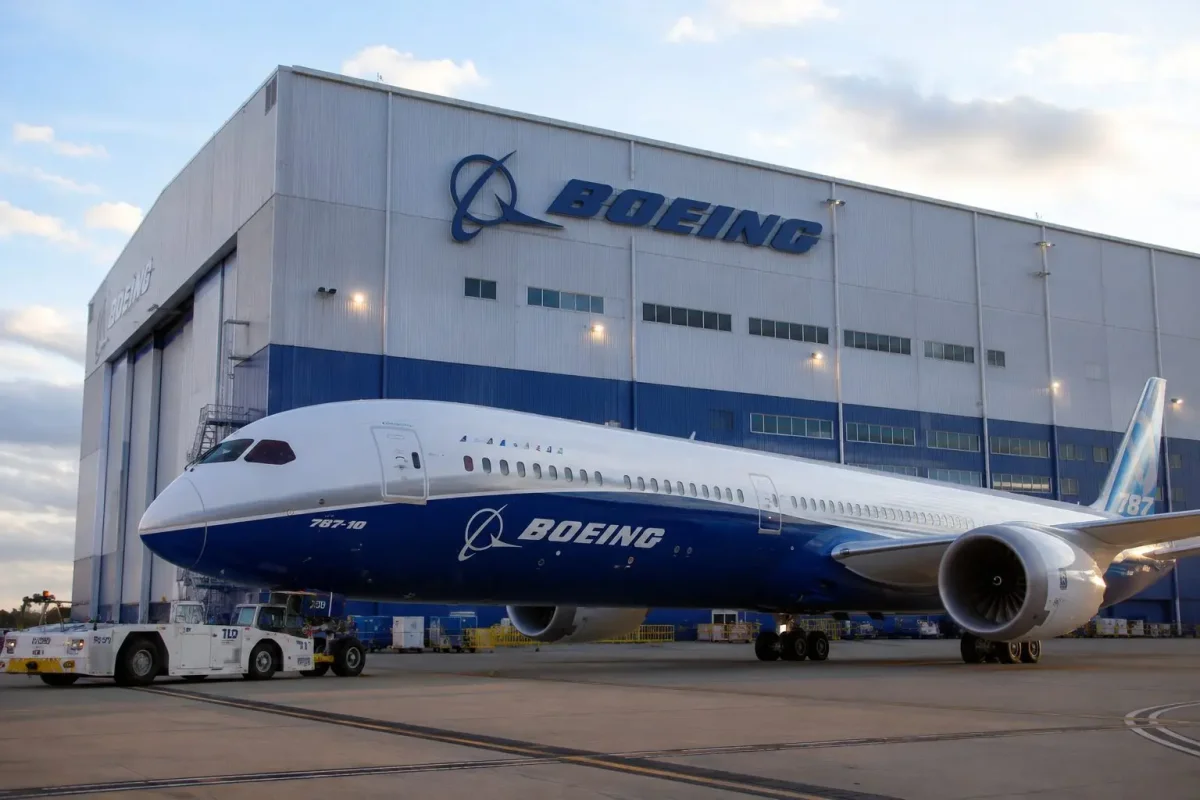
Boeing (NYSE:BA) shares climbed 3.4% to $218.65 in early trading on Tuesday, as the aerospace giant's positive free cash flow guidance for 2026 helped counterbalance a larger-than-anticipated quarterly loss. The stock rose even as the company reported a core loss per share of $0.76, significantly wider than the $0.30 loss analysts had expected according to LSEG data.
Cash Flow Momentum Builds
Boeing generated $631 million in free cash flow during the second quarter, a sharp reversal from the $200 million outflow in the same period last year. This metric, defined as operating cash flow minus capital expenditures, has become a key focus for investors. However, free cash flow for the first half remained negative at $823 million, underscoring that the recovery is still in its early stages.
The company reiterated its full-year 2026 guidance for positive free cash flow between $1 billion and $3 billion. To achieve the midpoint of this target, Boeing will need to generate between $1.823 billion and $3.823 billion in the second half of the year, implying a quarterly midpoint of approximately $1.412 billion—more than double the Q2 result.
Commercial Division Drives Optimism
The Commercial Airplanes segment remains the primary engine for Boeing's cash flow ambitions. Jet deliveries rose 14% year-over-year to 171 units in Q2, while segment revenue increased by $877 million. The unit's operating loss narrowed by $235 million to $322 million, with a reported margin of negative 2.7%, improving from negative 5.1% a year ago.
Production rates are also ramping up. Boeing has increased 737 output to 47 jets per month and launched low-rate initial production on the new Everett assembly line in July. On the certification front, the 737-7 and 737-10 models have completed flight testing, with certification expected in 2026 and initial deliveries slated for the following year.
CEO Kelly Ortberg noted, “Our operations are more stable and key certification programs remain on plan,” while acknowledging that “additional work is needed in the second half.”
Defense Woes and Other Headwinds
Progress in the commercial business was partially offset by challenges in the defense segment. Boeing recorded a $280 million charge related to delays in the VC-25B presidential jet program, pushing the division's reported margin to negative 0.2%. Excluding that charge, the non-GAAP defense margin stood at 3.54%, highlighting the outsized impact of a single fixed-price contract.
Additionally, the Federal Aviation Administration has proposed new inspections for 453 Boeing 737 MAX jets registered in the U.S., citing potential seat installation issues that could affect emergency evacuations. The recommendation is still under review and not yet final.
Financial Position and Outlook
Boeing's net loss narrowed to $428 million from $612 million in the prior-year quarter, as revenue climbed 8% to $24.56 billion. The company's backlog reached an all-time high of $715 billion, with $597 billion attributed to commercial aircraft. Total debt decreased by $1.3 billion to $45.9 billion, while cash and marketable securities fell by $900 million to $20 billion, resulting in a net debt reduction of approximately $400 million to $25.9 billion.
Despite the positive cash flow news, risks remain. The presidential aircraft charge underscores that defense cost overruns can offset commercial gains. Investors are now watching whether Boeing can sustain its cash generation pace through increased deliveries in the second half of the year.