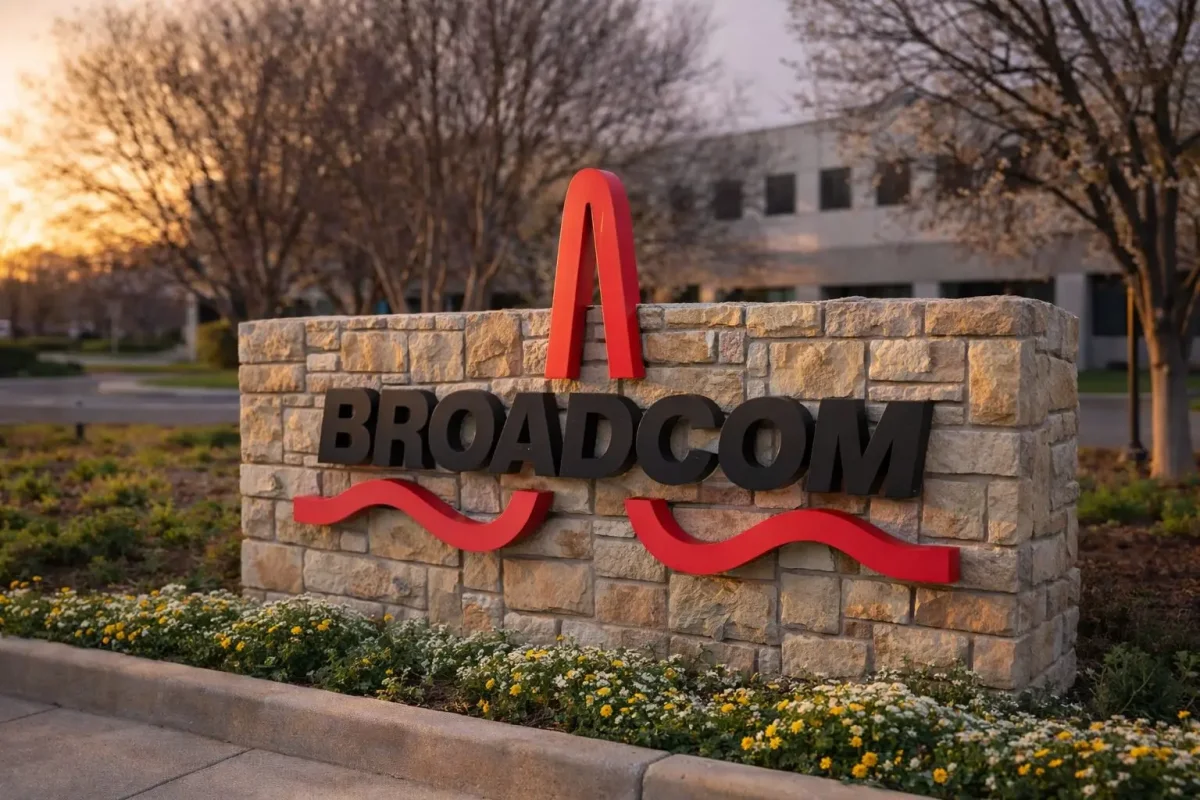
Shares of Broadcom Inc. declined sharply in Thursday's trading session, reflecting a broader downturn across semiconductor stocks. The sell-off occurred despite a strong quarterly report from industry bellwether Nvidia, highlighting persistent investor caution toward the high-flying chip sector.
Market Reaction and Price Action
Broadcom stock opened the regular session at $326.09 but quickly tumbled, hitting a low of $309.06. By 10:32 a.m. Eastern Time, the shares were trading at $309.77, marking a decline of 6.8% from Wednesday's closing price of $332.31 on the Nasdaq. This move erased the gains from the previous trading day.
Sector-Wide Pressure
The weakness was not isolated to Broadcom. Nvidia itself fell 3.1% to $189.67 in early trading, even after announcing financial results that exceeded analyst expectations and raising its forward outlook. This paradoxical reaction created a drag on major U.S. equity indexes and placed significant pressure on other companies within the chipmaking ecosystem. The market's response suggests that even stellar performance from a leader is currently insufficient to reignite the broader enthusiasm for artificial intelligence-related equities that propelled the sector for much of the past year.
Long-Term AI Strategy and 3D Chip Ambitions
Amid the near-term stock volatility, Broadcom is advancing a long-range strategic plan centered on advanced packaging technology. The company has informed investors that it is targeting sales of at least one million units by 2027 for its 3D "stacked" chip design. This approach involves vertically stacking two chips to create a single, more powerful component, which Broadcom claims enables faster data transfer and significantly reduced power consumption.
According to company statements, this stacked design can deliver a tenfold improvement in energy efficiency. Harish Bharadwaj, vice president of product marketing, noted that adoption is growing, stating, "Now, pretty much all of our customers are adopting this technology." The company plans to ship two additional stacked products in the second half of 2026. For context, Fujitsu is already producing engineering samples of similar technology, with mass manufacturing slated to begin later this year.
Broader Market Context and Analyst Views
The technology sector has experienced notable volatility in 2026 as traders and investors work to differentiate between companies that are genuine beneficiaries of the AI investment cycle and those that may be overhyped. "AI will continue to disrupt the world but I don't think it's the end of the world," commented Ken Polcari, partner and chief market strategist at Slatestone Wealth, capturing the tempered yet ongoing optimism.
Analysts also point to potential risks outside of Broadcom's core hardware business. Earlier this week, UBS maintained its Buy rating on the stock with a $475 price target but highlighted concerns on the software side. A primary risk involves the potential for VMware customers to depart in 2026 and 2027 as their initial three-year contracts, established after Broadcom's acquisition, come up for renewal.
Investor Focus Shifts to Upcoming Earnings
With the 2027 target for stacked chips representing a longer-term horizon, investor patience can wear thin during periods of sector instability. Attention is now firmly turning to the company's imminent financial update. Broadcom is scheduled to release its fiscal first-quarter results after the market closes on Tuesday, March 4. A conference call with management is set for 5:00 p.m. ET that day, where executives will likely address the current market sentiment, near-term financial performance, and progress on strategic initiatives like the 3D chip roadmap.
The upcoming report will provide a critical data point for investors weighing the company's fundamental strength against the backdrop of a skittish market for semiconductor equities.