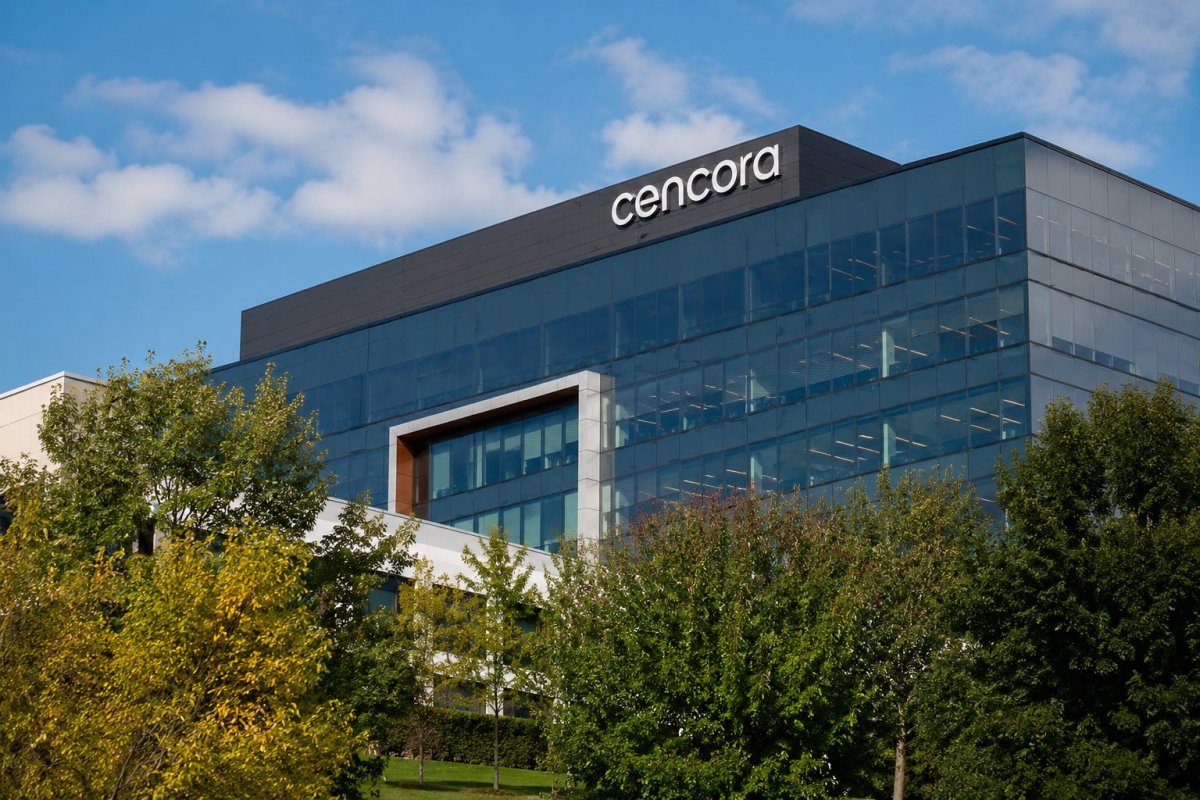
Cencora Inc. (COR) saw its shares slide approximately 13.5% to $264.49 in late morning trading Wednesday, following the drug distributor's decision to trim its full-year revenue growth projection after a disappointing quarterly performance in its core U.S. market. The move overshadowed an upward revision to the company's profit forecast and a new share repurchase program.
The revenue miss was centered in Cencora's U.S. Healthcare Solutions segment, which accounts for the vast majority of the company's top line. For the quarter ended March 31, sales in that division rose 2.9% to $68.8 billion, falling short of the $71.26 billion consensus estimate compiled by LSEG. Total company revenue reached $78.4 billion, well below Wall Street's expectation of $81.09 billion.
In response to the shortfall, Cencora lowered its outlook for fiscal 2026 revenue growth. However, the company raised its adjusted earnings per share forecast to a range of $17.65 to $17.90, up from the prior $17.45 to $17.75. Management also announced plans to repurchase $1 billion of its common stock by the end of calendar 2026 and declared a quarterly dividend of 60 cents per share.
Adjusted diluted EPS for the quarter came in at $4.75, a 7.5% increase year over year but slightly below the analyst consensus of $4.81 per share. The company's adjusted earnings exclude certain items management considers not indicative of ongoing operations.
The slowdown in U.S. revenue was attributed to several factors: lower prices on branded drugs from manufacturers, a shift by a major mail-order pharmacy client toward branded medications rather than generics, and the loss of both an oncology and a grocery customer in the prior year. Additionally, while sales of GLP-1 drugs for diabetes and weight loss surged, these products carry slimmer gross profit margins, further pressuring the division's growth.
On the call with analysts, CFO James Cleary acknowledged that the company had not anticipated the speed at which the large mail-order client would pivot to branded drugs. J.P. Morgan analyst Lisa Gill described the deceleration in U.S. Healthcare Solutions growth as disappointing, noting the results "fall short of investor expectations."
International operations provided a bright spot. Revenue from the International Healthcare Solutions segment climbed 13.0% to $7.6 billion, driven by stronger distribution in Europe. Operating income for that segment also improved, rising 13.7% to $175.8 million.
The company's bottom line also benefited from a $1.1 billion gain related to the remeasurement of its stake in OneOncology. However, interest expense increased as Cencora took on debt and used variable-rate term loans to fund its February acquisition.
CEO Robert P. Mauch described the quarter as producing "solid results" and said the company is "in a position to resume opportunistic share repurchases." Nonetheless, investor sentiment was dominated by the revenue guidance cut, sending the stock sharply lower.
Cencora's update comes amid a competitive drug wholesale sector dominated by a few large players, including McKesson and Cardinal Health. Last week, Cardinal Health also reported a revenue miss for its quarter but similarly lifted its profit outlook. Analysts caution that if Cencora faces further brand price cuts, additional mail-order mix changes, or slower customer recapture, it may need to rely more on cost containment, OneOncology performance, and share buybacks to sustain earnings growth.