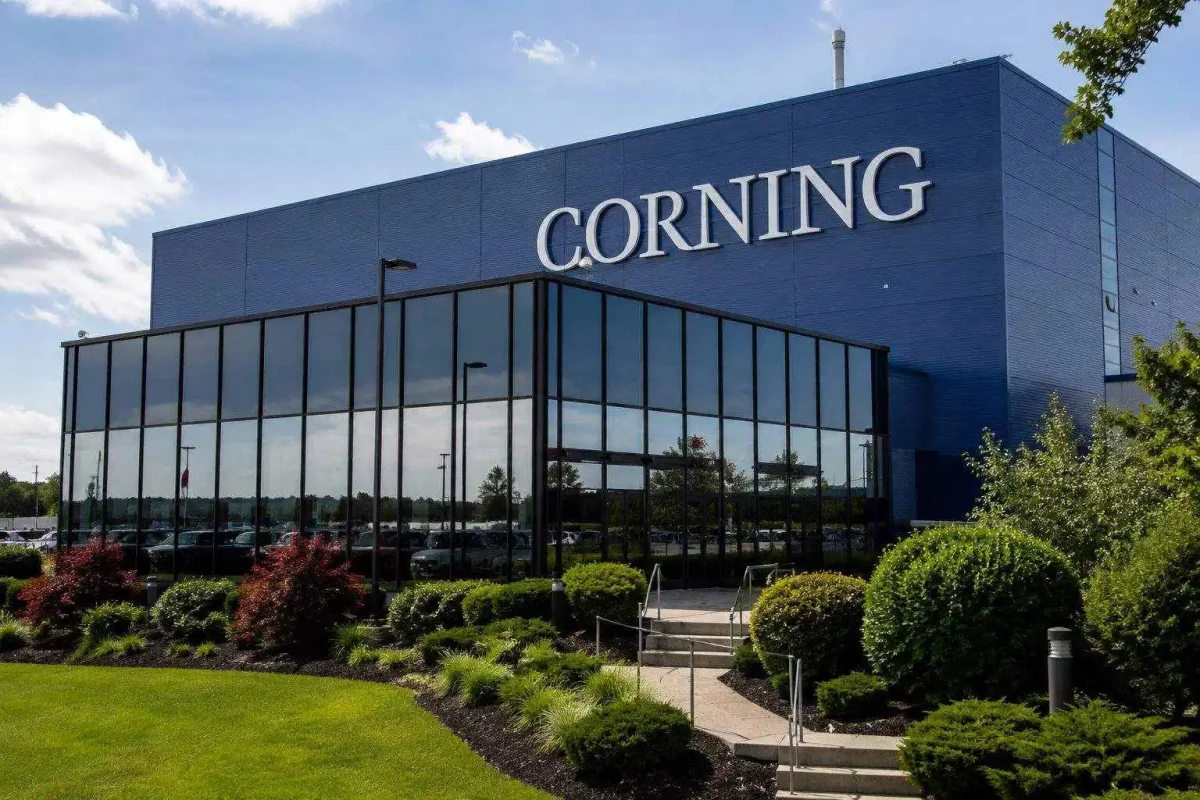
Shares of Corning Incorporated (NYSE: GLW) experienced a sharp decline of approximately 17% in premarket trading on Tuesday, falling to around $119 from Monday's close of $143.36. If the loss holds, it would mark the company's largest single-day drop since 2002. The sell-off came after the company released its second-quarter earnings report and third-quarter guidance, which, while showing solid results, raised concerns about the pace of its AI-driven fiber optics growth.
Corning reported second-quarter core sales of $4.74 billion and core earnings per share (EPS) of $0.78, both beating consensus estimates of $4.63 billion and $0.76, respectively. However, the company's third-quarter outlook fell short of expectations. Management projected Q3 core sales between $4.9 billion and $5.0 billion, with a midpoint of $4.95 billion, which is 0.8% below the FactSet consensus of $4.99 billion. The midpoint for Q3 core EPS was $0.87, exceeding forecasts by 2.4%.
The key metric that weighed on investor sentiment was the annualized sales pace implied by the Q3 midpoint. At $19.8 billion, it is just 1% below Corning's end-of-2026 target of $20 billion. While the goal appears within reach, the market had apparently priced in a faster trajectory, leading to disappointment. The company's second-quarter results were solid, with core sales rising 17% year-over-year and core EPS advancing 30%. Core operating margin expanded by 190 basis points to 20.9%, and adjusted free cash flow surged to $1.42 billion, more than triple the $451 million reported a year earlier.
The primary growth engine was the Optical Communications segment, which posted a 32% revenue increase to $2.07 billion and a 77% jump in segment income to $438 million. The segment's share of core sales rose to 43.7%, up from 38.7% in the prior year. Within this segment, Enterprise Networks sales soared 65%, driven by generative-AI offerings. However, growth outside of optical was weaker. Glass Innovations revenue inched up only 1%, while Life Sciences and Emerging Growth Businesses sales dropped 15%. Solar revenue jumped 90% to $438 million, but the division reported a $7 million loss, with management expecting improved profitability in Q3 after maintenance work.
Corning CEO Wendell Weeks stated that the company is "entering a new phase of accelerating growth," with long-term targets of $30 billion in annualized sales by 2028 and $40 billion by 2030. These ambitions are supported by major customer agreements, including a multiyear, multibillion-dollar supply pact with Amazon.com (NASDAQ: AMZN) and a long-term collaboration with NVIDIA (NASDAQ: NVDA) to increase U.S. connectivity manufacturing output tenfold. Corning plans to expand its U.S. fiber production capacity by over 50%.
Despite these strategic moves, investor enthusiasm has waned. Corning's shares had surged 64% year-to-date as of Monday, but have dropped 47% from their June 30 peak. The stock declined 5.1% from the previous Friday to Friday and slipped another 2.2% on Monday. Rivals in the optical sector also felt the pressure, with Ciena (NYSE: CIEN), Coherent (NYSE: COHR), and Lumentum (NASDAQ: LITE) each falling about 5% to 6% in premarket trading.
Key updates are expected later this week. Corning will hold its earnings call at 8:30 a.m. ET. Meta Platforms (NASDAQ: META), a significant buyer of Corning fiber, reports results on Wednesday, followed by Amazon on Thursday. The market will be closely watching for any signals on demand trends. Risks remain concentrated: AI-fiber demand could soften until additional capacity comes online, while demand from glass and life sciences stays subdued, and the solar segment has yet to reach profitability.
In summary, Corning is approaching its 2026 sales target, but the market's expectations for a faster ramp-up have not been met. The disconnect—not the company's second-quarter performance—is the key message for investors. The stock's sharp decline reflects a reassessment of the near-term growth trajectory, even as the long-term narrative remains intact.