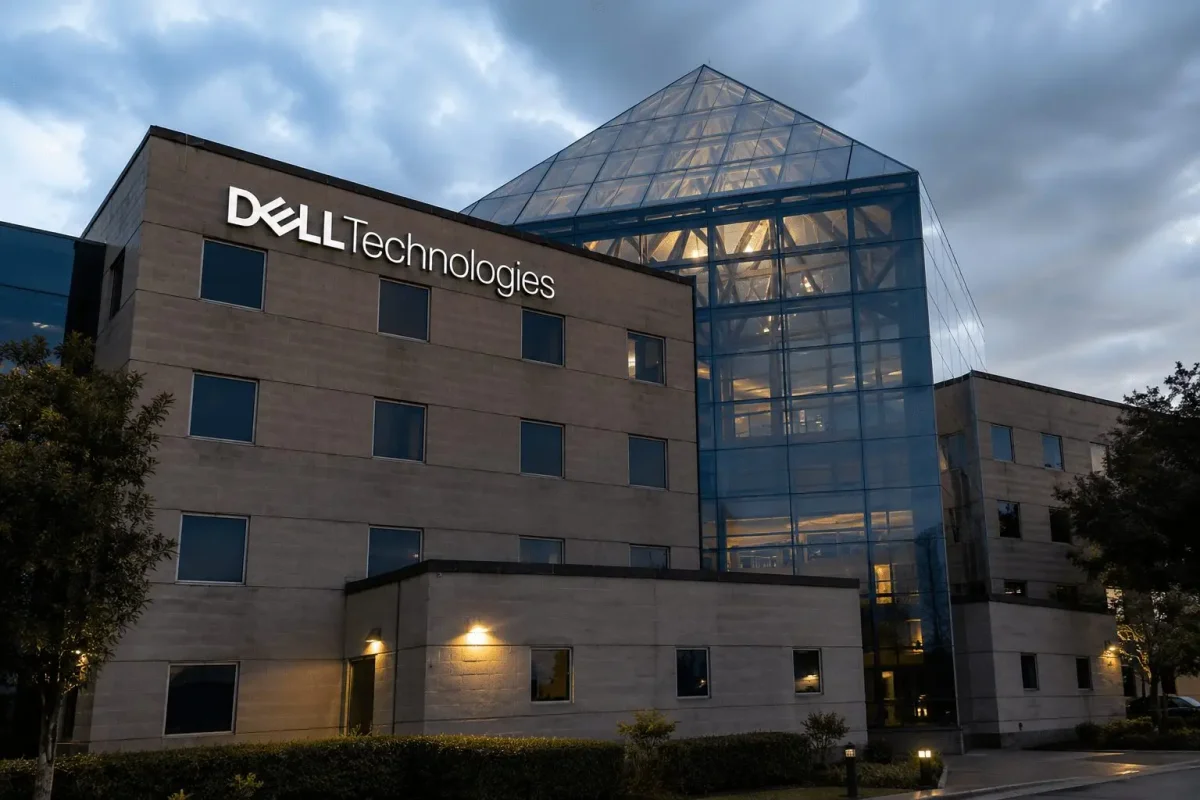
In a stark reversal of fortune, Dell Technologies (NYSE:DELL) saw its market capitalization shrink by approximately $37.1 billion on Wednesday, as shares tumbled 12.4% to $400.98 by midday. The decline, which occurred even as the Dow Jones, S&P 500, and Nasdaq Composite posted modest gains of 0.2% to 0.4%, underscores a growing reassessment of the company's valuation premium tied to artificial intelligence.
The scale of Dell's loss was roughly double the entire market value of Super Micro Computer (NASDAQ:SMCI), which itself slipped 3.3% to $26.75. Hewlett Packard Enterprise (NYSE:HPE) also fell, dropping 6.8% to $46.21, but neither rival matched the magnitude of Dell's decline. The sell-off appeared to be driven by shifting investor sentiment rather than any new corporate guidance, as Dell's investor relations page showed no fresh operating releases.
The evaporation of value is particularly striking when measured against Dell's own financial metrics. The $37.1 billion loss represents 0.62 times the company's fiscal 2027 AI server revenue guidance of approximately $60 billion, and 1.52 times the $24.4 billion in AI orders booked during the first quarter. It also equates to roughly nine times Dell's quarterly operating cash flow of $4.1 billion. These ratios, though imperfect, highlight how quickly investors can erase value in the absence of new catalysts.
Despite the steep drop, Dell's stock remains up about 221% from its December 31 close of $124.92. The year-to-date return through July 10 stood at 248.2%, vastly outperforming the Invesco AI and Next Gen Software ETF (NYSEARCA:IGPT), which gained 66.4% over the same period. The $56.56 decline in Dell's share price on Wednesday erased roughly 17% of the gains accumulated since the start of the year through Tuesday.
Options market data from Trefis placed Dell's implied volatility at 81%, ranking in the 98th percentile, indicating that traders had been pricing in significant risk. Wednesday's sell-off brought that risk into sharp focus, confirming the high degree of uncertainty surrounding the stock.
Dell's fundamental business story remains robust. First-quarter revenue surged 88% year-over-year to $43.8 billion, fueled by a 757% jump in AI server sales to $16.1 billion. The company booked $24.4 billion in AI orders during the quarter and reported a $51.3 billion backlog of orders not yet recognized as revenue. 'The AI opportunity shows no signs of slowing,' Chief Operating Officer Jeff Clarke said in a statement accompanying the earnings release.
However, beneath the top-line growth lie margin pressures. Adjusted gross margin contracted to 18.1% from 21.6% a year earlier, as lower-margin AI systems accounted for a larger share of sales. Adjusted operating margin improved to 9.7% from 7.1%, driven by revenue growth outpacing expense increases. This dynamic encapsulates the core challenge: Dell is shipping more hardware, but investors want evidence that higher volumes will continue to offset the margin compression from lower-margin products.
Demand visibility also remains murky. Clarke noted that some customers accelerated purchases to secure components ahead of price increases, and the company is 'supply constrained in the second half.' Chief Financial Officer David Kennedy added that 'demand continues to outpace the supply.' Yet market chatter on Wednesday focused on concerns that major cloud operators may have overbuilt capacity, following reports that Meta Platforms (NASDAQ:META) might seek to rent out unused AI compute resources. A July 1 report indicated Meta's plans were not final and subject to change, and the report was not independently confirmed. Investing.com also highlighted rising memory costs and questions about AI server margins.
The overbuild debate is far from settled. Meta announced on Monday that its Hyperion data center in Louisiana would reach 5 gigawatts of computing power and cost over $50 billion. If hyperscale customers continue to expand capacity and Dell secures sufficient components, Wednesday's sell-off could prove excessive. Conversely, if excess capacity builds up and customers had already placed orders ahead of demand, the backlog and margins may fail to meet guidance.
Looking ahead, Dell has guided for second-quarter revenue of $44 billion to $45 billion, with adjusted earnings of $4.80 per share at the midpoint. AI server revenue is expected to reach approximately $15.5 billion. Investors are closely watching how quickly the company can convert its $51.3 billion backlog into sales and cash, and whether operating margins can hold. The order book is substantial, but so is the pressure to deliver.