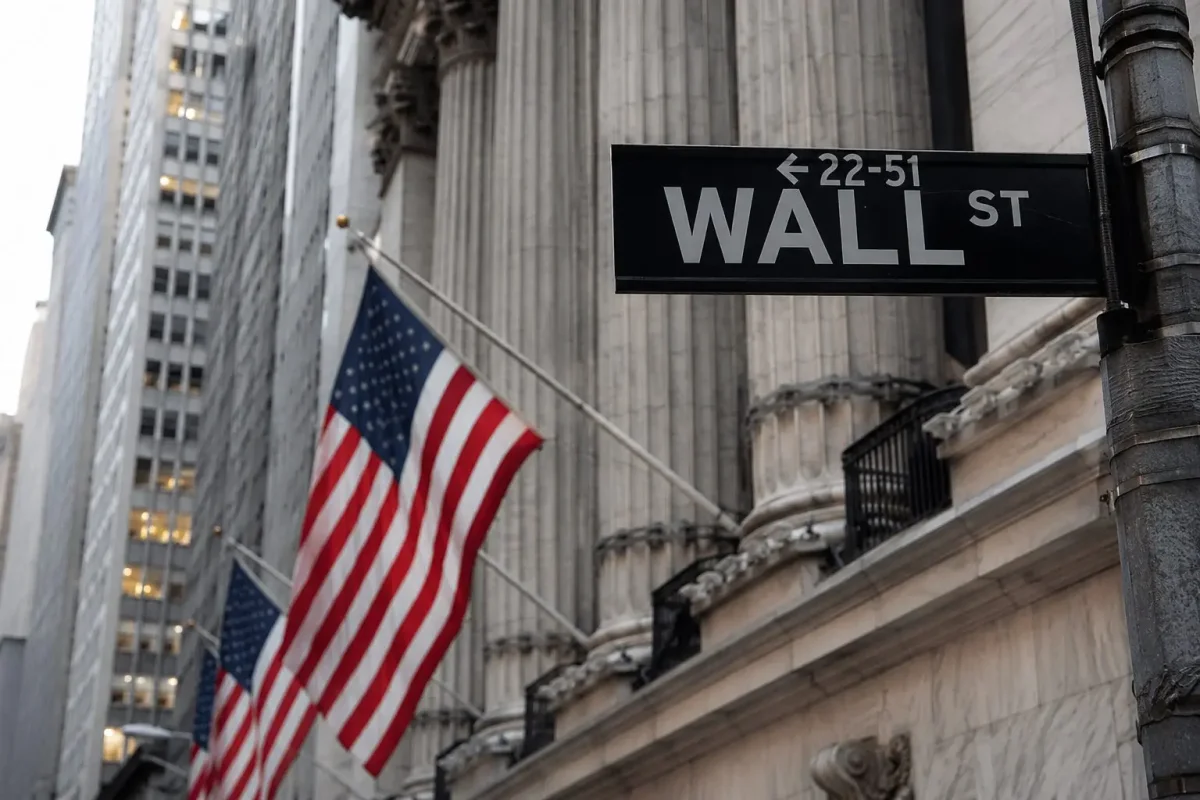
Wall Street closed mixed on Wednesday, with the Dow Jones Industrial Average posting a solid gain while the Nasdaq Composite retreated, as investors recalibrated their expectations for artificial intelligence capital expenditures. The blue-chip index rose 0.83%, or 448 points, to 54,533.87, while the S&P 500 edged up 0.07% to 7,742.05. The tech-heavy Nasdaq slipped 0.49% to 26,455.43, as traders trimmed positions in high-priced AI names that lack immediate earnings justification.
The rally's narrow breadth was evident beneath the headline numbers. Despite fresh intraday records, declining issues outnumbered advancers on both major exchanges. On the New York Stock Exchange, losers held a 1.07-to-1 edge over gainers, while on the Nasdaq the ratio widened to 1.29-to-1. This divergence suggests that while index-level performance was buoyed by a handful of large-cap winners, the broader market lacked conviction.
Corporate earnings continued to dominate the tape. Amgen (NASDAQ:AMGN) climbed 3.5% after reporting a 9% increase in quarterly sales, drawing a flurry of price-target hikes from analysts. Eli Lilly (NYSE:LLY) advanced 3.9% after raising its full-year revenue outlook, citing robust demand for its weight-loss and diabetes drugs. Walt Disney (NYSE:DIS) rose 3.4% after delivering better-than-expected quarterly profits, supported by its entertainment and parks divisions.
In the technology sector, SpaceX (NASDAQ:SPCX) tumbled approximately 12% despite posting a 92% surge in revenue to $7.8 billion, beating the consensus estimate of $6.9 billion and narrowing its losses. The sell-off was attributed to the upcoming unlock of 911 million shares on Thursday, which could flood the market with additional supply. Advanced Micro Devices (NASDAQ:AMD) fell about 6% even after projecting revenue ahead of expectations, as investors questioned whether the guidance justified its valuation. Nvidia (NASDAQ:NVDA) bucked the trend, gaining roughly 4% following the announcement of a new data-centre chip collaboration with SpaceX.
Macroeconomic data offered little relief. ADP reported that private payrolls increased by 44,000 in July, falling short of the 70,000 economists had forecast. Meanwhile, the Institute for Supply Management's services PMI came in at 54.1, slightly above the prior reading of 54.0, indicating continued expansion. However, price pressures intensified, with the prices index jumping to 70.3 from 67.7, and the employment subindex fell to 47.4, signaling contraction in services-sector hiring.
Bond investors interpreted the data as pointing to a slowdown in hiring rather than an easing of inflation. The yield on the 10-year Treasury note remained near 4.63%, reflecting expectations that the Federal Reserve will maintain a 'higher-for-longer' stance. According to CME Group's FedWatch tool, the probability of a rate hike at the next meeting stood at 54.9%, down slightly from 58.3% a week earlier but still elevated.
Edward Jones analyst Brian Therien noted that the market is shifting its focus from merely recognizing companies' AI expenditures to evaluating the resulting revenue and earnings. This selective approach was evident in Wednesday's trading, where stocks with clear AI monetization paths, such as Nvidia, were rewarded, while those with less-defined returns, like AMD, were penalized.
Despite the mixed close, the major indices are on track for a strong week. The S&P 500 has gained 3.37% since July 31, while the Nasdaq has advanced 4.26% and the Dow has risen 3.90%. These gains more than double last week's advances, driven by optimism around AI spending and a resilient earnings season. With 85.2% of S&P 500 companies beating expectations so far, well above the historical average of 67.5%, valuations remain stretched at approximately 20 times forward earnings, compared to a decade-long average of 19 times.
Looking ahead, investors will turn their attention to Friday's July employment report, which is expected to show 80,000 jobs added and the unemployment rate holding steady at 4.2%. The data will be pivotal in shaping rate expectations and market direction in the coming weeks.