Eos Energy Enterprises (NASDAQ: EOSE) is repositioning itself from a battery manufacturer into a project-finance platform, unveiling a new venture called Frontier Power USA backed by private equity firm Cerberus Capital Management. The announcement comes alongside a sharp increase in first-quarter revenue, signaling the company's pivot toward financing and operating long-duration energy storage projects.
Record Revenue and Strategic Shift
For the first quarter of 2026, Eos reported revenue of $57.0 million, a 445% year-over-year jump. The company reaffirmed its full-year 2026 revenue guidance of $300 million to $400 million. However, the path to profitability remains challenging, with an adjusted EBITDA loss of $68.0 million and a gross loss of $44.4 million. Net income of $508.9 million was largely driven by non-cash fair-value adjustments related to the company's capital structure, not operational earnings.
Interim Chief Financial Officer Nathan Kroeker emphasized that adjusted EBITDA is the key metric to watch, stating the company still aims to achieve positive adjusted gross margin later this year and positive adjusted EBITDA before year-end. CEO Joe Mastrangelo highlighted the challenge ahead: converting a $24.3 billion pipeline into operational storage projects.
Frontier Power USA: A New Storage Venture
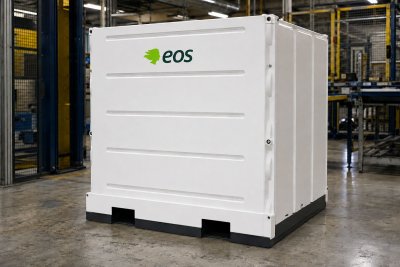
The launch of Frontier Power USA marks a strategic shift for Eos. The venture is designed to build, own, and operate long-duration energy storage projects using Eos's Z3 zinc-based battery technology. Cerberus is expected to commit $100 million in equity, while Eos targets approximately $150 million through a rights offering. The venture also includes a 15-year technology performance insurance framework valued at up to $1.5 billion, aimed at reassuring lenders about the reliability of the battery systems.
Frontier Power USA has already secured a 2 gigawatt-hour (GWh) capacity reservation, reflecting growing demand for long-duration storage from utilities, data centers, and industrial customers. Eos's commercial pipeline now exceeds 100 GWh, with 55% of that capacity at eight-hour-plus duration.
Manufacturing Progress and Competitive Landscape
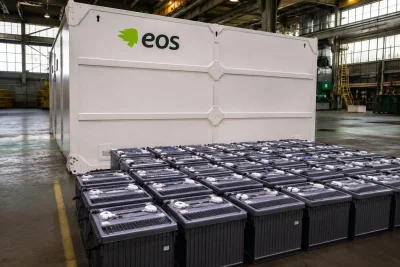
On the manufacturing front, Eos announced that its second battery line at the Thorn Hill facility has passed factory acceptance testing, with installation and power-on underway. Initial production is expected by the end of the second quarter. Chief Operating Officer John Mahaz confirmed that the line is being debugged for a June production start.
The Z3 battery technology competes with lithium-ion and lead-acid batteries for 3- to 12-hour discharge applications. While lithium-ion remains the dominant technology, Eos argues its zinc-based batteries offer advantages in safety, recyclable inputs, and flexible duration. However, the company faces competition from cheaper lithium iron phosphate systems for many projects.
Market Context and Financing
The success of Frontier Power USA depends heavily on the interest rate environment, as the venture will rely on project debt. Current market data indicates a 97.5% probability of no rate change at the June Federal Reserve meeting and roughly 70% odds of zero rate cuts in 2026. Higher-for-longer rates would keep financing costs elevated, a key factor in the Eos story.
The transaction is subject to several conditions, including completion of the rights offering, shareholder approval to increase authorized common shares, third-party approvals including from the U.S. Department of Energy, and definitive commercial and governance agreements. Eos also filed a shelf registration allowing for the sale of various securities over time.
Eos shares traded at $8.28, up about 2.2% from the previous close. The Cerberus deal provides a clearer answer to the long-standing question of who will fund Eos's projects, but the next critical step is converting reservations into funded, operational sites that deliver power to the grid.