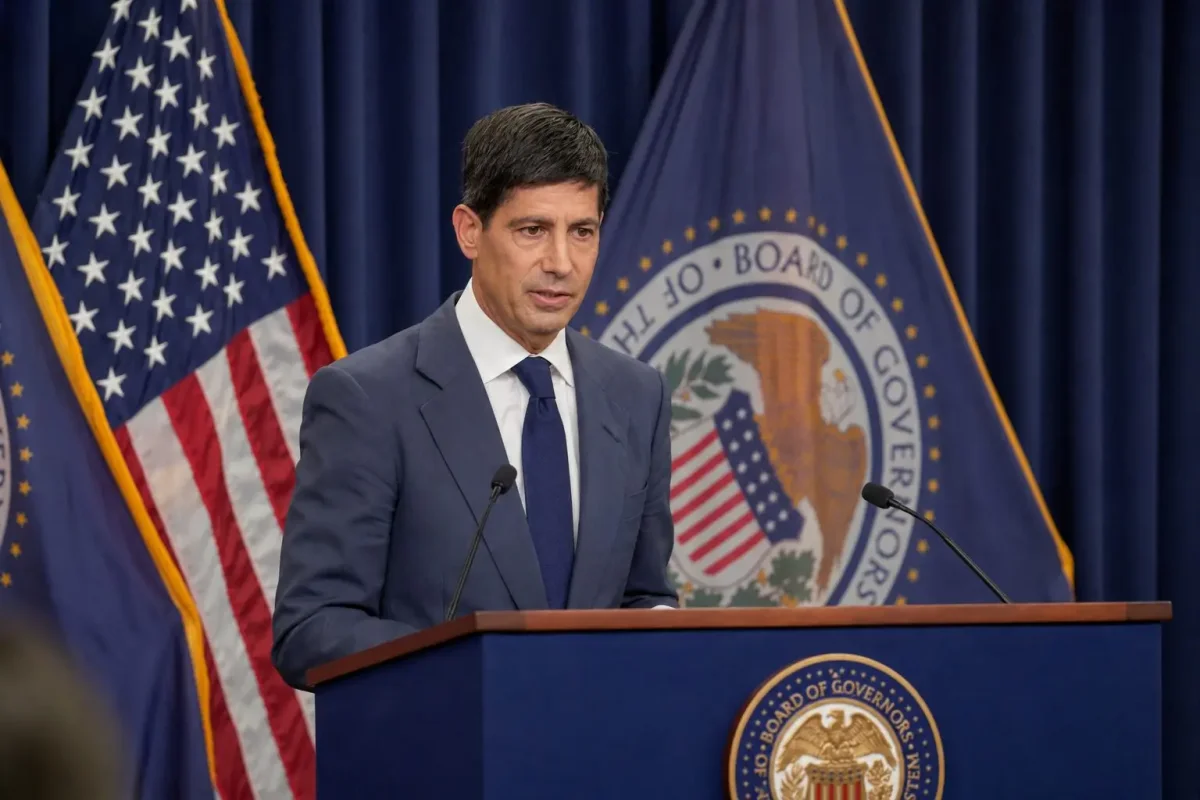
The Federal Reserve left its benchmark interest rate unchanged at 3.50%-3.75% on Wednesday, marking Kevin Warsh's first policy meeting as chair. The decision, which was unanimous, came with a notably leaner statement and a clear hawkish tilt in the Fed's updated projections. The new dot plot now shows a median federal funds rate of 3.8% for 2026, up sharply from the 3.4% forecast in March, signaling that policymakers are leaning toward at least one rate hike this year. Just one official expects a cut.
The shift in tone sent shockwaves through financial markets. The S&P 500 dropped 1.21%, the Dow Jones Industrial Average fell 0.98%, and the Nasdaq Composite lost 1.34%. All 11 S&P 500 sectors ended in the red, with regional banks and homebuilders hit hardest as rising funding and mortgage costs weighed on sentiment. The two-year Treasury yield, a key gauge of rate expectations, surged 16 basis points to 4.207%, its highest level since February 2025. Rate markets now price in a 72% probability of a hike by October.
The Fed's updated Summary of Economic Projections also showed a significant upward revision to inflation forecasts. The central bank now sees 2026 PCE inflation at 3.6%, up from 2.7% in March, while core PCE inflation was raised to 3.3% from 2.7%. The higher inflation outlook reflects ongoing supply shocks from the Middle East conflict and persistent price pressures. The statement noted that economic activity is expanding solidly and job growth is keeping pace with the labor force, but inflation remains above the Fed's 2% target.
Warsh, appointed by President Donald Trump who had previously pushed for lower rates, did not submit his own rate projection. He has been a longstanding critic of the Summary of Economic Projections, and the latest dot plot contained only 18 entries instead of the usual 19. The chair also launched five new task forces to review Fed communications, balance-sheet policy, data usage, productivity and employment, and inflation frameworks. Warsh told reporters he expects preliminary feedback by the fall, with most work completed by year-end.
The stripped-down statement omitted the usual easing bias and concluded with a concise line: "The Committee will deliver price stability." Market analysts noted the lack of forward guidance. "This Fed decision was short, but not sweet," said Karl Schamotta, chief market strategist at Corpay, adding that Warsh had removed most of the language traders typically watch for hints. Tom Graff, chief investment officer at Facet, said there had "clearly been a big shift" despite the rate hold.
The dollar strengthened in response to the hawkish outlook, pushing gold prices lower. Spot gold fell 0.7% to $4,299.89 an ounce, as a stronger greenback made the metal more expensive for overseas buyers. "A new Fed," said Tai Wong, an independent metals trader, noting that Warsh did little to push back against the hawkish tone. The U.S. dollar index rose broadly, adding pressure on commodities priced in the currency.
The Fed's move aligns with a broader global tightening trend. The Bank of Japan raised rates on Tuesday to their highest level since 1993, while the Bank of England is set to meet Thursday with no policy change expected, though inflation remains a key concern. The synchronized hawkish stance suggests central banks worldwide are grappling with persistent price pressures.
Some investors caution that the dot plot may overstate the likelihood of further tightening. Oil prices have slipped from this year's highs after reports of an early U.S.-Iran agreement, and cheaper energy could help keep inflation in check, potentially allowing the Fed to hold steady. "The path is narrow," said Kay Haigh, global head of fixed income and liquidity solutions at Goldman Sachs Asset Management, noting that the Fed could maintain the current rate if inflation moderates.
President Trump, traveling in France, offered little reaction to the Fed's decision. Asked about the rate hold, he said, "It's all right. Whatever," and reiterated that Warsh is his guide, though he called a rate hike "hard to believe." The market's immediate response suggests traders are bracing for a more aggressive Fed under Warsh's leadership, with the next policy meeting in September likely to be closely watched for further signals.