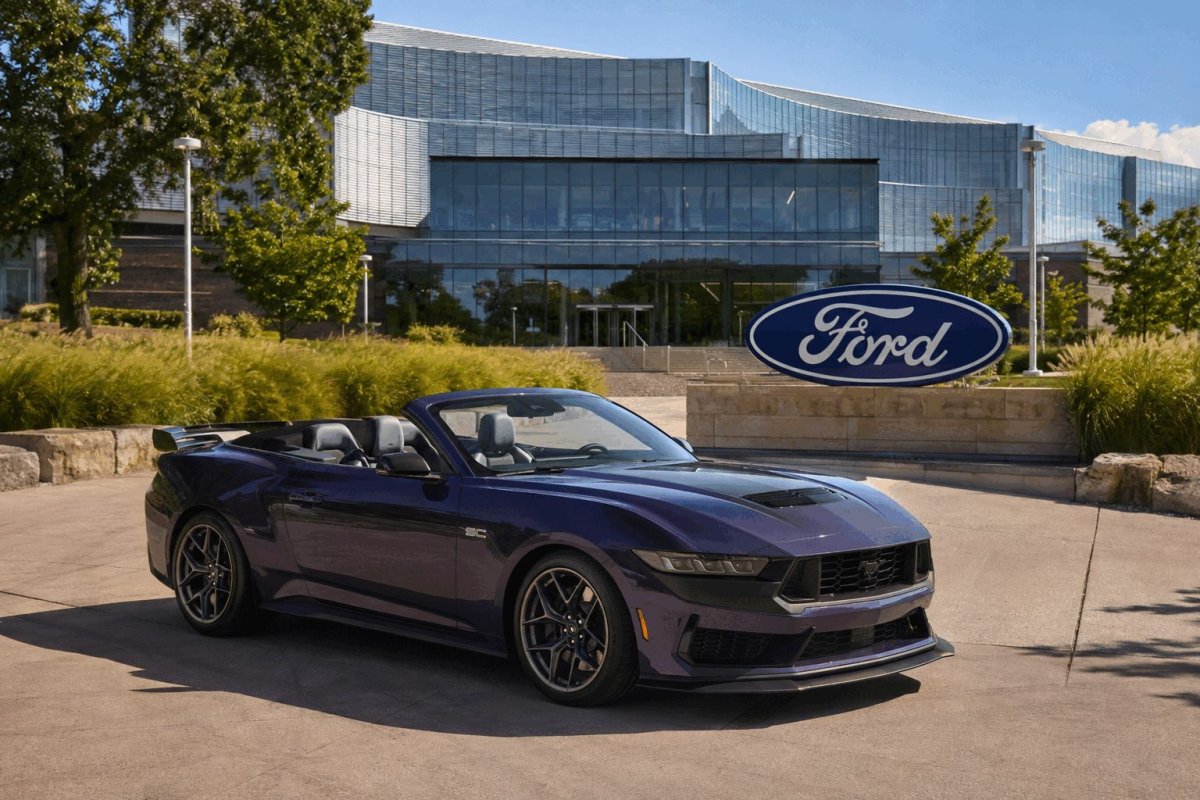
In premarket trading on Friday, Ford Motor Company (NYSE:F) saw its shares tick up 0.3% to $13.93, following Thursday's close at $13.89. The modest gain came as investors digested the automaker's latest high-performance offering—the Mustang Dark Horse SC Convertible—which carries a price tag roughly 2.5 times the company's average revenue per vehicle.
Premium Pricing Strategy
The new convertible, boasting 795 horsepower and 660 pound-feet of torque, is expected to retail around $110,000, positioning it above the $108,485 SC coupe. While official pricing remains undisclosed, early estimates suggest Ford is pushing into a higher market segment. For context, Ford reported $44.89 billion in automotive sales from 1.039 million wholesale vehicles in Q2, averaging approximately $43,200 per unit. The Mustang's expected price would be about 2.5 times that average.
Ford is introducing its first high-performance Mustang convertible in over a decade. Orders open this fall, with deliveries slated for spring 2027. The model features a supercharged 5.2-liter V-8 engine paired with a seven-speed dual-clutch transmission. Unlike the SC coupe, this convertible focuses on grand touring, omitting the Track Pack, carbon-fiber wheels, and carbon-ceramic brakes, yet retains the full 795-horsepower output.
Market Reaction and Investor Sentiment
Ford's stock movement was largely in line with General Motors (NYSE:GM), which rose 0.30%, while Stellantis (NYSE:STLA) gained 0.74%. Toyota (NYSE:TM) had no premarket quote available. The subdued reaction suggests investors view the Mustang launch as a mixed signal—positive for brand positioning but not a dramatic shift in earnings expectations.
Analyst sentiment remains cautiously optimistic. The 15-analyst consensus shows seven Buys, seven Holds, and one Sell, with an average price target of $15.89—implying a potential 14.4% upside from Thursday's close. However, the wide target range of $11 to $20 highlights uncertainties around tariffs, electric vehicle losses, and Ford's ability to sustain pricing power.
Financial Performance and Challenges
Ford's Q2 results underscored the importance of product mix. The company reported total revenue of $48.3 billion and adjusted EBIT of $2.5 billion. Ford Blue, the traditional combustion segment, saw profits surge 72% year-over-year to $1.1 billion on $26.1 billion in revenue, despite a 4% drop in overall company revenue. Ford Pro, the commercial division, remained the most profitable with $1.7 billion in adjusted EBIT. Meanwhile, Ford Model e, the EV unit, posted a $919 million loss, though that was an improvement of $410 million from the prior year.
Executives raised their full-year adjusted EBIT outlook to a range of $10 billion to $11 billion. However, Mustang remains a niche model, with U.S. sales of 28,725 units in the first half—up 22% but representing just 2.9% of Ford's total 1,006,515 deliveries.
Risks and Outlook
The immediate challenge for Ford is pricing discipline. An order book exceeding $100,000 would validate Ford Blue's mix strategy, but soft demand or heavy incentives could signal brand constraints. Additionally, planned North American content regulations may add at least $2 billion in annual costs for each Detroit automaker, and Ford has already projected a $1 billion tariff impact this year.
Mark Rushbrook, global director of Ford Racing, described the development as creating a “direct pipeline of innovation” between race cars and consumer models. Whether that translates into sustained premium pricing remains to be seen, but the company is clearly betting on the Mustang's iconic status to drive higher margins.
As the market opens, all eyes will be on Ford's ability to convert this high-performance halo into tangible financial results, especially as the industry navigates a turbulent transition toward electrification.