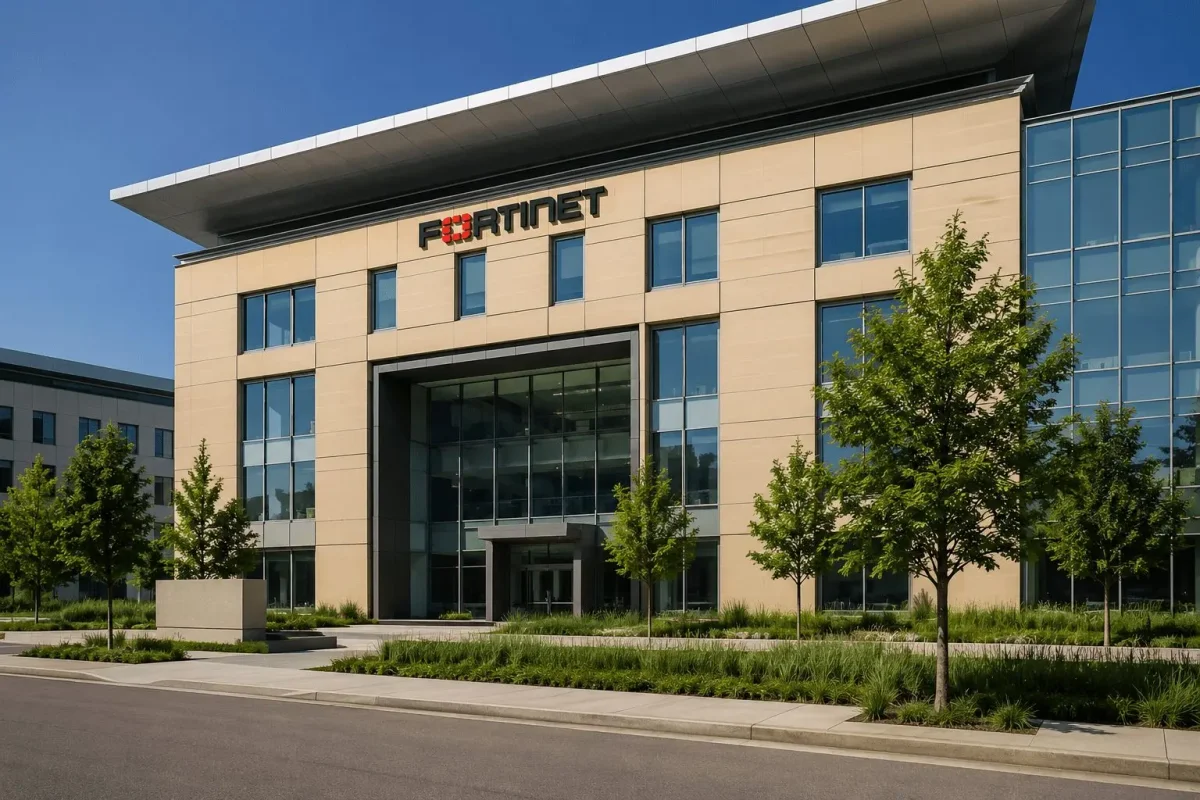
Fortinet Inc. (FTNT) saw its shares rally as much as 24% in after-hours trading on Wednesday, propelled by a strong first-quarter earnings report and an upward revision to its full-year revenue forecast. The cybersecurity firm delivered results that surpassed Wall Street expectations, underscoring growing demand for security solutions tailored to artificial intelligence workloads.
For the quarter ended March 31, Fortinet reported revenue of $1.85 billion, a 20% increase year-over-year and above the consensus estimate of $1.73 billion. Adjusted earnings per share came in at $0.82, well ahead of the $0.61-$0.62 range analysts had projected. The company's billings, which reflect contracted sales yet to be recognized as revenue, climbed 31% to $2.09 billion, marking the fastest growth in over three years. Free cash flow reached a record $1.01 billion, underscoring operational efficiency.
CEO Ken Xie attributed the performance to broad-based demand across the company's portfolio and geographies, citing an increasingly complex threat landscape intensified by AI. "Our focus on integrating networking and security continues to drive our strategy," Xie noted. CFO Christiane Ohlgart told analysts that AI is expanding the attack surface and increasing performance demands, factors that are fueling steadier security spending. She highlighted particular momentum among larger enterprises, with deals over $1 million and overall deal value surging more than 60%.
Fortinet raised its full-year revenue guidance to a range of $7.71 billion to $7.87 billion, up from prior expectations, and projects billings of $8.80 billion to $9.10 billion. For the second quarter, the company expects revenue between $1.83 billion and $1.93 billion, with adjusted EPS of $0.72 to $0.76. The full-year adjusted EPS forecast was set at $3.10 to $3.16.
In a move to capitalize on the AI security trend, Fortinet unveiled two new firewall models—the FortiGate 3500G and 400G—designed to handle encrypted traffic, AI workloads, and large-scale distributed environments. The company positioned these products directly against high-end offerings from rivals Palo Alto Networks (PANW), Cisco (CSCO), and Check Point Software (CHKP) in the upper tier of network security.
The competitive landscape remains intense, with investors closely watching how IT budgets shift among bundled platforms, cloud-first solutions, and hardware-centric network protection. Fortinet's strong quarter suggests that enterprises are still investing in firewalls and secure networking gear, particularly those optimized for larger AI-driven data loads. Analysts at RBC Capital noted that Fortinet highlighted broad-based demand amid a threat environment that is only growing more severe with AI adoption.
While the results were unequivocally positive, Fortinet's outlook also flagged potential headwinds. The company cited risks including economic softness, supply-chain disruptions, intensifying competition, sales execution challenges, shifting AI trends, and potential tariffs or trade barriers that could affect future performance.
For now, investors are focusing on the bullish signals: a decisive earnings beat, a raised outlook, and a narrative that positions AI as a catalyst for security spending rather than a threat. The key question moving forward is whether Fortinet can sustain its billing growth and outpace rivals in capturing a larger share of enterprise security budgets.