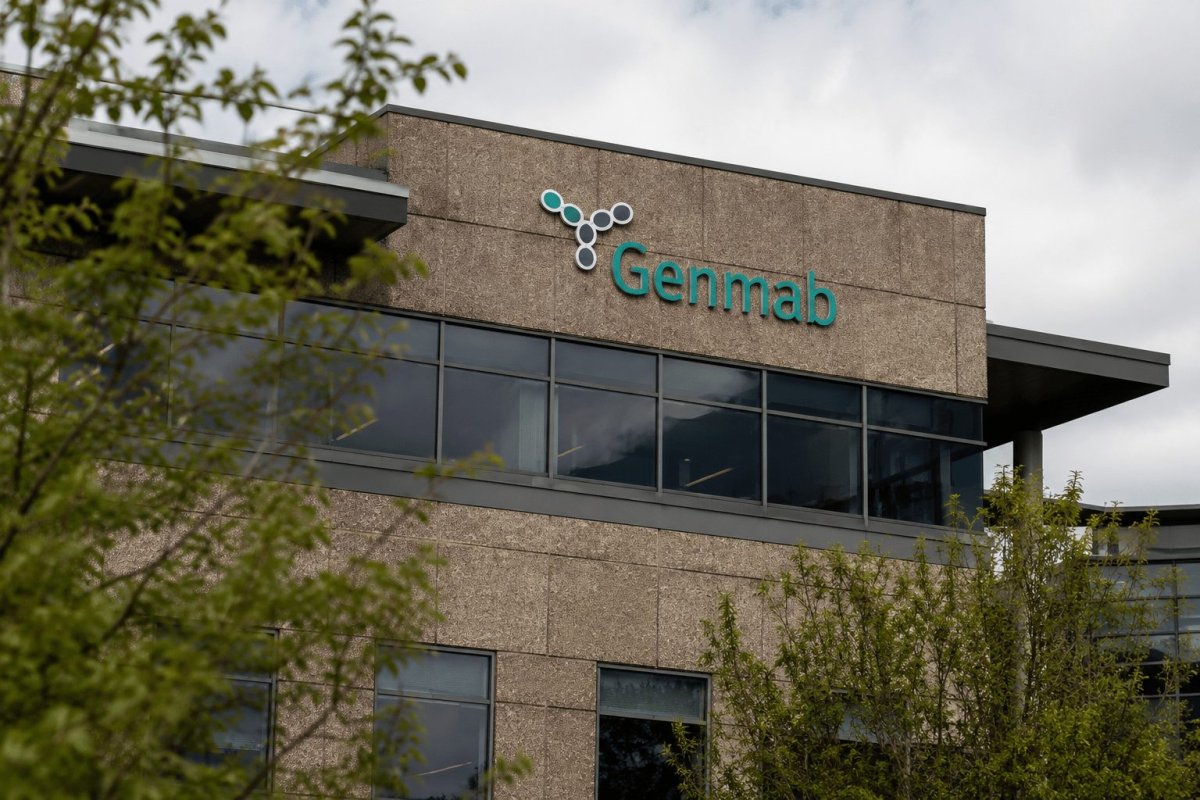
Copenhagen, May 8, 2026 — Shares of Genmab A/S dropped approximately 10% on Friday, as the Danish biotech company reported a sharp decline in first-quarter net profit, overshadowing a solid revenue increase. The stock was trading at 1,586.25 Danish crowns, down 9.8% around midday CEST, according to Cboe Europe data.
The profit slump was driven by higher costs associated with the company's recent acquisition of Merus and increased research and development spending. These expenses offset a 25% revenue jump to $896 million, up from $715 million in the same period last year. Net profit fell to $53 million from $195 million, while operating profit slipped to $180 million, missing the FactSet consensus estimate of $187 million.
This quarter is being closely watched by investors as it is one of the first to reflect Genmab's new spending profile following its strategic shift away from a traditional royalty model. Last year, Genmab completed an $8 billion acquisition of Merus, a Dutch cancer drugmaker, gaining the late-stage candidate petosemtamab for head-and-neck cancer. This move signals Genmab's intent to rely more on its own product sales rather than partner royalties.
Revenue growth was primarily fueled by a 26% increase in royalty income to $742 million, driven by stronger sales of Johnson & Johnson's Darzalex for multiple myeloma and Novartis's Kesimpta for multiple sclerosis. EPKINLY, Genmab's proprietary lymphoma treatment, also contributed to the gains. First-quarter proprietary sales rose 43% to $176 million, with EPKINLY alone generating $137 million, up 52% year-over-year.
Expenses were a key factor in the profit decline. Genmab recorded $45 million in acquisition and integration costs, mostly related to severance and retention from the Merus deal. Excluding those, operating expenses still climbed 25% as the company advanced its pipeline candidates Rina-S and petosemtamab and prepared for potential launches.
Despite the earnings miss, Genmab maintained its 2026 outlook, projecting revenue between $4.065 billion and $4.395 billion and operating profit between $900 million and $1.4 billion. CEO Jan van de Winkel described the quarter as one of “tangible progress,” highlighting the integration of Merus and the advancement of EPKINLY, Rina-S, and petosemtamab. He called 2026 a “catalyst-rich year,” with upcoming data readouts that could pave the way for launches in 2027.
Analysts remained largely bullish. BofA Securities reiterated its buy rating, calling the update “reassuring” and noting no delays in catalyst timing. Goldman Sachs raised its price target to 2,300 crowns from 2,200, maintaining a buy stance.
However, the company's financial position shows some strain. As of March 31, Genmab held $1.52 billion in cash and cash equivalents against $5.21 billion in borrowings. Net cash from operations dropped sharply to $3 million from $287 million a year earlier, highlighting the risks of the strategic shift. If pipeline trials stumble or adoption lags, the added research costs and debt could weigh heavily.