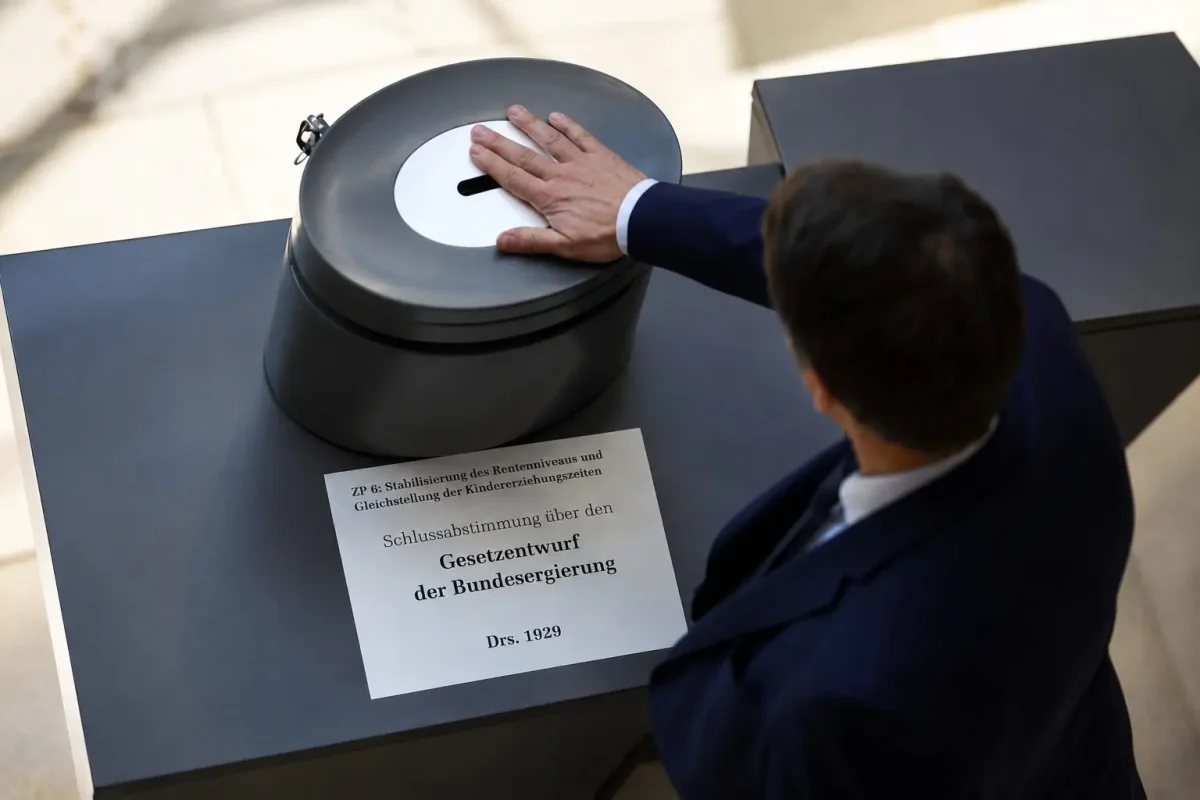
Germany's pension commission is set to recommend a significant overhaul of the country's retirement system, including raising the retirement age and introducing a state-run investment fund, according to reports from Reuters and Handelsblatt. The proposals, which will be presented to Chancellor Friedrich Merz and Labour Minister Bärbel Bas on Tuesday, aim to address the growing financial strain from an aging population and rising defense expenditures.
The commission's key recommendations include tying the retirement age to life expectancy, with the age reaching 67.5 by 2041 and 68 by 2051. Under current trends, this method could push the retirement age to 70 by 2092, Reuters reported, citing sources. Currently, German law aims to raise the pension age to 67 by the early 2030s. The plan also proposes eliminating deduction-free early retirement at 63 for those with 45 years of contributions, though hardship exceptions would be made for workers in physically demanding jobs.
A central element of the reform is the creation of a new funded pillar, where some payroll contributions are invested in financial assets rather than used to pay current retirees. This shift toward a Sweden-style system is intended to bolster pensions from around 2040. However, the proposal has drawn criticism. Marcel Fratzscher, president of the German Institute for Economic Research, told Handelsblatt the reforms are "too cautious" and lack "courage and consistency." Social association leader Michaela Engelmeier warned that returns from the capital-funded component are uncertain, while Verdi's Frank Werneke argued the plans ignore the daily realities for workers in tough physical and mental jobs.
The timing of the reform is critical, as Berlin juggles pension promises, shaky public finances, and expanding rearmament plans, including defense-industrial projects with Australia. Pensions and defense now compete for political attention, Handelsblatt noted. The commission's proposals force Merz's coalition to weigh later retirement, higher contributions, and market risk against the backdrop of an aging population that is straining public finances.
Austria provides a relevant comparison, though the data reveals complexities. Austrian pensions have risen in recent years, partly due to high inflation adjustments, but the gap between existing and new retirees is widening. Austrian pension-insurance data for 2025 shows average monthly payouts of €1,705.26 for women and €2,434.77 for men, with a gender pension gap of 40.3% according to Statistics Austria. Austria's 2026 pension adjustment was set below inflation, with pensions up to €2,500 receiving a 2.7% increase, while those above got a flat €67.50 boost, against a CPI rise of 2.9% to 3.0%.
The OECD notes that Austria's public pension bill is 14.8% of GDP, set to rise to around 15.4% by 2035, one of the highest among member countries. The organization recommends linking retirement age to life expectancy as a way to control costs and keep more people working. Germany faces similar trade-offs: market-linked funds risk disappointing savers if returns lag, raising the pension age pressures workers in tough jobs, and getting the self-employed or politicians to contribute won't close the gap alone.
Germany's choices are clear: demand longer working lives, higher contributions, more market risk, or a combination. The commission has packaged these options into one proposal, and Merz's coalition must decide what it can support. The outcome will test the coalition's unity and its ability to navigate the competing demands of pension promises, fiscal constraints, and defense spending.