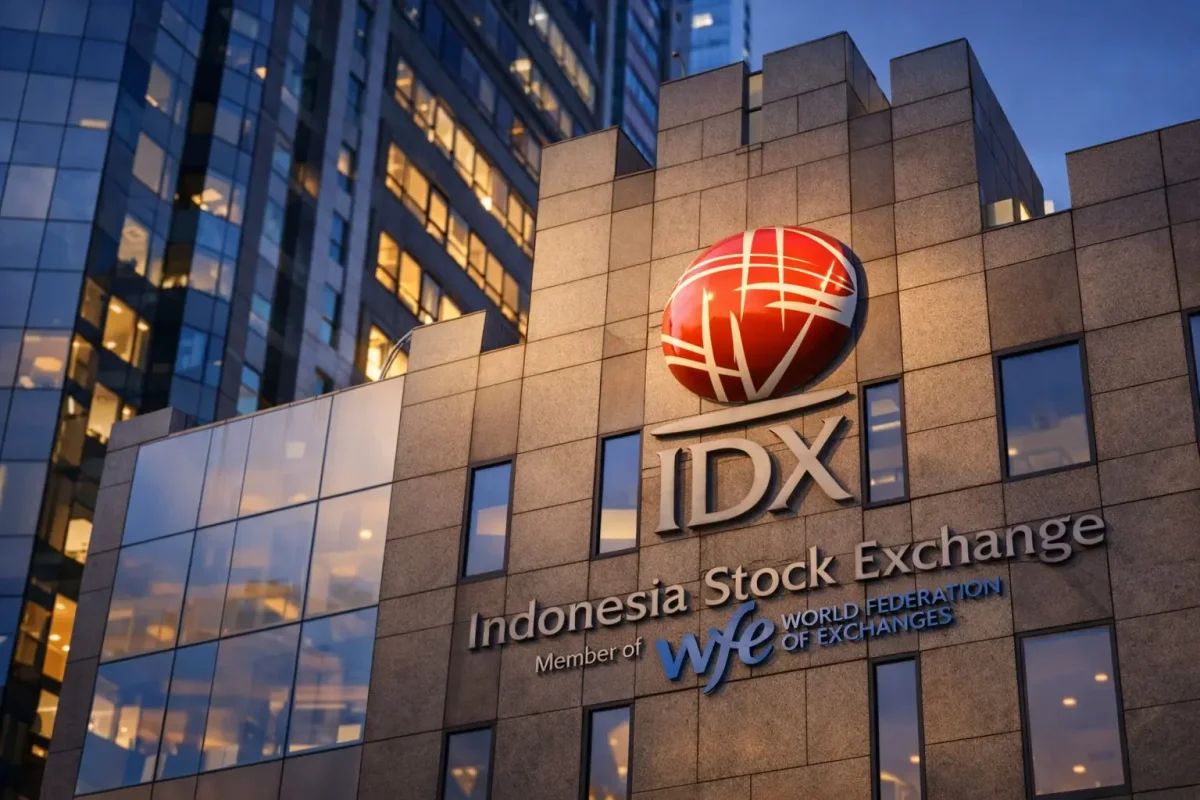
The Indonesia Stock Exchange (IDX) is poised for a consequential week, with regulatory changes and key economic data set to influence market direction. Starting next week, the bourse will implement an updated shareholder registry and commence the phased enforcement of a stricter 15% minimum free-float rule. Interim CEO Jeffrey Hendrik indicated this mandate could pressure more than two hundred listed entities to bolster their public share float, a move aimed at improving market liquidity and governance standards.
Market Context and Liquidity Concerns
The timing of this regulatory shift presents a challenge. The IDX Composite has underperformed year-to-date, and market liquidity often tightens when such policy announcements coincide with broader interest rate anxieties. Hendrik highlighted the central question for market participants: "Our primary focus is on how the market will absorb the potential increase in share supply." This sentiment underscores concerns that a surge in available shares could dampen prices if investor demand does not keep pace.
Last week's trading provided a mixed preview. The Jakarta Composite Index declined 0.44% over the February 23–27 period, closing at 8,235.485 after fluctuating between 8,093.749 and 8,437.089. Sector performance was divergent; banking stocks advanced while energy and mining shares, including Dian Swastatika Sentosa, Bumi Resources Minerals, and Bumi Resources, exerted downward pressure. Notably, foreign investors were net buyers to the tune of 4.91 trillion rupiah in the regular market.
Corporate Action and Fiscal Backdrop
Significant corporate activity is adding to the week's narrative. Conglomerate Bakrie & Brothers has announced a substantial rights issue, offering up to 90 billion new shares to existing shareholders. Finance Director Roy Hendrajanto M. Sakti stated the offering aims to raise between 4 trillion and 6.5 trillion rupiah, with final pricing expected by March 9. CEO Anindya N. Bakrie clarified that the proceeds are earmarked for settling obligations and funding business expansion linked to the acquisition of Cimanggis Cibitung Tollways.
This type of major corporate initiative can significantly sway sentiment in Jakarta's market, where individual company news sometimes outweighs broader index movements. The move aligns with the exchange's wider efforts to enhance trading standards and increase the stock inventory available to investors.
Meanwhile, fiscal risks are resurfacing as a background concern. Analysts at S&P Global Ratings have pointed to rising government interest payments. Sovereign analyst Rain Yin suggested these payments "likely surpassed the critical threshold of 15% of government revenue last year." Additionally, S&P's Kim Eng Tan warned that asset prices might face pressure if index reclassifications, potentially triggered by the new free-float rules, alter benchmark weightings for Indonesian securities.
Immediate Data Catalysts
The immediate market catalyst arrives on Monday with the release of January trade data and February inflation figures from Indonesia's statistics bureau, scheduled for 0400 GMT (11:00 a.m. Jakarta time). According to a Reuters survey, economists anticipate a trade surplus of $2.76 billion for January. For February, headline consumer price inflation is forecast at 4.31% year-over-year, while core inflation—which excludes administered prices and volatile food items—is projected to be 2.48%.
These numbers hold substantial power to shift market sentiment. An inflation reading that surprises to the upside could reignite fears of monetary policy tightening by Bank Indonesia, potentially weighing on rate-sensitive sectors like banking and consumer goods. Conversely, a stronger-than-expected rupiah or benign inflation data could provide support.
Market Implications and Risks
The interplay between regulatory supply, corporate action, and macroeconomic data creates a complex risk landscape for the week ahead. If inflation delivers an unexpected surge, or if the rupiah shows renewed weakness, banks and consumer stocks could come under early pressure. Furthermore, any perception that the market lacks the capacity to digest the additional share supply from companies scrambling to meet the free-float rule could trigger accelerated profit-taking, particularly in stocks with historically thin public floats.
The successful absorption of the Bakrie & Brothers rights issue will be closely watched as a bellwether for market appetite. The broader success of the IDX's initiative to deepen its market hinges on balancing increased supply with sustained investor confidence, all against a backdrop of global and domestic economic crosscurrents.