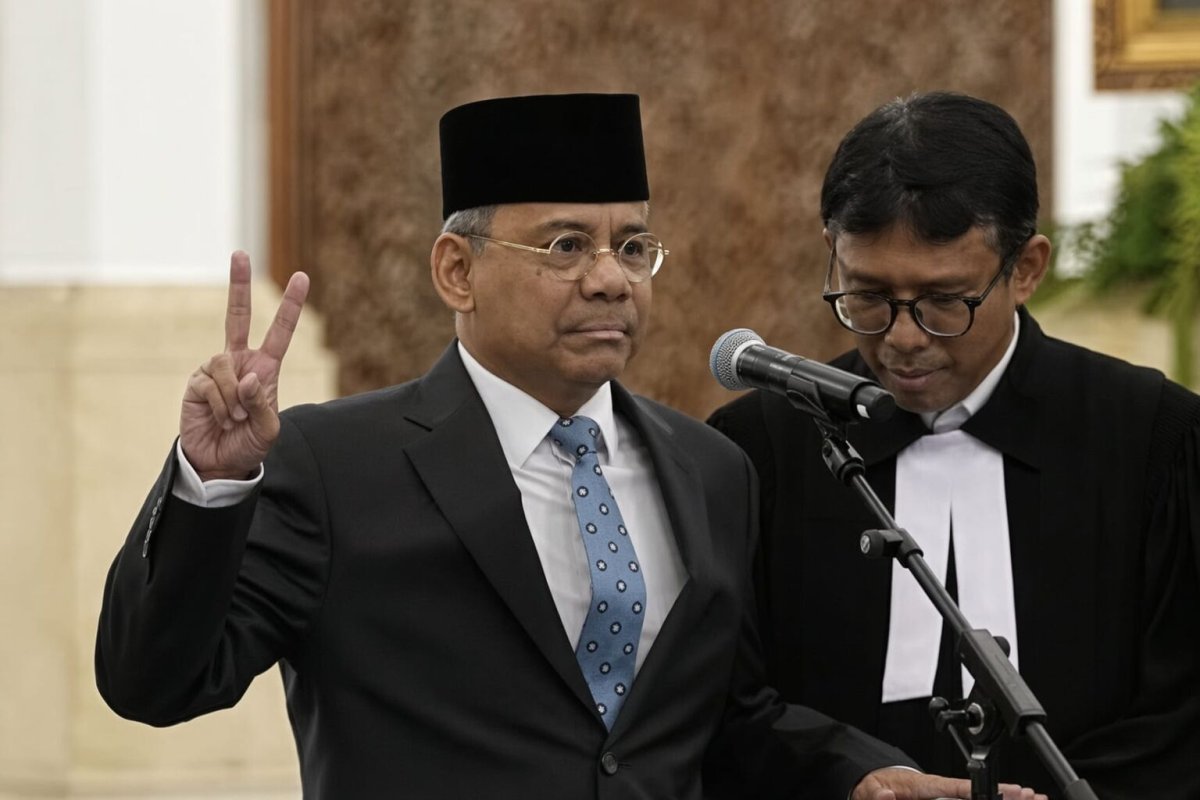
In a late-afternoon cabinet reshuffle on Monday, President Prabowo Subianto elevated Suahasil Nazara from deputy to finance minister, succeeding Purbaya Yudhi Sadewa. The personnel change is now settled, but for investors, the more pressing question is whether Nazara can deliver the 2.4%-of-GDP deficit he presented to markets less than two weeks ago.
The appointment was formalized under Presidential Decree 97/P/2026 at the State Palace in Jakarta. Nazara pledged a smooth transition, stating he would coordinate with his predecessor and that the ministry would maintain its regular operations. Indonesia's financial markets had limited time to react, with the rupiah closing Monday at 17,669 per dollar, down 0.33%, while the Jakarta Composite Index slipped 0.10% to 6,534.693. Given the timing, Tuesday's session is expected to provide a clearer read on investor sentiment.
A Fiscal Insider with a Demanding Agenda
Nazara is not an outside political appointment. Having served as deputy finance minister since 2019 and previously heading the ministry's Fiscal Policy Agency, his promotion signals continuity in the bureaucracy that designs the budget, manages sovereign financing, and coordinates with Bank Indonesia. His own recent guidance gives investors a direct scorecard: at a Mandiri Sekuritas investor meeting on September 1, he outlined a draft 2027 budget built on 6% economic growth, 2.5% inflation, an exchange rate of 17,500 rupiah per dollar, and a deficit of 2.4% of GDP. The ministry's account emphasized that the lower deficit aims to signal fiscal credibility while retaining room below the 3% ceiling in case of global shocks.
Monday's rupiah close of 17,669 was about 1.0% weaker than that planning rate, according to a TS2 calculation. This is not a forecast error—the budget assumption is a policy input for next year—but it underscores the limited currency cushion in the draft. Bank Indonesia's official JISDOR reference rate stood at 17,611 on Friday, September 11, before the reshuffle.
The 2.4% Deficit as the Credibility Benchmark
The 2.4% deficit is the stronger test. It leaves a 0.6 percentage point buffer below the 3% limit, but that margin must absorb any revenue shortfalls, new priority spending, or weaker growth. A minister can defend the headline deficit by cutting other programs or boosting revenue—choices that carry different consequences for listed contractors, banks, and consumer-facing companies.
What Tuesday's Session Can—and Cannot—Answer
The first signal will be the rupiah. A move back toward Friday's 17,611 reference would suggest investors view Nazara's promotion as continuity. A break further above 17,669 would raise the cost of imported fuel and other dollar-priced goods, complicating the inflation and subsidy assumptions in his budget framework. The Jakarta Composite is a less precise gauge, as global equity conditions and company news also move the index. Banks and businesses exposed to imported inputs may offer a more useful read. Indonesia's government-bond market will also matter: higher borrowing costs would consume some of the fiscal room the 2.4% target is meant to preserve.
There is a credible bullish interpretation. Promoting a career fiscal policymaker who helped construct the 2027 budget can reduce execution risk, and Nazara has publicly committed to an orderly handover. The counterargument is that another abrupt change at the top of the ministry makes investors less willing to treat any medium-term promise as durable until it appears in enacted budget numbers and the financing calendar.
Tuesday's prices can measure confidence in the appointment, but they cannot settle the fiscal question. That answer will come from whether Nazara keeps the deficit near 2.4%, how the government funds its priorities, and whether the rupiah assumption survives the path to the final 2027 budget.