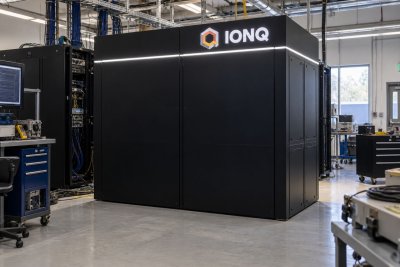
IonQ Inc. is set to release its first-quarter financial results after the market close on Wednesday, May 6, with investors closely watching whether the company can sustain its revenue growth trajectory amid heavy spending on quantum hardware development. The College Park, Maryland-based firm ended Friday at $46.20, up 2.4%, giving it a market capitalization of approximately $13.6 billion.
The company has provided first-quarter revenue guidance in the range of $48 million to $51 million, with full-year 2026 revenue expected between $225 million and $245 million. This follows 2025 revenue of $130.0 million, which represented a 202% year-over-year increase. However, IonQ also anticipates an adjusted EBITDA loss of $310 million to $330 million for 2026, underscoring the significant investment required to advance its quantum computing technology.
Adjusted EBITDA, which excludes interest, taxes, depreciation, amortization, and certain other charges, highlights the gap between IonQ's revenue growth and its path to profitability. In February, CEO Niccolo de Masi stated that the company had "once again significantly outperformed" its guidance, while CFO Inder Singh noted that over 60% of 2025 revenue came from commercial clients.
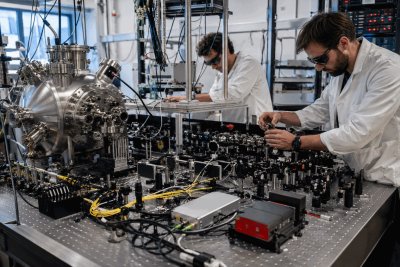
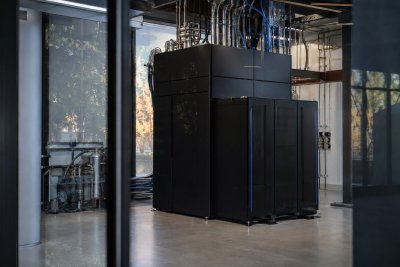
IonQ's business encompasses quantum computing and networking hardware, along with services such as maintenance, support, and cloud-based access to quantum computers. Quantum machines rely on qubits, the fundamental units of quantum information, enabling them to perform certain calculations differently than classical computers.
The stock is among a small group of publicly traded quantum computing companies. On Friday, shares of smaller rivals Rigetti Computing and D-Wave Quantum also rose, though all three—including IonQ—trade at negative price-to-earnings ratios, reflecting investor focus on future breakthroughs rather than current profitability.
Wednesday's report will serve as a key indicator of whether commercial demand for quantum computing is gaining traction. As Reuters Breakingviews noted last week, quantum hopefuls like IonQ and Rigetti still face the challenge of converting research interest into meaningful business, with high spending and volatile public market sentiment continuing to weigh on the sector.
Adding to the narrative, IonQ is pursuing its most ambitious move yet: the pending acquisition of SkyWater Technology. In January, Reuters reported that IonQ agreed to acquire the chipmaker for approximately $1.8 billion in a mix of cash and stock. The goal is to integrate semiconductor manufacturing into IonQ's operations and accelerate development of new quantum processors.
However, the deal faces regulatory hurdles. An April 24 filing revealed that the U.S. Federal Trade Commission has issued a second request for additional information, extending the waiting period to 30 days after both IonQ and SkyWater substantially respond—unless regulators terminate or extend the review earlier. Despite this, the companies still aim to close the merger in the second or third quarter, subject to conditions.
For now, the immediate focus is whether IonQ can meet its revenue targets and justify the continued investment required to scale its technology. A strong quarter would signal that customers are moving beyond experimentation, while any shortfall or cautious commentary on the backlog could shift attention to losses and the SkyWater review.
Investors will scrutinize the earnings call for details on revenue quality, cash deployment, expected regulatory timelines, and any changes in management's tone regarding commercial quantum computing demand. The report represents a critical checkpoint for IonQ as it navigates the intersection of technological promise and financial reality.