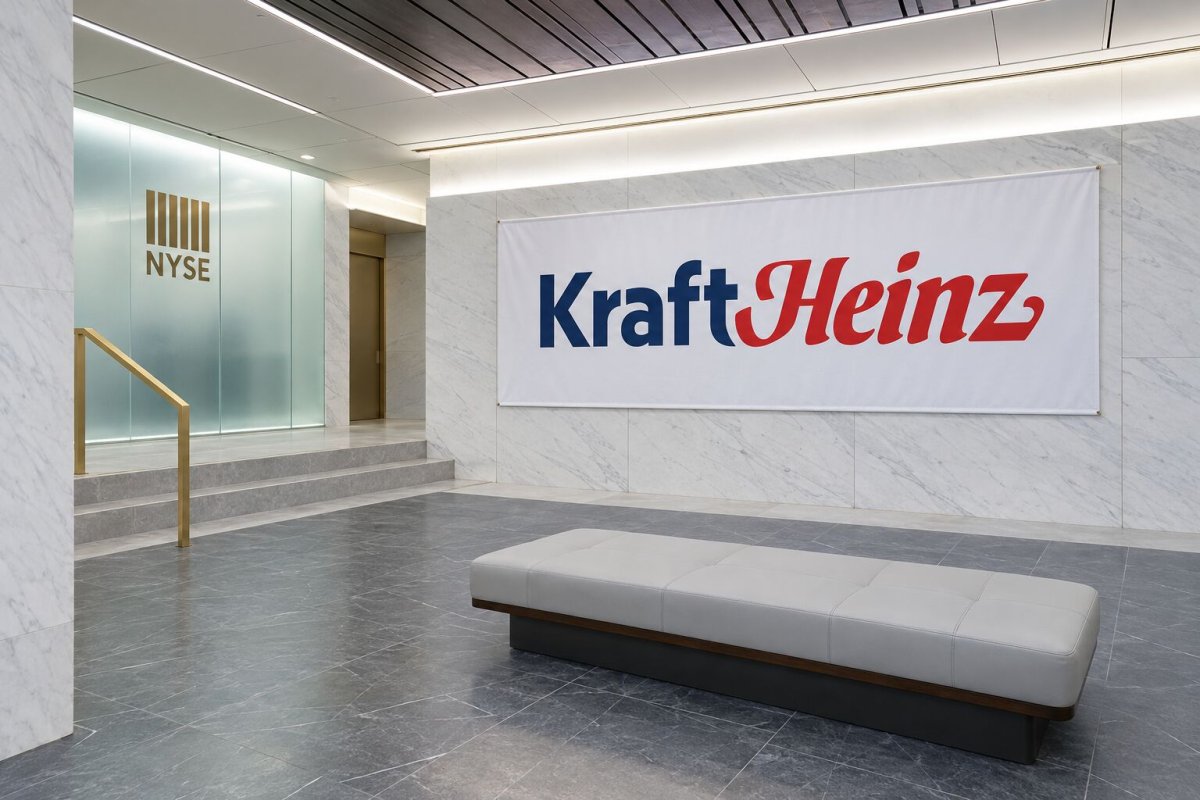
Kraft Heinz (KHC) will commence trading on the New York Stock Exchange (NYSE) on Monday, retaining its familiar KHC ticker symbol. The move, which was announced in an August 26 filing with the Securities and Exchange Commission, marks a significant shift in the company's primary listing venue. While the exchange changes, the company's shareholder claims, dividend rights, and financial structure remain unchanged.
The company's final session on the Nasdaq on Friday, September 11, saw extraordinary trading activity. Shares closed at $24.60, up 0.9%, with a staggering 123.8 million shares changing hands. This volume represented roughly 7.4 times the stock's three-month average daily volume, translating to approximately $3.0 billion in turnover at Friday's closing price. This unusual combination of massive trading volume and a modest price movement suggests that the activity was driven by exchange- and index-related repositioning rather than a fundamental reassessment of Kraft Heinz's earnings potential.
What Changes for KHC Stock on Monday
For ordinary shareholders, the venue change has no impact on the number of shares owned, the dividend claim, or the company's financial statements. The filing describes a transfer of the same common stock, not the issuance of a new security. However, the change is mechanically significant for certain portfolios and benchmarks that have listing-venue eligibility rules. These institutional trades can be much larger than the information content of the corporate event itself.
Kraft Heinz entered Friday as a constituent of the Nasdaq-100 index, which tracks the largest non-financial companies listed on the Nasdaq. With the move to the NYSE, KHC is no longer eligible for this index. The scale of this rebalancing is not trivial: Nasdaq has indicated that more than 200 products with over $800 billion in assets track the Nasdaq-100, and Kraft Heinz holds a weight of approximately 0.13% in the index. Multiplying these figures yields an estimated $1.0 billion of KHC exposure across the stated asset base, though this is a rough estimate as some products use derivatives and not all vehicles transact the full amount in the underlying stock.
The Listing Is New; the Operating Test Is Not
Investors should not mistake a new trading floor for a new profit engine. In the second quarter, Kraft Heinz reported a 1.3% decline in organic net sales. Price contributed 1.3 percentage points, but volume and mix subtracted 2.6 points. Adjusted operating income fell 18.4% to $1.04 billion, and adjusted earnings per share dropped 18.8% to $0.56.
The company's full-year outlook makes the same tension explicit. Management expects organic net sales to fall 0.5% to 2.0% and constant-currency adjusted operating income to decline 16% to 18%, partly because it is raising 2026 incremental investment to about $700 million. The bet is that heavier brand support can restore volume-led growth; the risk is that spending rises before consumers respond.
Cash generation is the strongest counterweight. Year-to-date free cash flow increased 10.3% to $1.7 billion, and Kraft Heinz paid $949 million in dividends. But management said the cash improvement was helped by working-capital changes, particularly accounts payable, while the company made no share repurchases during the first half. That makes the quality and repeatability of cash flow as important as the headline amount.
The next scheduled fundamental checkpoint is November 12 investor day, when management plans to discuss its long-term strategy, financial outlook, and milestones. Evidence that volume declines are narrowing without another margin sacrifice would matter far more to valuation than the letters on the exchange building.
Market Context and Implications
The exchange transfer is a technical event, but it carries broader implications for passive investment flows. As KHC exits the Nasdaq-100, index funds and ETFs tracking that benchmark will need to adjust their holdings, which likely contributed to the heavy volume on Friday. This rebalancing is a one-time occurrence, and Monday's opening auction may still see residual technical flow, making early volume a poor signal for investor sentiment.
For long-term investors, the focus remains on Kraft Heinz's ability to execute its turnaround strategy. The company is investing heavily in its brands, hoping to reverse volume declines and return to sustainable growth. The upcoming investor day will be a critical test of management's credibility and the feasibility of its plans.
In the meantime, the stock's valuation will continue to be influenced by fundamental metrics such as free cash flow, dividend sustainability, and margin trends. The exchange listing change does not alter these underlying drivers, and investors should view it as a purely administrative shift.