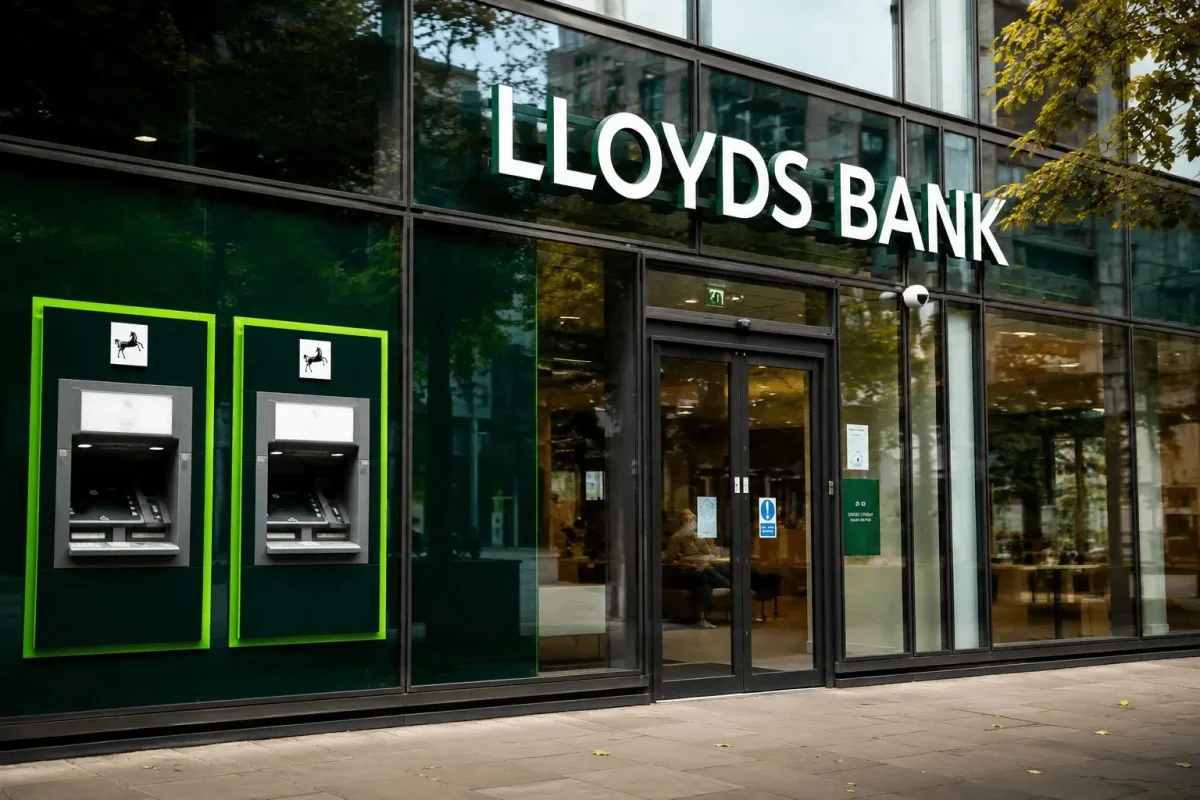
Lloyds Banking Group (LON:LLOY) has now utilized approximately 72% of its £1.75 billion share repurchase program, as the bank's stock price continues to trade at a significant premium to its tangible net asset value (TNAV). In the last two trading sessions, the lender bought back 14 million shares at an average price of 111.64 pence each, representing a 93% premium over its reported TNAV of 57.9 pence per share, which excludes intangible assets.
Buyback Economics Shift with Higher Share Price
The elevated share price is reshaping the financial dynamics of the buyback. While repurchasing shares above TNAV still boosts earnings per share, it reduces TNAV per share on a static balance sheet, as the bank pays more than book value for each canceled share. At 111.64p, £1 billion can retire about 896 million shares—a stark contrast to the 2.26 billion shares that the same amount would have bought at Lloyds' average 2022 price of 44.16p.
Market Performance and Valuation
Lloyds shares were trading at 112.85p, up 0.3% in morning London trading, just 2.7% below their 52-week high. The stock now commands a price-to-TNAV ratio of 1.95x, based on the March 31 tangible book value. This premium places Lloyds above peers like NatWest (NWG), which trades at 1.66x TNAV despite a higher first-quarter return on tangible equity (ROTE) of 18.2% versus Lloyds' 17.0%. Barclays (BARC) trades at 1.30x TNAV with a 13.5% ROTE.
Buyback Progress and Spending
Through July 15, Lloyds has spent £1.253 billion on buybacks, acquiring 1.266 billion shares at an average price of 98.99p each, according to daily regulatory filings. This leaves approximately £496.5 million, or 28.4% of the total budget, yet to be deployed. Between July 1 and July 15 alone, the bank purchased 74.0 million shares at an average cost of 112.72p, reflecting the upward trend in the stock price.
Historical Context of Buyback Efficiency
The declining purchasing power of buyback capital is evident when comparing across programs. In fiscal 2021, £1 billion bought 2.264 billion shares at an average price of 44.16p. By fiscal 2024, the same amount purchased only 1.297 billion shares at 77.13p. In the current program through July 15, £1 billion buys just 1.010 billion shares at 98.99p, more than double the 2022 average price. This highlights the quieter downside of a stronger share price: while the denominator for earnings per share shrinks, the same capital now buys a smaller ownership stake.
Financial Performance and Outlook
Lloyds' strong financial results provide ample room for shareholder returns. First-quarter pretax profit rose 33% to £2.025 billion, with underlying net interest income up 8% to £3.569 billion. The return on tangible equity reached 17.0%, and CEO Charlie Nunn expressed confidence in delivering on the group's ROTE target of over 16% through 2026. The bank noted that its Q1 buyback partially offset a 0.9p increase in TNAV, underscoring the capital balancing act.
Macro Context and Upcoming Catalysts
UK GDP edged up 0.1% in May, matching the April decline, as services growth offset falls in production and construction. The Office for National Statistics noted that its early estimate may be revised. With less than two weeks until Lloyds' half-year results and strategy update on July 30, investors will focus on whether retained earnings are lifting TNAV quickly enough to keep pace with the buyback price. The premium could narrow even without a share price decline if TNAV rises, but risks from slower lending or higher impairment charges could undermine the valuation.
