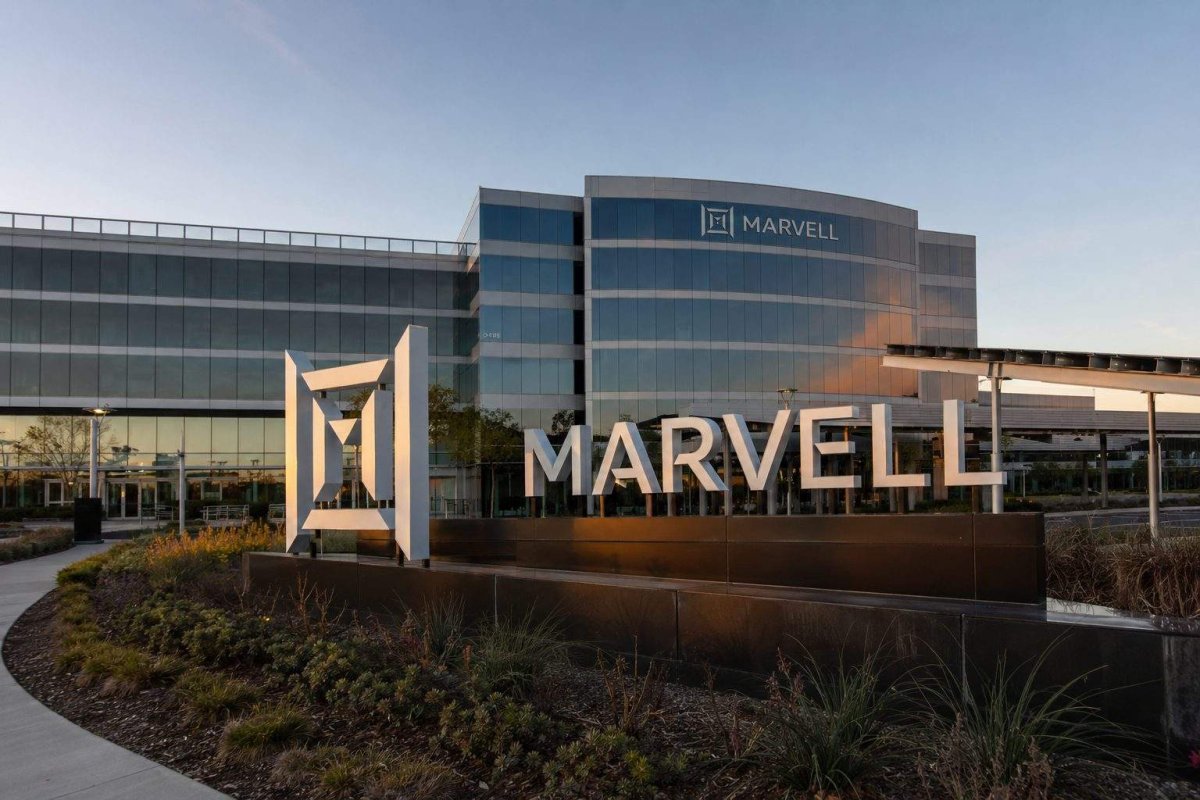
Marvell Technology, Inc. (NASDAQ:MRVL) experienced a sharp decline in its last trading session, with shares falling 9.84% to close at $245.29. This drop erased approximately $23.4 billion in market capitalization, bringing the company's total value to roughly $214.58 billion. The selloff occurred despite a shortened trading week due to the Independence Day holiday, which closed U.S. markets on Friday, July 3.
The stock has now lost about 20% since its June 22 close, which marked its first trading day after joining the S&P 500 index. Since that milestone, Marvell shares have fallen from $307.86 to $245.29, a decline of roughly 20.3% in under two weeks. The move highlights growing investor skepticism about the company's ability to monetize its artificial intelligence (AI) initiatives.
Peer Comparison Underscores Weakness
Marvell's decline outpaced its semiconductor peers. The VanEck Semiconductor ETF (NASDAQ:SMH) fell 4.59%, while NVIDIA Corp. (NASDAQ:NVDA) dropped only 1.47%. Broadcom Inc. (NASDAQ:AVGO) slipped 2.48%, and Advanced Micro Devices, Inc. (NASDAQ:AMD) declined 4.24%. Marvell's 9.84% drop was significantly worse than these competitors, suggesting company-specific concerns rather than sector-wide weakness.
The stock hit an intraday low of $237.20 during the session. Over the abbreviated week, Marvell lost 8.05%, despite a 7.25% gain on Tuesday. The two-day decline from Tuesday's close totaled 17.66%, according to historical data.
Valuation and Revenue Outlook
Despite the selloff, Marvell's valuation remains elevated. The stock trades at a price-to-earnings (P/E) ratio of approximately 84, based on trailing twelve-month earnings. On a revenue basis, the company's market cap of $214.58 billion equates to roughly 26.2 times its fiscal 2026 revenue of $8.195 billion. This multiple suggests investors are still pricing in significant future growth, even as near-term AI revenue expectations cool.
Marvell reported first-quarter fiscal 2027 revenue of $2.418 billion on May 27, with CEO Matt Murphy noting "exceptional AI-related bookings." The company guided second-quarter revenue to $2.700 billion, plus or minus 5%. Data center revenue accounted for $1.83 billion, or 75.7% of total revenue, underscoring the company's heavy reliance on AI and cloud infrastructure spending.
Custom Chip Ambitions Face Scrutiny
Marvell's long-term growth story hinges on its custom-chip business, which the company now expects to exceed $10 billion in revenue by fiscal 2029. The company also raised its fiscal 2028 revenue forecast to approximately $16.5 billion, up from a prior estimate of $15 billion. However, Morningstar analyst William Kerwin described the custom-chip target as "$5 billion in incremental revenue from FY28 to FY29 exclusively from one business," highlighting the concentration risk.
CEO Matt Murphy emphasized that Marvell has "custom engagements across the board at all the U.S. hyperscalers," but the market appears to be taking a wait-and-see approach. The stock's recent decline suggests investors are demanding more concrete evidence of revenue generation from these partnerships.
Technical and Dividend Developments
Marvell's 52-week range spans from $61.44 to $329.88, indicating the stock has experienced significant volatility. The company has set July 10 as the record date for its next quarterly dividend of $0.06 per share, payable on July 30. While the dividend yield remains modest, the record date is important for indexing and income-focused funds, particularly after the recent selloff.
In product news, Marvell unveiled its Teralynx T100 switch silicon on June 1, touting 102.4 terabits per second of bandwidth. The chip is designed for AI data-center networking and is currently sampling to customers. Rishi Chugh, head of Marvell's data-center switch business, described the chip as "designed without the legacy baggage that inflates power."
The company also deepened its relationship with NVIDIA, announcing a $2 billion investment from NVIDIA in March. The collaboration, called NVLink Fusion, integrates Marvell's optical, analog, and custom silicon technology into NVIDIA's AI ecosystem. NVIDIA CEO Jensen Huang declared that "the inference inflection has arrived," but the market's reaction to Marvell suggests that the payoff from these partnerships may take longer than initially anticipated.