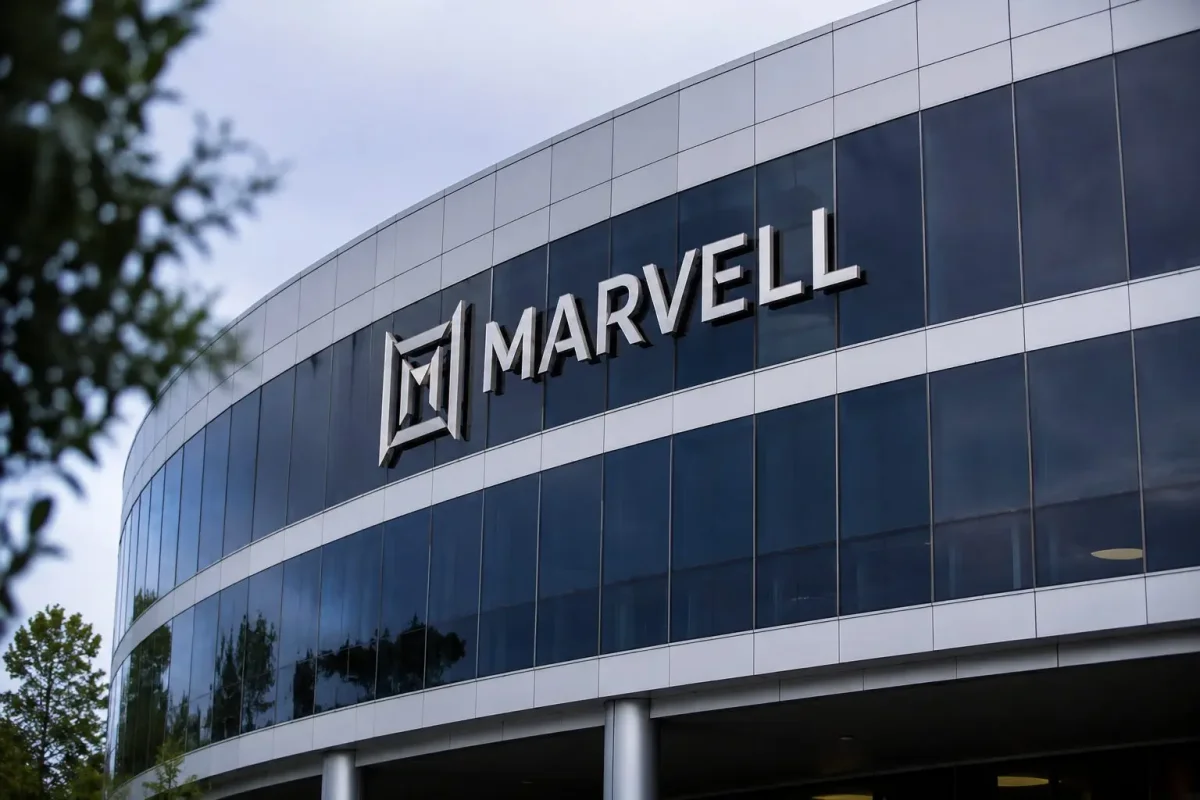
Shares of Marvell Technology (MRVL) experienced a notable surge in premarket trading on Monday, climbing approximately 7% following the announcement from S&P Dow Jones Indices that the chipmaker will be added to the S&P 500 index later this month. This inclusion is set to trigger forced buying by index funds and exchange-traded funds (ETFs) that track the benchmark, providing a significant demand catalyst for the stock.
According to data from Google Finance, Marvell shares were trading at $282.50 ahead of the opening bell, up 7.22% from Friday's closing price of $263.47. The move places Marvell among the ranks of the 500 largest publicly traded companies in the United States, a designation that carries weight with institutional investors and passive fund managers.
The S&P 500 is widely regarded as Wall Street's standard for large-cap U.S. equities, covering approximately 80% of the total U.S. market capitalization. For Marvell, this transition from a volatile AI-focused growth stock to a core index component represents a significant shift in its market standing. The company will now be included in most mainstream U.S. equity portfolios, potentially broadening its investor base.
S&P Dow Jones Indices also announced that Flex (FLEX) will join the S&P 500 alongside Marvell, while Pool Corp (POOL) and The Campbell's Company (CPB) will be removed as part of the quarterly rebalance. The changes will take effect before the market opens on June 22.
The broader chip sector also showed strength, with futures moving higher. Premarket data from Reuters indicated that Nvidia (NVDA), Broadcom (AVGO), and Micron (MU) were up between 1.5% and 3.9%, while Marvell added 6.6%. S&P 500 futures rose 0.35% and Nasdaq 100 futures gained 0.69% in early trading.
Marvell's stock has been highly volatile this year, more than tripling in value driven by robust demand for artificial intelligence (AI) applications. The company has become a key player in the AI infrastructure trade, supplying data-center chips and networking equipment that facilitate data movement within and between large computing systems. Larger competitor Broadcom also focuses on custom chips for cloud companies, a segment attracting increased investor attention as Big Tech seeks alternatives to Nvidia's expensive and hard-to-source AI processors.
Adding to the positive sentiment, Marvell reported strong earnings on May 27. Fiscal first-quarter revenue surged 28% year-over-year to a record $2.418 billion, and the company guided second-quarter revenue to approximately $2.7 billion at the midpoint. CEO Matt Murphy highlighted "exceptional AI-related bookings" and raised revenue targets for fiscal 2027 and 2028, signaling confidence in sustained growth.
Analysts have had mixed views on Marvell. J.P. Morgan's Harlan Sur described the stock as a "battleground" due to rising competition in chips and optical connectivity. Meanwhile, HSBC's Frank Lee noted that the market may still be underestimating Marvell's optical revenue potential. UBS Global Wealth Management CIO Mark Haefele expressed confidence in the AI outlook, though some concerns about rapid price appreciation persist.
Despite the positive momentum, risks remain. In its latest quarterly filing, Marvell highlighted heavy reliance on a few large customers, concentration in the data-center business, macroeconomic risks such as high interest rates, and potential trade curbs with China. The company also flagged challenges in demand forecasting, which could lead to excess inventory or supply shortages.
For now, the focus is on the immediate impact of the S&P 500 inclusion. Marvell's addition to the index is expected to drive significant buying from passive funds, while investors weigh whether the AI growth narrative justifies the stock's elevated valuation. The coming weeks will be crucial as the market absorbs this development and assesses Marvell's long-term prospects.