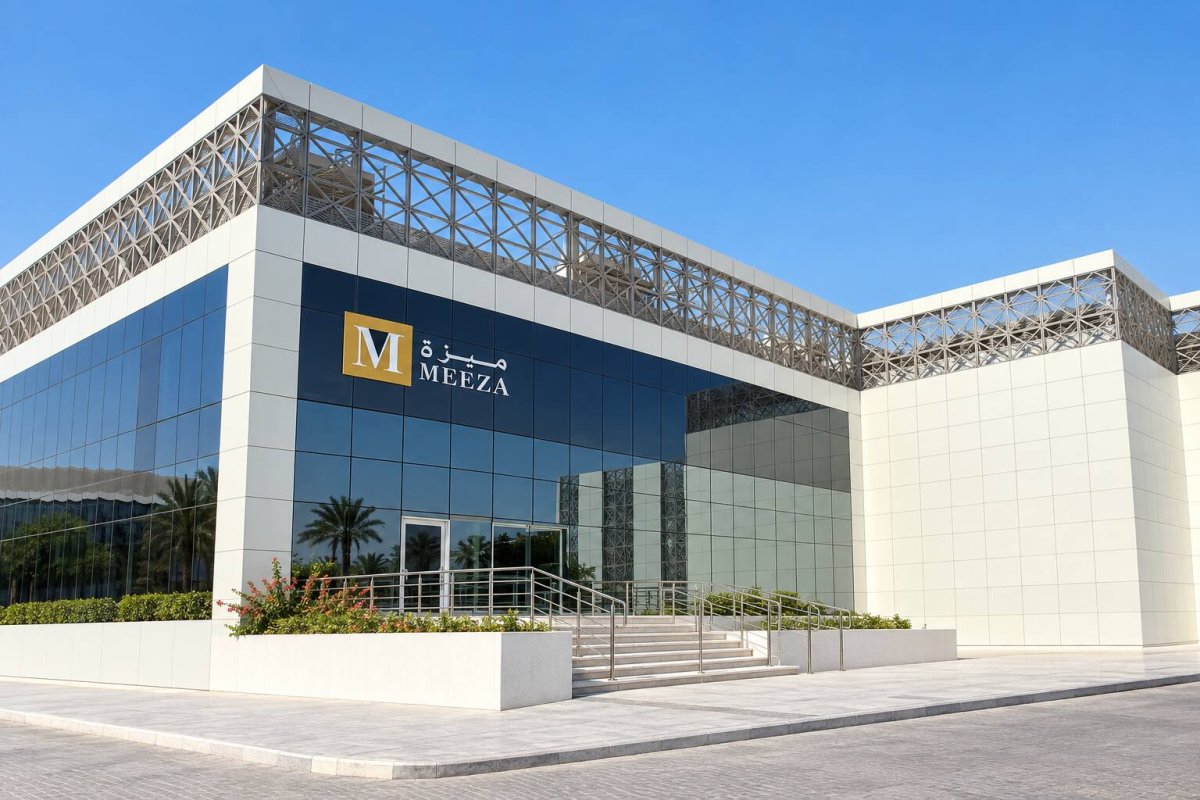
MEEZA QSTP-LLC, a Qatari data-center operator, has unveiled the largest contract in its corporate history: a long-term lease valued at over QAR 1 billion ($275 million) for 8 megawatts of capacity at a new data-center campus. The agreement, announced on September 7, is designed to support cloud and artificial intelligence workloads for an unnamed global hyperscaler. The gross contract value is more than 4.6 times MEEZA's entire first-half revenue, underscoring the deal's significance for shareholders even without full details.
The market reaction was immediate. MEEZA shares (QSE:MEZA) jumped 10% from QAR 3.01 on September 7 to QAR 3.31 the following day, closing the trading week at QAR 3.281 on September 10. However, analysts caution that the headline figure should not be mistaken for near-term revenue. MEEZA has not disclosed the lease term, service start date, revenue-recognition schedule, specific campus, or the customer's identity—all critical factors for evaluating the deal's true financial impact.
A Contract That Dwarfs Current Operations
In its official announcement, MEEZA said the agreement would deliver 8 MW of operational capacity for cloud and AI workloads at a new data-center campus. The company generated QAR 217.3 million in revenue during the first half of 2024, up 15.2% year-over-year. Dividing the contract's stated minimum value by that revenue yields the striking 4.6-times comparison. The deal also exceeds one-third of the QAR 2.9 billion order backlog reported at June 30, though MEEZA has not clarified whether or when the new lease will be added to that backlog.
Context from MEEZA's previous hyperscaler project is instructive. In June, the company completed a separate 4 MW expansion under an agreement valued at over QAR 350 million, with a term exceeding ten years. That history highlights why megawatts and total contract value are more informative than an assumed annual sales figure. The new lease is twice the capacity and nearly three times the stated value of that earlier award, but its economics cannot be inferred without a term and commissioning date.
Funding the Expansion: The Key Risk
MEEZA ended June with 18 MW of installed capacity at full occupancy. The new 8 MW commitment therefore represents 44% of its current footprint. Management's July investor presentation outlines a path to more than 60 MW by 2029: M-VAULT 8 is scheduled to add 4 MW in late 2026, M-VAULT 6 another 24 MW in late 2027, and M-VAULT 7 another 16 MW in early 2028.
This buildout transforms the investment case from one of scarce, occupied capacity to one of execution and capital discipline. First-half capital expenditure reached QAR 171.5 million, while cash and equivalents fell to QAR 139.8 million from QAR 330.8 million at year-end. Murabaha financing totaled QAR 309.4 million at June 30. MEEZA subsequently secured an additional QAR 1.6 billion commodity Murabaha facility from Dukhan Bank, bringing project-financing facilities to QAR 2.7 billion.
Management has explicitly noted that annualized return on capital employed declined because financing arrived ahead of data-center activation. This timing gap is the central risk: interest and construction spending can precede lease revenue by several quarters.
What Would Turn the Headline Value into Earnings?
The strongest bull case is straightforward. MEEZA has sold a meaningful block of future capacity before completing its expansion, reducing demand risk while Qatar tries to establish itself as a regional cloud and AI hub. The company also demonstrated execution by delivering its earlier 4 MW project nine months ahead of schedule.
The counterargument is that a very long lease can produce a large headline value without an equally dramatic annual profit contribution. An unnamed customer also leaves concentration, credit, and bargaining-power questions unanswered. If the 8 MW sits in a capital-intensive new campus, the return depends on construction cost, power economics, and the pace of facility drawdowns—not merely on filling the space.
Three disclosures would materially improve the valuation read-through: the ready-for-service date and campus, the contract term and revenue-recognition profile, and the expected return on invested capital after financing costs. Until those arrive, the most defensible conclusion is narrower than the share-price reaction: MEEZA has validated hyperscaler demand for almost half its existing capacity, but shareholders still need proof that the QAR 1 billion commitment converts into earnings faster than the new infrastructure consumes cash.
