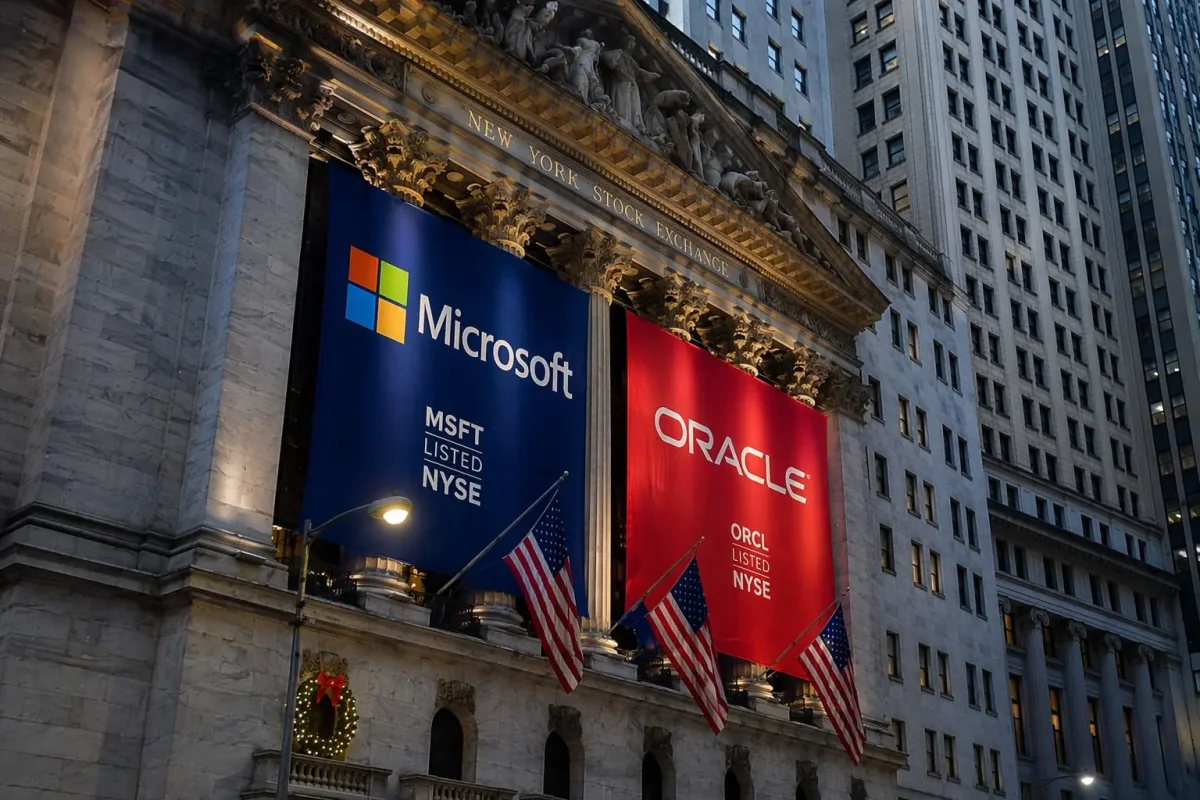
Shares of Microsoft Corporation and Oracle Corporation moved higher in Thursday morning trading, as the market digested fresh indicators of sustained artificial intelligence demand and strategic moves to secure critical infrastructure. The positive momentum reflects a tentative shift in sentiment as analysts and investors evaluate whether massive capital expenditures in cloud and AI infrastructure will begin yielding clearer financial returns.
Market Movement and Broader Context
By late morning in New York, Microsoft stock had gained $6.46 to trade at $417.68. Oracle shares saw a more pronounced increase, adding $7.04 to reach $176.85. This upward movement occurred against a backdrop of renewed confidence in the technology sector, with the Nasdaq Composite Index closing at a record high the previous day. The gains for these two industry giants come after a period of pressure, with both stocks having traded at notable discounts following a recent market sell-off. Some commentators had even labeled Microsoft among the weaker performers in the elite group of major U.S. tech stocks earlier in the year.
The AI Investment Thesis Under Scrutiny
The core narrative for both companies revolves around their enormous bets on artificial intelligence. Microsoft has invested over $200 billion in AI initiatives since the start of its 2024 fiscal year, a figure that has sparked intense debate about the timeline for realizing a return on that capital. The company's previous earnings report in January, which highlighted record cloud revenue alongside peak AI spending, was met with a tepid market response, indicating investor wariness. Microsoft's next crucial update arrives with its fiscal third-quarter results, scheduled for release on April 29.
Oracle, meanwhile, delivered a staggering metric last month that captured Wall Street's attention: its remaining performance obligations (RPO), representing future contracted revenue, surged 325% year-over-year to $553 billion. An analyst described the quarter as a "stress test result for the AI trade," a phrase that has resonated. The central question for Oracle is whether this enormous backlog will successfully convert into strong cash flow and healthy margins.
Analyst Perspectives and Ratings
Despite prevailing skepticism, several analysts maintain constructive views. Baird analyst William Power recently reduced his price target on Microsoft to $500 from $540 but reaffirmed his Outperform rating. He cited ongoing adoption of Copilot AI tools, steady momentum in the Azure cloud platform, and expectations for solid earnings as reasons for optimism. Similarly, KeyBanc Capital Markets holds an Overweight rating on Microsoft with a $600 price target. The firm's survey data revealed that 85% of IT and cybersecurity executives plan to increase their spending on Azure, suggesting Microsoft is maintaining its competitive position against rivals Amazon Web Services and Google Cloud.
The Critical Issue of Power Supply
A new and critical factor has entered the investment calculus for cloud providers: securing sufficient electricity. Oracle made headlines this week by significantly expanding a deal with Bloom Energy to lock in up to 2.8 gigawatts of fuel-cell power generation, with 1.2 gigawatts already in active deployment. Mahesh Thiagarajan, Executive Vice President of Oracle Cloud Infrastructure, stated the goal is to "quickly meet the demands" of the company's U.S. cloud customers as this new capacity comes online.
This focus on power is not incidental. The U.S. Energy Information Administration recently projected that national electricity demand will reach record levels in 2026 and 2027, driven largely by the expansion of data centers to support AI and other compute-intensive workloads. For Oracle, which is working to narrow the gap with cloud leaders AWS and Azure, securing reliable and scalable power has become nearly as strategically important as procuring advanced semiconductors.
Persistent Risks and Challenges
The improved sentiment does not erase underlying risks. In March, reports indicated Oracle was trimming jobs and slowing hiring as it managed rising data-center operational costs and ongoing concerns about debt and cash burn. Microsoft faces a different set of uncertainties, including the potential for AI-focused startups like Anthropic to disrupt traditional software profit models before Microsoft's own Azure and Copilot investments can generate the returns that bullish investors anticipate.
Conclusion: The Path Forward
The mood surrounding Microsoft and Oracle has demonstrably brightened, fueled by concrete data points on AI demand and proactive steps to address infrastructure bottlenecks. However, the fundamental hurdle remains unchanged. For both companies, the ultimate validation of their multi-billion-dollar strategies will depend on translating ambitious spending into tangible growth in earnings, profit margins, and free cash flow. The upcoming earnings season, starting with Microsoft's report at the end of April, will provide the next critical data point in that ongoing assessment.