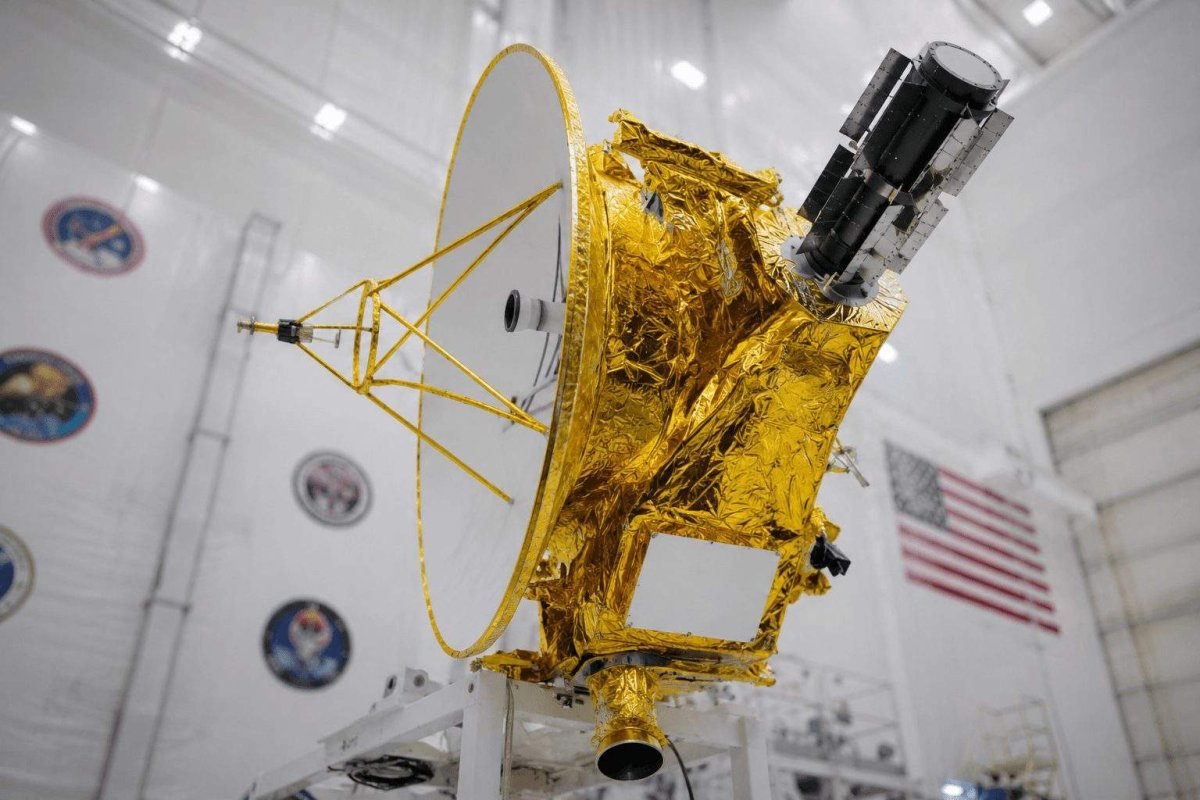
WASHINGTON, July 8, 2026 — NASA’s New Horizons spacecraft has successfully emerged from a 321-day hibernation period, transmitting a beacon signal from approximately 5.9 billion miles (9.5 billion kilometers) away. The one-way signal travel time of 8 hours and 52 minutes underscores the limitations of current commercial communications infrastructure, which remains focused on cislunar and near-space operations rather than deep-space exploration.
The mission, managed by the Johns Hopkins Applied Physics Laboratory (APL) and with science leadership from the Southwest Research Institute, relies on NASA’s government-funded Deep Space Network (DSN) for communications. In contrast, the agency’s commercial Near Space Network only supports missions up to roughly 2 million kilometers from Earth — a distance New Horizons exceeds by a factor of nearly 4,750.
NASA has been actively expanding commercial participation in space communications. In February 2025, the agency awarded Near Space Network contracts worth up to $4.82 billion, with a base period running through September 2029 and an optional extension to September 2034. Intuitive Machines (NASDAQ: LUNR) secured task orders for GEO-to-cislunar and x-cislunar direct-to-Earth links, while Viasat (NASDAQ: VSAT) received a task order for low-Earth orbit science support. These contracts are designed to increase capacity and reduce reliance on the DSN.
Kevin Coggins, NASA’s deputy associate administrator for Space Communications and Navigation, stated that industry involvement will be key to enabling higher data return from future missions. Commercial relay services for NASA missions could be operational by 2028, with testing and validation expected to continue through 2031.
Despite the strategic importance of these contracts, the market reaction has been muted. As of 09:47 EDT, Intuitive Machines shares traded at $18.07, up 1.23%, giving the company a market capitalization of $2.67 billion. Viasat shares were at $77.22, up 0.65%, with a market cap of $10.88 billion. The modest moves reflect investor focus on near-term lunar and Earth-orbit opportunities rather than the distant Kuiper Belt work of New Horizons.
New Horizons’ ongoing science mission continues to yield valuable data. During hibernation, the spacecraft maintained a weekly “green” beacon, and the team now plans to download health and safety data before retrieving information from three science instruments. The Alice ultraviolet spectrograph is studying hydrogen in the outer heliosphere, while the probe’s plasma, energetic-particle, and dust detectors remain active. Pontus Brandt, New Horizons project scientist at APL, noted that a potential future encounter with the termination shock would provide “a treasure trove for space physicists worldwide.”
The mission’s funding profile highlights the relatively low cost of extended operations. According to The Planetary Society, New Horizons cost $780.6 million to build and launch, with ongoing operations averaging $14.7 million per year since 2017. This annual cost is a fraction of the potential peak funding for the Near Space Network, which could support approximately 328 New Horizons-style annual budgets.
Alan Stern, principal investigator for the mission at Southwest Research Institute, emphasized that “science data collection never stops” even during hibernation. NASA is also upgrading ground-system software, with testing currently underway and expected to continue through the year.
The contrast between New Horizons’ deep-space reach and the commercial network’s limited range underscores a key investment theme: while deep-space communications remain out of investor reach for now, the cislunar and near-space sectors are attracting significant capital. As NASA continues to shift toward commercial partnerships, companies like Intuitive Machines and Viasat are positioned to benefit from the growing demand for reliable space-based data transmission.