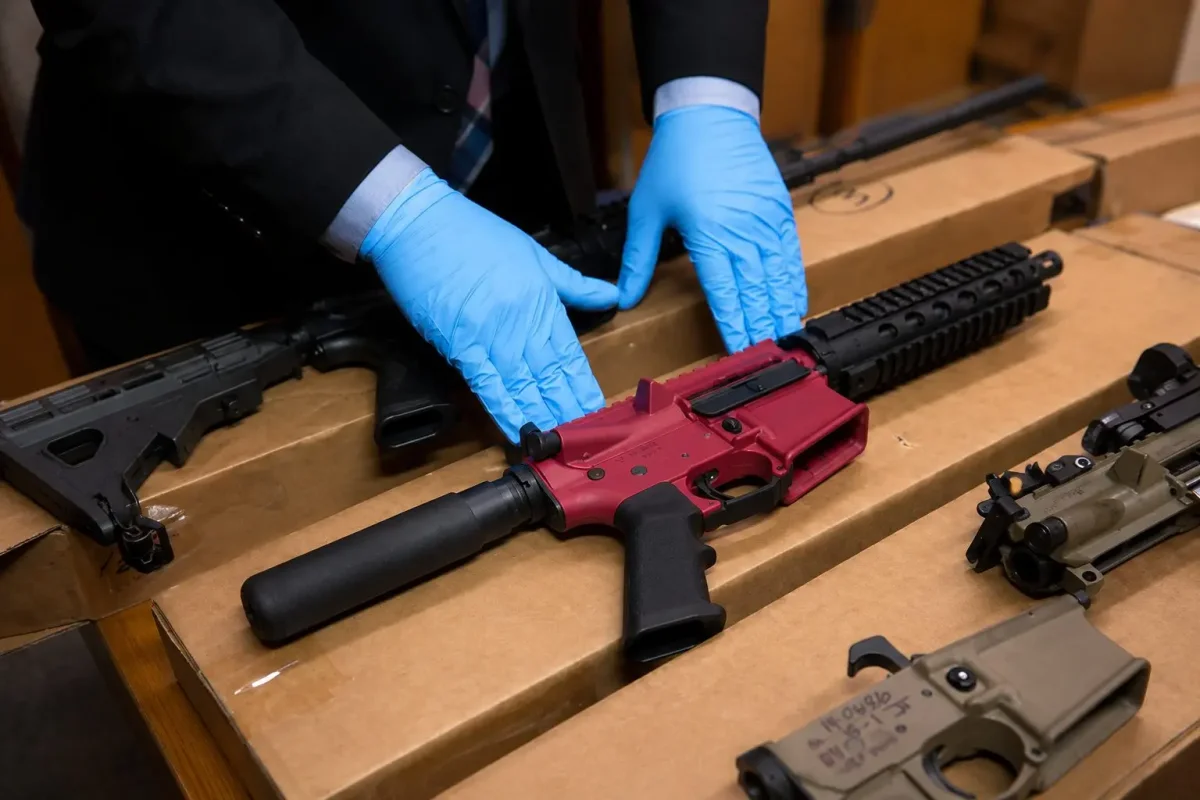
New York has enacted a groundbreaking budget law that could require manufacturers of 3D printers to integrate technology designed to prevent the production of firearms. Signed by Governor Kathy Hochul as part of the FY27 budget, the measure is a direct response to a dramatic increase in privately made firearms, often called ghost guns, recovered in criminal investigations.
Rising Ghost Gun Seizures
Federal data reveals that the number of suspected privately made firearms linked to crimes surged from 1,629 in 2017 to 27,490 in 2023, a staggering increase of approximately 1,600%. These weapons are particularly challenging for law enforcement because they lack serial numbers, making them nearly impossible to trace. The new law aims to curb this trend by targeting the tools used to create these firearms.
How the Law Works
The legislation does not impose an immediate ban on the sale of 3D printers. Instead, it mandates that within 90 days, New York's Division of Criminal Justice Services, Department of State, and the State University of New York (SUNY) form a working group. This panel will include experts in additive manufacturing, artificial intelligence, digital security, firearms regulation, public safety, and product safety. Their task is to assess the feasibility of implementing firearm-blocking technology in 3D printers sold in the state.
If the working group determines that such technology is not currently practical, the requirement will not be enforced until a viable solution emerges. Should the standards be approved, sellers must wait for formal regulations before the mandate takes effect. Noncompliance could result in a civil penalty of $5,000 per product sold, delivered, or transferred illegally, though certain licensed gunsmiths and federal firearms licensees may seek exemptions from the attorney general.
Legal and Technical Challenges
The law also targets the illegal possession, sale, or distribution of digital gun blueprints and the manufacturing of 3D-printed firearms. However, digital rights groups, including the Electronic Frontier Foundation, have raised concerns about potential surveillance of all print jobs and the risk of blocking legitimate designs or violating privacy. Gun-rights organizations, such as the NRA Institute for Legislative Action, argue that the measures infringe on Second Amendment rights, with executive director John Commerford stating that they restrict law-abiding citizens from engaging in constitutionally protected activities.
Industry and Regulatory Impact
Manhattan District Attorney Alvin Bragg hailed the law as a potential game-changer for prosecutors dealing with ghost guns, comparing it to technology that prevents standard printers from copying currency. The law is seen as a test case for whether such blocking technology can effectively curb home manufacturing of firearms.
National Context
New York is not alone in its efforts. According to Fox News and Stateline, at least 16 states now have laws targeting 3D-printed firearms, with seven passing significant measures this year, including Colorado, New Jersey, Maine, Virginia, and Washington. California is also considering a bill that would require printer companies to incorporate firearm-blocking technology. The outcome of New York's feasibility review will likely influence regulatory approaches across the country, potentially shifting the focus from punishing illegal possession to preventing the creation of ghost guns at the point of sale.