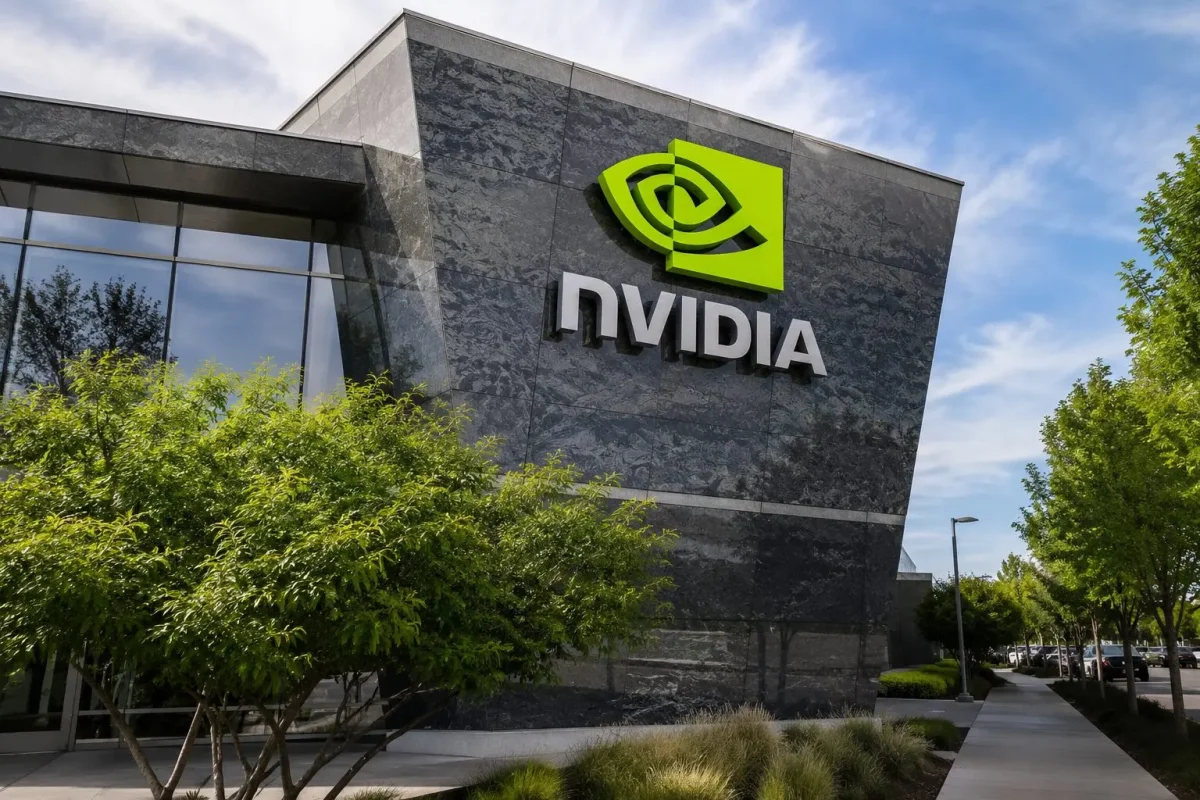
Nvidia (NASDAQ:NVDA) is facing a significant gap with the broader chip market, trailing the PHLX Semiconductor Index by 65.2 percentage points in 2026, as news of stricter compliance checks on Asian buyers weighs on investor sentiment. The company's stock has risen just 9.1% year-to-date through Monday, compared to a 74.3% surge in the SOX index, highlighting a divergence between AI enthusiasm and Nvidia's near-term growth visibility.
In premarket trading Tuesday, Nvidia shares were up 0.52% at $204.58, after closing at $203.53 on Monday, down 3.52%. The broader Nasdaq-100 futures were up 0.48% early Tuesday. The modest premarket gain does little to offset Monday's steep decline, which erased roughly $181 billion in market capitalization—more than double the company's $80 billion buyback authorization announced in May.
According to a Financial Times report, Nvidia has cut its list of approved Asian buyers for AI chips by more than half, tightening checks in Singapore, Malaysia, and Japan. Reuters could not independently verify the report, and Nvidia did not respond to requests for comment. Buyers removed from the list can reapply with changes, but the path to sales has become more complex, potentially delaying orders and clustering demand among fewer approved channels.
The selloff rippled across the semiconductor sector Monday. Advanced Micro Devices (AMD) fell 4.21%, Broadcom (AVGO) dropped 3.98%, and the PHLX Semiconductor Index itself slid 4.78%. However, Nvidia's larger decline is somewhat unique, driven by concerns over its exposure to Asian markets rather than a broad demand slowdown.
Nvidia's fundamentals remain robust. First-quarter revenue surged 85% year-over-year to $81.6 billion, with Data Center revenue up 92% to $75.2 billion. The company's second-quarter revenue guidance of $91 billion implies approximately 11.5% sequential growth, and notably does not include any Data Center compute sales in China. CEO Jensen Huang described the AI buildout as "accelerating at extraordinary speed," suggesting demand is not the issue.
Demand-side evidence remains strong. Taiwan Semiconductor Manufacturing Co (TSM) posted a 36% jump in second-quarter revenue, and analysts project a 59% profit gain. Global spending on cloud and AI infrastructure is on track to reach $1.5 trillion by 2027, a 40-50% increase over the prior year. However, the tightening of Nvidia's approved buyer list in Asia could constrain its ability to capture that demand, even as suppliers like TSMC report record sales.
Nvidia is now trading at roughly 19 times forward earnings, its lowest valuation multiple in over a decade. LSEG analyst targets suggest more than 40% upside from current levels. Steve Sosnick of Interactive Brokers noted, "We've never seen this kind of extreme earnings growth," while Chris Maxey of Wealthspire added that "earnings growing faster than the price" presents a potential opportunity. Marija Veitmane of State Street said "the cycle will just get a lot longer."
The key question is whether the discount will persist. If removed buyers clear reviews and TSMC raises its full-year forecast, Nvidia's multiple could expand. Conversely, tighter U.S. export controls, a slowdown in cloud spending, the rise of custom chips, or persistent inflation could make the 19-times multiple a warning sign rather than a bargain. Markets will first react to U.S. consumer-price data due at 8:30 a.m. EDT Tuesday, then shift focus to TSMC's earnings on Thursday. For Nvidia, another strong spending outlook may not fully resolve the valuation debate until AI budgets translate into revenue that passes compliance checks.