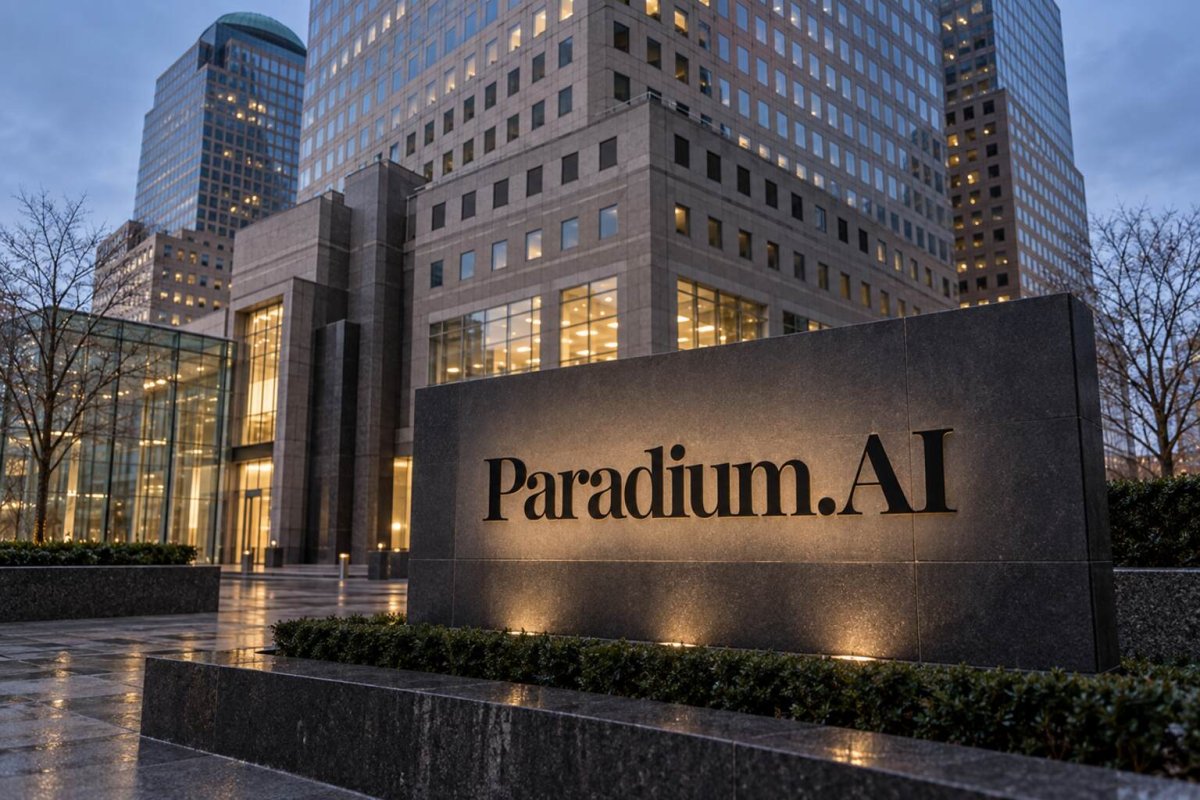
Paradium.AI (PAAI) experienced a dramatic halt in trading on Thursday after its stock price rocketed 271% within a single session, leaving investors with a last traded price of $3.34 but no opportunity to exit through a conventional closing auction. The halt, triggered under the T1 news-pending code at 11:50:06 a.m. Eastern Time, came just hours before the company disclosed a monumental ten-year operating agreement with Roundtable, a deal valued at $1 billion on paper but one that hinges on a substantial capital infusion.
The announcement, published by Roundtable at 2:50 p.m., outlined a transformative partnership in which Paradium would migrate its publishing, advertising, technology, syndication, streaming, data, community, and decentralized-finance operations onto Roundtable's MediaOS platform. In exchange, Roundtable would receive a perpetual, worldwide, and non-cancelable license to Paradium's technical assets, which include prominent media properties such as TheStreet, Parade, Men's Journal, and Athlon Sports. However, the binding economics remain far from settled, as the deal's closure depends on Roundtable completing an $89 million cash-and-stock investment for approximately 49% of Paradium's equity.
Timeline of the Trading Halt
The sequence of events underscores the market's reaction to the news. Roundtable initiated a shareholder call at 11:00 a.m. ET, which it had previewed in a September 15 SEC filing as a discussion of a signed “transformative transaction.” Just fifty minutes later, PAAI shares entered a news-pending halt after multiple volatility pauses, with the market-wide halt feed indicating no resumption time. The stock had already climbed $2.44 from Wednesday's close of $0.8999, and volume soared to 31.76 million shares—more than 30 times its 20-session average. The halt was never lifted during the regular or late sessions, meaning the $3.34 print is a last sale, not a closing price at which investors could trade.
Deal Structure and Funding Uncertainty
According to the release, the agreements are subject to Roundtable making an $89 million private investment, paid in a mix of cash and stock, for roughly 49% of PAAI. However, the disclosure lacks critical details: it does not specify the cash-versus-stock split, the number or class of securities to be issued, or how the $1 billion contract value will be allocated between the companies. No same-day transaction filing appeared in either company's SEC feed by Thursday evening, leaving investors in the dark about the deal's mechanics.
The $1 billion figure represents contract value spread over a decade, with Roundtable forecasting $100 million in annualized revenue after closing. This is not an upfront cash payment, but rather a projection contingent on the transaction receiving financing. Investors cannot yet determine Paradium's revenue retention, cost transfers, minimum payment guarantees, or termination provisions.
Market Reaction and Valuation
The market's response has been dramatic. Paradium reported 47.61 million common shares outstanding as of June 30. At the halted price of $3.34, the equity value implied is approximately $159 million, up roughly $116 million from the prior close. This calculation does not account for potential dilution from securities issued to Roundtable, which could significantly alter the ownership structure. Depending on the final terms, the investment could bring meaningful capital and strategic operational support, but it also carries the risk of control changes and dilution for existing shareholders.
Funding Challenges
Funding remains a critical hurdle. Roundtable's June-quarter filing showed just $492,000 in cash, $95,000 in USDC, and bitcoin worth $2.07 million, alongside a $10 million nonrefundable deposit on a digital-media investment. The company used $5.17 million in cash from operations during the first half of the year. An $89 million package far exceeds its reported cash balance, making the stock component and new financing central to whether the deal closes—and to the dilution borne by shareholders of both companies.
Paradium also enters the negotiation with a leveraged balance sheet. Its second-quarter Form 10-Q reported $11.17 million in cash, $97.61 million in term debt, and a stockholders' deficit of $7.55 million. Quarterly revenue fell to $22.18 million from $45.01 million a year earlier, as average monthly page views dropped to 187.7 million from 423.4 million. Despite generating $2.28 million in operating income, interest expenses pushed continuing operations to a $176,000 loss.
Bull and Bear Cases
The bullish case is not without merit. A funded partner that absorbs platform operations and monetizes a large media portfolio could reduce Paradium's execution burden, while $89 million in consideration would be material relative to its cash balance. The stronger counterargument is that the market has already priced in much of that benefit before investors can read the contracts, evaluate the financing, or trade after the formal release.
The next decisive documents will be a Paradium Form 8-K, the investment agreement, the operating contract, and an exchange notice setting a reopening time. These should reveal the security mix, ownership denominator, cash recipient, revenue commitments, termination rights, and financing sources. Until then, the halted $3.34 print measures enthusiasm during a news event; it does not settle the value of a transaction that still must be funded.
