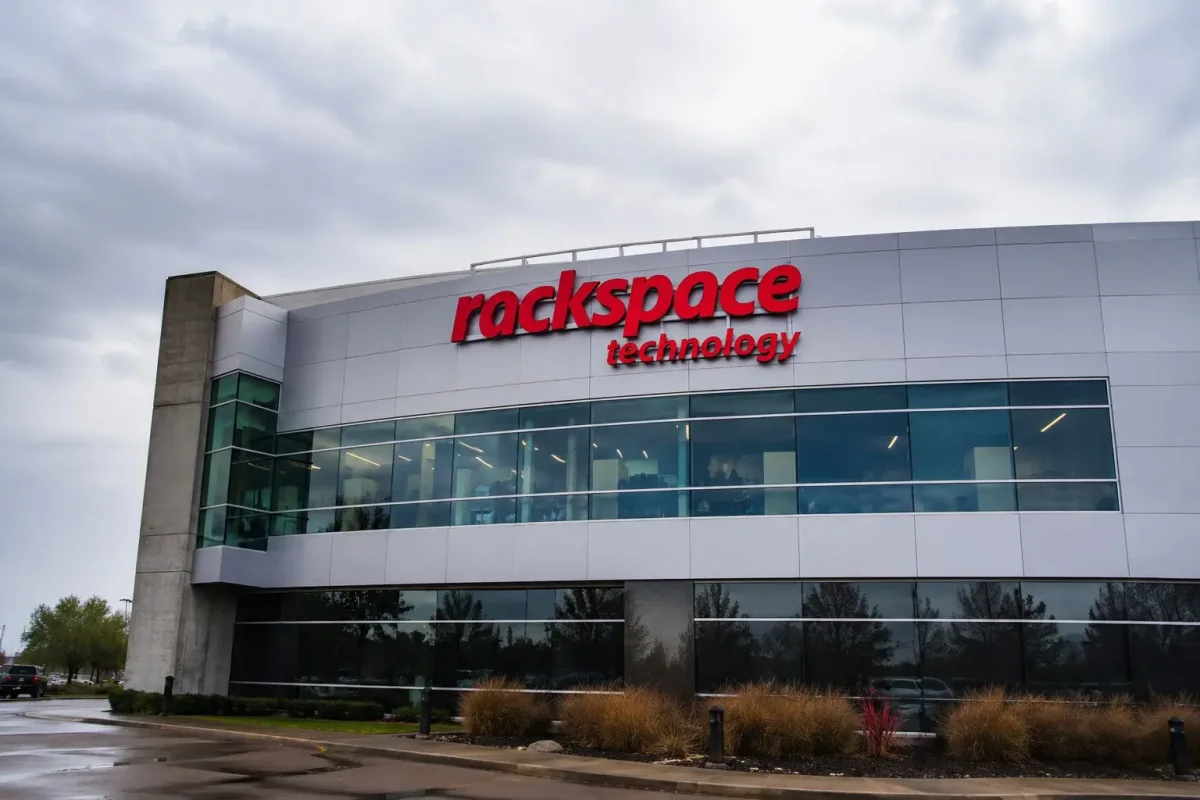
Rackspace Technology (RXT) shares closed at $6.33 on Tuesday, surging 34.97% after the company announced a memorandum of understanding (MOU) with Advanced Micro Devices (AMD) to develop an "Enterprise AI Cloud" tailored for regulated and sovereign workloads. Trading volume exploded to 61 million shares, roughly three times the typical average, as short sellers scrambled to cover positions.
The stock opened at $4.79 and hit an intraday high of $6.34 before settling slightly lower at $6.20 in after-hours trading. The sharp move came as 24.55% of Rackspace's shares were held short, representing a 3.1-day cover ratio that added fuel to the rally.
Q1 Earnings Show Improvement
Rackspace's first-quarter results, released on May 7, provided additional support for the bullish narrative. Revenue edged up 2% year-over-year to $678 million, driven by a 7% increase in public cloud revenue to $443 million. The company swung to net income of $8 million, reversing a $72 million loss in the same period last year. Non-GAAP operating profit rose 20% to $31 million.
However, private cloud revenue continued to decline, falling 6% to $235 million, highlighting the mixed nature of the quarter. Free cash flow remained negative at $9 million, and liquidity stood at $295 million.
AMD Deal Sparks AI Infrastructure Play
The partnership with AMD positions Rackspace to serve regulated industries such as banking, healthcare, and government that require managed AI infrastructure. The Enterprise AI Cloud will leverage AMD Instinct GPUs and EPYC CPUs within a governed stack. CEO Gajen Kandiah emphasized accountability, noting that enterprises want a single responsible party for running AI workloads.
Bulls point to Rackspace's growing AI partner lineup, which also includes Palantir Technologies (PLTR). The company completed its first joint Palantir deal in 41 days, using AI-powered workflows on Palantir Foundry to reduce a client's quoting cycle by 94%.
Bears Cite Debt and Non-Binding Agreement
Skeptics note that the AMD agreement is non-binding and early-stage, with no guarantees on financing terms. Rackspace's balance sheet remains heavily leveraged, with total debt of $2.71 billion as of March 31, including $2.48 billion in principal. Interest expense rose to $26.2 million from $19.4 million a year ago, driven by an interest-rate swap maturity and increased borrowing.
The company maintained its 2026 outlook, projecting revenue of $2.6 billion to $2.7 billion and adjusted EBITDA of $305 million to $315 million, with no upward revision despite the stock surge.
Market Context and Technical Factors
The rally occurred amid broader tech weakness, with the Nasdaq Composite falling 0.71% on Tuesday due to hotter-than-expected inflation data and geopolitical concerns. AMD slipped 2.3%, Palantir declined 0.6%, and DigitalOcean fell 4.3%. Rackspace's move was distinctly company-specific.
Analyst targets have lagged the price action. BMO Capital Markets raised its price target to $5 from $2, but the stock closed at $6.33, indicating sell-side estimates are trailing the market's enthusiasm.
With interest rates expected to remain elevated—Polymarket shows a 63.1% probability of zero Fed cuts in 2026—Rackspace's leveraged position and capital-intensive AI infrastructure plans face headwinds. The rally has transformed the stock from a managed-services laggard into a small-cap AI infrastructure play, but sustainability depends on converting the AMD MOU into binding contracts and demonstrating tangible revenue growth.