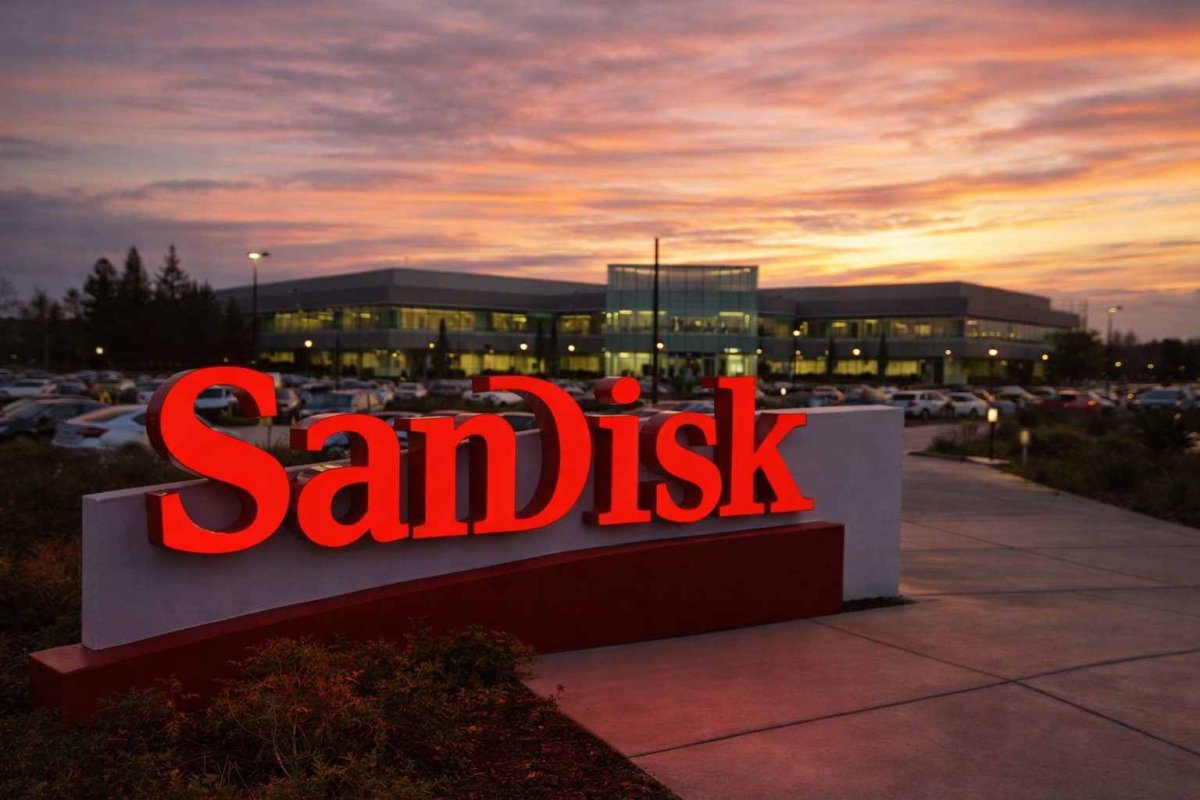
Sandisk Corporation (SNDK) shares closed at a record $1,562.34 on Friday, May 8, 2026, lifting the flash-storage company's market capitalization to approximately $245 billion. The milestone underscores a dramatic shift in how Wall Street views the memory-chip sector, as NAND flash storage becomes increasingly integral to artificial intelligence infrastructure.
The stock's rally—up from a close of $1,255.86 on May 4—was accompanied by heavy trading volume of 20.6 million shares on Friday. The session high reached $1,564.00, reflecting investor enthusiasm for Sandisk's positioning in the AI data-center ecosystem.
Explosive Revenue Growth
Sandisk reported fiscal third-quarter revenue of $5.95 billion, a 251% year-over-year increase. Data-center revenue alone soared 645% to $1.47 billion, highlighting the company's central role in powering AI workloads. For the fiscal fourth quarter, management guided revenue between $7.75 billion and $8.25 billion, with non-GAAP diluted earnings per share expected in the range of $30 to $33.
CEO David Goeckeler described the quarter as a "fundamental inflection point," attributing the growth to data-center demand driving higher-value end markets. He emphasized "structurally higher and more durable earnings power," a phrase that has resonated with investors amid the stock's rapid ascent.
Long-Term Contracts Stabilize Volatile Market
In a move to tame the notoriously cyclical memory market, Sandisk secured five long-term supply agreements, including three signed in the last quarter totaling at least $42 billion. "The bane of this industry has been the boom-bust cycle," Goeckeler told Reuters. "We want consistent, predictable economics."
The company disclosed $41.6 billion in remaining performance obligations as of April 3—sales already contracted but not yet recognized as revenue. Sandisk expects to recognize roughly 15% of that amount within the next year, providing a clear visibility into future earnings.
Outpacing Former Parent and Peers
Sandisk's market value now far exceeds that of its former parent, Western Digital (WDC), which stands at about $165 billion. The company was spun off from Western Digital in 2025. Meanwhile, Micron Technology (MU), another major memory player riding the AI wave, hovers near $853 billion in market capitalization.
Analyst Vijay Rakesh at Mizuho raised his price target on Sandisk to $1,625 from $1,220, citing "demand outpacing supply in the NAND market." He noted that other names in the space are seeing similar dynamics.
Risks and Insider Activity
Despite the bullish outlook, Sandisk's quarterly filing flagged execution, financial, and market risks associated with its long-term agreements. Missed deliveries or specifications could result in penalties or reduced volumes. The company also cited ongoing hazards from volatile demand, price fluctuations, and sales cycles.
Following the stock's surge, a minor insider-sale filing appeared. On May 8, Director Necip Sayiner submitted a Form 144 to sell 579 common shares worth approximately $870,300.69. The filing indicated no sales in the prior three months.
For now, scarcity, clear contracts, and AI-driven storage demand are propelling Sandisk's market. The real test will come if NAND supply increases, customers reduce purchases, or the new contract structure proves less resilient than expected—any of which could pressure margins.