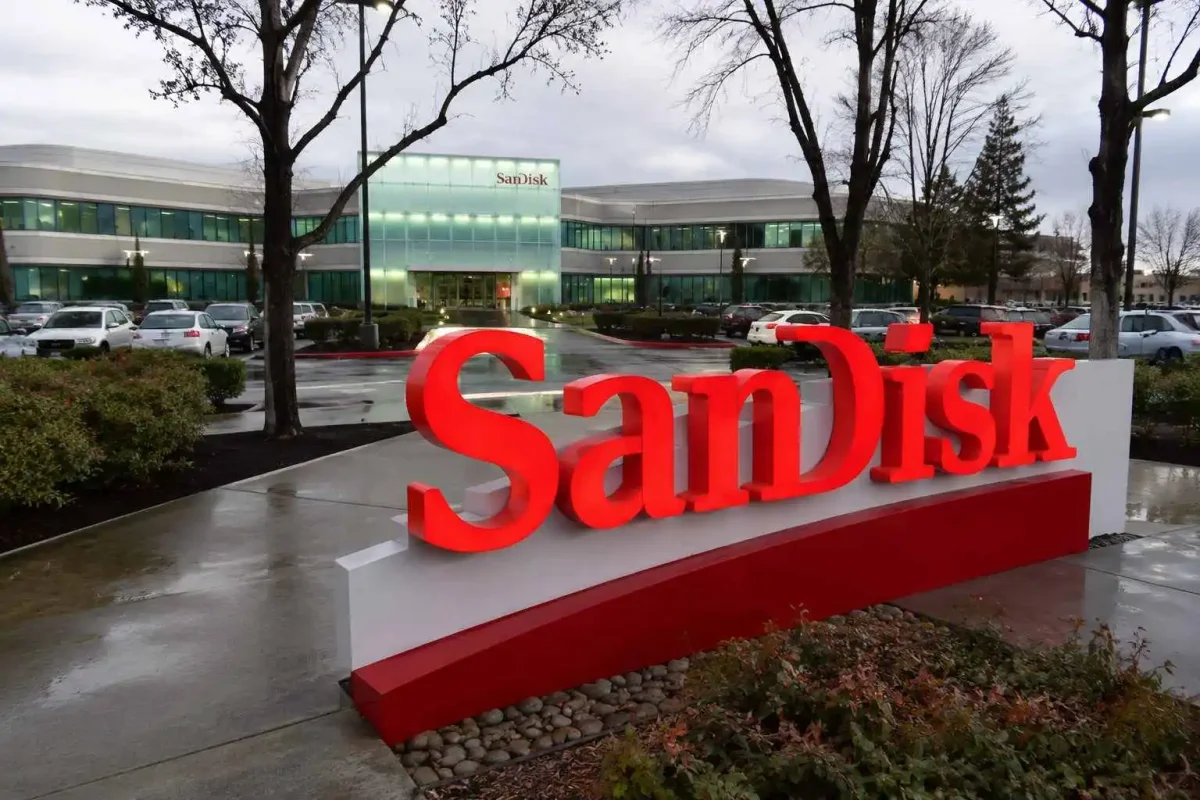
New York, July 28, 2026 — Sandisk Corporation (NASDAQ:SNDK) saw its shares plunge 11.0% in Monday's regular session, closing at $1,278.23, as investor sentiment soured amid a probe into China's NAND flash memory industry. Pre-market trading on Tuesday indicated a further decline of approximately 5%, signaling continued bearish pressure on the memory chipmaker.
Massive Value Destruction
The two-day sell-off, which began with a 10.8% drop on Friday, has erased an estimated $49.2 billion in market capitalization based on the company's 148.09 million outstanding shares. This staggering figure is more than eight times Sandisk's $6 billion share repurchase authorization, underscoring the severity of the market's reaction.
The decline was triggered not by direct news about Sandisk, but by concerns over China's broader semiconductor ambitions. CXMT Corp (SHA:688825), a Chinese DRAM manufacturer, made its Shanghai debut with a 466% surge, focusing investor attention on potential government financing for the sector. While CXMT produces DRAM, Sandisk specializes in NAND flash, but market participants fear that similar support could benefit unlisted NAND competitor YMTC.
Market Context and Comparisons
Sandisk's 11% drop outpaced both Micron Technology (NASDAQ:MU), which fell 2.2%, and the Philadelphia Semiconductor Index, which declined 2.2% on Monday. This disproportionate decline highlights the market's heightened sensitivity to NAND supply dynamics and valuation concerns.
According to Reuters, YMTC accounted for 11.8% of global NAND market share last year, roughly on par with Sandisk. Projections indicate YMTC could surpass 14% by early 2027, and its planned new facilities may more than double its capacity, intensifying competitive pressure.
Revenue Composition and AI Demand
Sandisk's revenue composition reveals the stakes. In the last quarter, datacenter revenue reached $1.47 billion, representing 24.7% of total revenue, while edge products generated $3.66 billion, or 61.6%. Although AI-driven demand is genuine, approximately three-quarters of current revenue still comes from outside the datacenter segment, leaving the company exposed to broader memory market cycles.
Chief Executive David Goeckeler has sought to mitigate cyclical volatility through long-term customer agreements. Sandisk has secured five extended deals, with three involving minimum commitments of $42 billion each. "We want consistent, predictable economics," Goeckeler told Reuters in May.
Guidance and Valuation
Despite the market turmoil, Sandisk maintains robust near-term guidance. The company forecasts fourth-quarter revenue between $7.75 billion and $8.25 billion, with a midpoint of $8 billion representing sequential growth of 34%. Adjusted earnings per share are projected at $30 to $33, with adjusted gross margins of 79% to 81%.
Based on Monday's closing price, Sandisk trades at approximately 10.1 times projected annual earnings at the midpoint of guidance. However, memory sector earnings can shift rapidly depending on supply-demand dynamics.
Broader Market Sentiment
Investor skepticism extended across Asian markets. Kioxia Holdings (TYO:285A), which collaborates with Sandisk on NAND technology, fell 18.3% on Tuesday. "Investor focus is not so much on CXMT's present profits but on its ability to ramp up capacity more quickly," noted analyst Kim Seok-hwan.
Sandisk's next major test comes on August 5 with its fiscal fourth-quarter earnings release, followed by Investor Day on August 13. Investors will seek clarity on fiscal 2027 NAND pricing, contracted sales, and the datacenter revenue share.
Key risks include increased production at YMTC or declining NAND prices pressuring Sandisk's elevated margins. Conversely, constrained supply, effective price floors, or additional datacenter contracts could suggest the recent sell-off has been excessive.