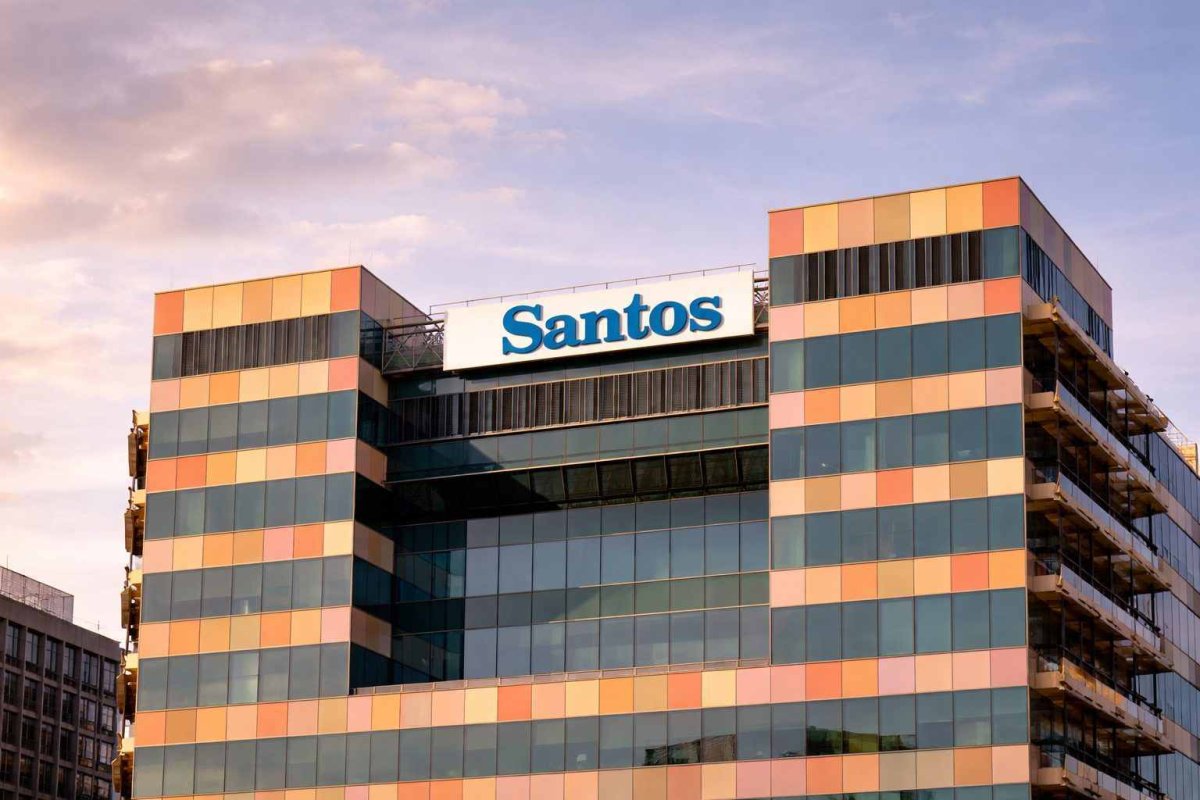
The share price of Santos Ltd (ASX:STO) experienced a slight decline during Tuesday's trading session, closing 0.14% lower at A$6.94. The stock fluctuated within a narrow band, reaching an intraday high of A$7.03 and a low of A$6.94, with trading volume reaching approximately 13.1 million shares. This movement occurred against a backdrop of easing crude oil prices and as market participants began positioning ahead of the company's forthcoming full-year financial report.
Market Context and Sector Performance
Broader market sentiment was mixed, with the ASX 200 index closing marginally lower as investors processed early earnings season announcements. Within the energy sector, performance was divergent. Santos's larger peer, Woodside Energy Group Ltd (ASX:WDS), managed to finish the session in positive territory, gaining 0.35% to close at A$25.93. The sector's overall direction was heavily influenced by commodity price movements, with Brent crude futures trading around $68.85 per barrel, representing a modest decline. Analysts noted that geopolitical tensions in the Middle East, particularly concerning shipping routes like the Strait of Hormuz, continue to inject a degree of risk premium into oil markets, preventing a steeper slide in prices.
Focus Shifts to Corporate Fundamentals
Investor attention is now squarely fixed on Santos's scheduled release of its full-year 2025 results on Wednesday, February 18. The report is anticipated to provide critical updates on several fronts that are key to shareholder value. Market observers will scrutinize the company's guidance on capital expenditure, the timing of major projects, and most importantly, any signals regarding cash returns to shareholders through dividends or buybacks. This earnings release is viewed as a significant checkpoint for the company's annual trajectory and strategic execution.
The fundamental backdrop for oil and gas producers remains complex, with supply dynamics presenting a mixed picture. Recent data indicates that OPEC's collective output saw a slight contraction in January. Concurrently, the broader OPEC+ alliance has opted to pause its planned production increases for the current quarter, a move interpreted as a response to concerns over potential oversupply in the market. These coordinated actions aim to provide underlying support for prices, balancing against softer demand indicators and global economic uncertainty.
Long-Term Project Catalysts
Beyond the immediate earnings report, the longer-term investment thesis for Santos hinges on the successful transition of two major development projects from the construction phase to cash-generating operations. The company has previously provided production guidance for 2026, forecasting output between 101 million and 111 million barrels of oil equivalent. This represents a substantial increase from the 87.7 million barrels expected in 2025. The growth is primarily driven by the Barossa gas field and the Pikka oil project in Alaska.
Recent operational updates have been encouraging. Santos confirmed the loading of the first LNG cargo from the Barossa project for delivery to Japan, a milestone that analysts believe could alleviate persistent investor concerns regarding project commissioning risks. Furthermore, the company reported that the first phase of the Pikka project is 98% complete, with first oil anticipated by the end of March. The market will be keenly listening for confirmation of these timelines and details on the expected ramp-up profile during the upcoming results presentation.
Near-Term Risks and Considerations
For the remainder of the week and leading into the earnings date, traders are expected to maintain a dual focus. One eye will remain on the volatile crude oil market, where prices can swing sharply based on geopolitical developments or shifts in supply discipline from major producing nations. The other will be on Santos-specific metrics. Any deviation from the expected schedule for Barossa or Pikka, or unexpected cost pressures, could quickly impact the stock price. Similarly, the tone of management's guidance regarding 2026 operational and financial targets will be a key driver of sentiment.
In summary, Santos shares are currently trading in a holding pattern, reflecting a balance between near-term commodity price softness and the anticipation of significant project-led growth in the medium term. The February 18 results will provide the next major data points for investors to reassess the company's value proposition, its operational execution, and its capacity to deliver shareholder returns in a fluctuating energy market.