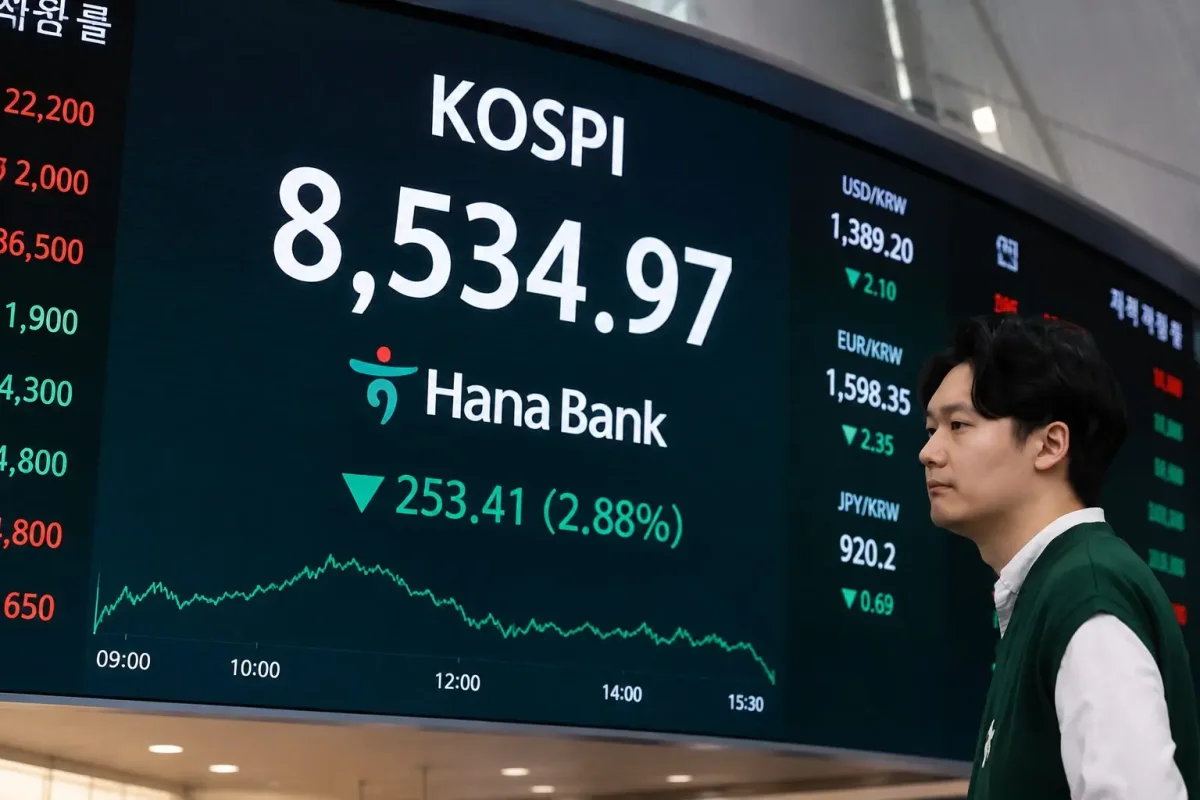
South Korea's benchmark KOSPI index suffered its worst single-day decline since March, plummeting 10.84% to close at 6,023.66 on Tuesday. The sharp sell-off was driven by a rout in semiconductor stocks, with heavyweight chipmakers SK Hynix and Samsung Electronics bearing the brunt of investor panic.
SK Hynix shares cratered 14.7%, while Samsung Electronics fell 13.4%, marking the latter's largest one-day drop in nearly two decades. The two companies together account for more than half of the KOSPI's total market capitalization, and their combined decline contributed at least 6.7 percentage points — or roughly 62% — of the index's overall loss.
The sell-off was broad-based: of the 917 stocks traded, 878 declined while only 36 advanced, meaning 95.7% of the market ended in negative territory. The KOSPI has now fallen 29% in July alone and is 34% below its June high, though it remains up 43% for 2026.
Foreign investors were net sellers of 5 trillion won ($3.42 billion), while retail investors stepped in to buy 4 trillion won, increasing their near-term market exposure. Regulators have signaled they may restrict retail access to single-stock leveraged ETFs, which could prompt further position reductions.
Adding to the pressure, Chinese memory chipmaker ChangXin Memory Technologies (CXMT) secured $8.6 billion in a Shanghai listing on Monday, with its shares surging 466% before retreating 4% on Tuesday. News that CXMT is advancing immersion DUV manufacturing capability raised concerns about increased memory supply from China, though analysts noted the company remains several years behind Korean rivals in high-bandwidth memory (HBM) technology.
The sell-off was amplified by weakness on Wall Street, where Nvidia fell 5% on Monday, AMD dropped 5.2%, and Micron Technology declined 2.3%. Reports that Nvidia may provide up to $250 billion in guarantees for OpenAI intensified worries that chip demand is becoming increasingly tied to supplier financing.
Looking ahead, SK Hynix is scheduled to report earnings on Wednesday, followed by Samsung on Thursday. Investors will focus on HBM demand, DRAM pricing trends, and capacity expansion plans. In the first quarter, SK Hynix held 58% of the HBM market, with Samsung and Micron each at 21%.
Market sentiment remains fragile. StoneX analyst Matt Simpson described the current phase as “the despair part of the selloff,” while Morningstar’s Jing Jie Yu characterized Tuesday’s trading as “largely a knee-jerk reaction and overdone.” The path to recovery hinges on whether upcoming earnings can reassure investors that the sell-off was overdone.