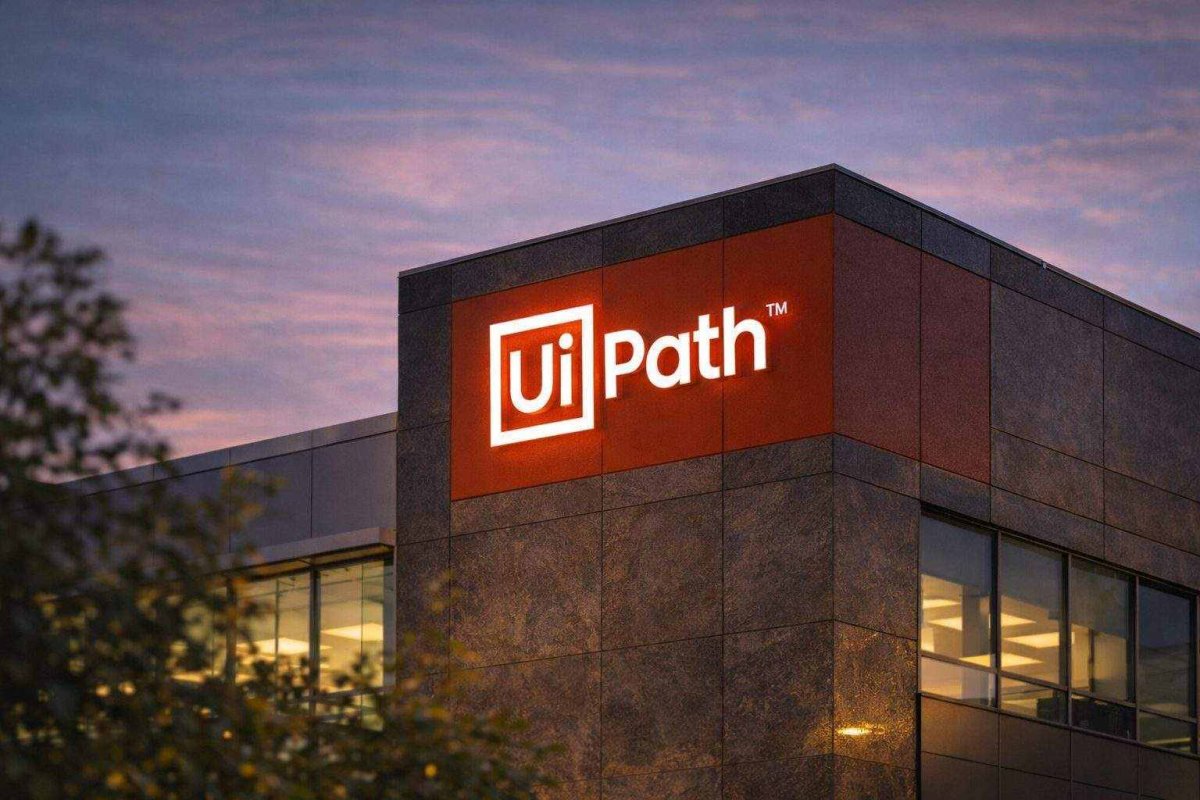
Shares of automation software leader UiPath experienced a sharp decline in late trading on Tuesday, March 24, 2026, falling approximately 8.7% to $11.07. The selloff placed the company among the hardest-hit names in a broader technology sector downturn, as investors renewed concerns that emerging artificial intelligence agents could threaten established business software providers. The stock touched an intraday low of $10.93 during the session.
Strong Fundamentals Overshadowed by Growth Concerns
The downturn arrived despite UiPath reporting several positive financial milestones. The company recently achieved its first full year of GAAP profitability, announced a new $500 million share repurchase authorization, and delivered double-digit growth in its annualized recurring revenue (ARR), a key subscription metric. However, Tuesday's market action made it clear that these achievements were insufficient to alleviate investor anxieties about the company's competitive positioning in an AI-driven landscape.
UiPath's financial results, reported on March 11, showed fourth-quarter revenue of $481 million, a 14% year-over-year increase. Annualized recurring revenue reached $1.853 billion, climbing 11%. The company also generated $80 million in GAAP operating income and authorized the aforementioned $500 million for stock buybacks. CEO Daniel Dines emphasized the company's role, stating, "As enterprise AI adoption moves from experimentation to scaled deployment, customers increasingly need a platform that can execute complex processes with reliability, governance, and scale."
Forecast Fuels Investor Worries
The primary catalyst for the selloff appeared to be the company's forward-looking guidance. For fiscal year 2027, UiPath projected revenue between $1.754 billion and $1.759 billion, representing growth of roughly 9%. This marks a deceleration from the 13% growth to $1.611 billion the company anticipates for fiscal 2026. Investors focused intently on this slowing growth trajectory, questioning the company's ability to maintain momentum.
Broader Sector Selloff Intensifies
The selling pressure was not isolated to UiPath. A wave of negativity swept across the software sector. The iShares Expanded Tech-Software Sector ETF (IGV) dropped 4.2%. Other major software names posted steep declines: HubSpot (HUBS) tumbled 9.2%, Atlassian (TEAM) fell 8.4%, and Salesforce (CRM) slid 6.3%. The broader Nasdaq Composite ended the day down 0.84%, with rising oil prices and persistent high interest rates adding pressure to risk assets.
Mounting Pressure from AI Competition
Fears of AI disruption have been building for weeks. A report from Reuters on March 12 indicated that AI plug-ins from companies like Anthropic contributed to a nearly $1 trillion selloff in software stocks. James St. Aubin, Chief Investment Officer at Ocean Park Asset Management, highlighted the critical factor for software vendors, noting that "proprietary data is the deepest moat by far" as the market determines which companies possess durable competitive advantages.
The competitive landscape is heating up rapidly. On Tuesday, Oracle (ORCL) announced updates to its finance and procurement applications, designed to allow AI agents to handle a larger portion of routine user tasks. Earlier in March, Reuters reported that both Oracle and Salesforce have been assuring investors that their tightly integrated data and workflows provide them with significant staying power. Oracle's Steve Miranda downplayed the threat to some automation, telling Reuters, "Typing in an invoice isn't a particularly high-value skill."
UiPath's Strategic Dilemma
UiPath finds itself in a complex strategic position. The company promotes its "agentic automation" platform, built for collaboration between AI agents, bots, and humans within business workflows. However, a fundamental question looms over the market: will increasingly capable AI assistants simply bypass components of UiPath's technology stack altogether, rather than requiring an additional software layer to manage those tasks?
The underlying risk for UiPath is straightforward. If rising costs and high interest rates prompt corporate customers to reduce software spending, or if they opt for more comprehensive AI solutions from larger technology rivals, the company's revenue growth could remain at the high-single-digit level projected for the coming year.
Financially, UiPath is not under immediate pressure. The company ended January with a strong balance sheet, holding $1.69 billion in cash, cash equivalents, and marketable securities. At a share price of $11.07, its market capitalization stood near $8.4 billion. Yet, as Tuesday's trading demonstrated, neither its substantial cash reserves nor its share repurchase plans have been enough to quell the significant doubts currently weighing on the stock.