The United States is advancing its semiconductor strategy on two fronts: accelerating domestic chip supply chain investments while slowing the addition of Chinese firms to trade blacklists. This week's developments underscore Washington's focus on bolstering homegrown chip production and tightening export controls, even as geopolitical tensions persist.
SandboxAQ Secures 0 Million for AI-Driven Chip Materials
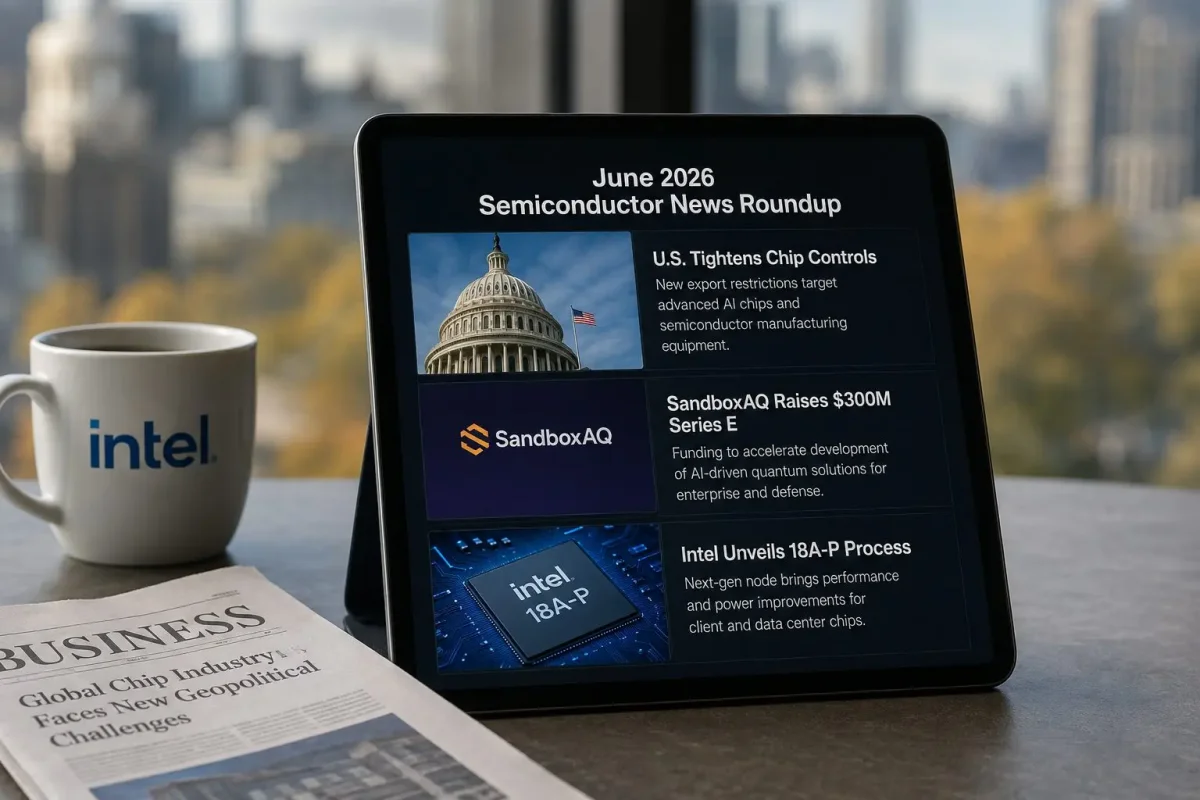
The U.S. Commerce Department's CHIPS Research & Development Office has finalized a $500 million award with SandboxAQ to develop AI-powered materials discovery for semiconductor manufacturing. The funding targets critical areas such as PFAS “forever chemicals,” catalysts, rare earth-free magnets, and backup-power battery chemistries. These materials are less visible than fabrication plants but essential to maintaining production continuity. In a novel move, the government will receive a minority, non-controlling equity stake in SandboxAQ and potential royalties if successful formulas are licensed to industrial partners. SandboxAQ, valued at $5.75 billion in April 2025 and backed by Nvidia, is exploring ways to replace or break down PFAS within fabs.
Intel 18A-P Enters Risk Production
Intel announced that its 18A-P process has entered risk production, an early manufacturing phase before full-scale output. The company claims the process delivers 9% higher performance at the same power level or reduces power consumption by 18% at equivalent performance. These metrics are aimed at customers comparing Intel against foundry leader TSMC. Intel Foundry chief Naga Chandrasekaran emphasized the company's commitment to leading-edge process innovation but acknowledged “more work ahead,” particularly in proving yields, customer demand, and economic viability.
Export Controls Stall as Chinese Firms Remain Unblacklisted
Despite being flagged as security risks, over 100 Chinese firms, including DeepSeek and memory chipmaker ChangXin Memory Technologies, have not been added to the Commerce Department's Entity List since October. This delay highlights a cautious approach amid broader trade policy considerations. Philip Luck of the Center for Strategic and International Studies described the list as “whack-a-mole,” while former Commerce official Kevin Kurland noted that trade policy is overshadowing national security tools. China's foreign ministry spokesperson Lin Jian urged the U.S. to stop politicizing economic and technology issues, as Chinese suppliers like Huawei argue they can work around U.S. limits.
AI Chip Competition Intensifies Below Nvidia's Tier
Startups continue to challenge Nvidia's dominance in data-center hardware. Tensordyne expects over $200 million in orders for its new AI inference system, which handles computing after model training. CEO Marc Bolitho reported “over a dozen” letters of intent and “over $200 million in forecasted demand.” The company's Napier chip, manufactured by TSMC and developed with Broadcom and HPE-owned Juniper Networks, targets inference workloads. This broadening competition underscores that the chip race now spans materials, export licenses, and specialized processors for AI services.
Market Implications and Outlook
This week's news does not resolve key uncertainties. SandboxAQ must convert models into factory-grade materials, Intel needs to demonstrate repeatable yields, and U.S. export policy risks leaving gaps if blacklists and AI-chip rules continue to lag behind events. With cash equities not yet open at the San Francisco dateline, the first market read is expected later Wednesday. However, the policy signal is clear: chips remain the nexus where industrial policy, China risk, and AI spending converge.