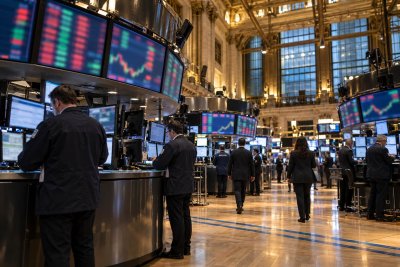
U.S. stock-index futures were trading moderately higher in early Friday action, offering a partial recovery from Thursday's sharp selloff, though investors remain cautious ahead of the release of the August inflation report. By 2:50 a.m. Eastern, delayed futures data showed the Dow Jones Industrial Average futures climbing 233 points, or 0.45%, to 52,328. The S&P 500 futures gained 32 points, or 0.42%, to 7,630.50, while the Nasdaq-100 futures rose 119.50 points, or 0.41%, to 29,254.75.
The overnight bounce was aided by a dip in energy prices, with West Texas Intermediate crude falling $1.40, or 1.37%, to $101.08 a barrel. However, oil remains above the $100 threshold, and the 10-year Treasury yield finished Thursday at 4.944%, up 10.7 basis points on the day. These two factors underscore the fragility of the current rally, as elevated yields and persistent inflation pressures continue to weigh on investor sentiment.
Thursday's Damage Not Yet Repaired
Thursday's cash session saw the Dow close down 316.60 points, or 0.60%, at 52,064.10, while the S&P 500 lost 44.66 points, or 0.58%, to 7,591.70. The Nasdaq Composite fell 171.62 points, or 0.65%, to 26,081.73. Friday's futures gains, therefore, appear more like a stabilization attempt than a decisive reversal of the recent downtrend.
The market's reaction to the latest producer price data has been mixed. The August Producer Price Index rose 0.4% month-over-month and 5.4% year-over-year, with goods prices surging 1.1% while services increased just 0.1%. This leaves investors grappling with an awkward combination: some relief from lower crude prices, but fresh evidence that energy and other input costs have already pushed wholesale inflation higher.
Yields: The Real Hurdle
For equity investors, the 4.944% reading on the 10-year Treasury is a more significant obstacle than the 233-point gain in Dow futures. A sustained move toward or through the 5% level would increase the discount rate applied to future corporate profits, particularly impacting expensive growth stocks. It also tightens financing conditions for housing, smaller companies, and leveraged balance sheets.
The upcoming consumer price index (CPI) report, scheduled for 8:30 a.m. Eastern, is the next major catalyst. July's CPI was unusually benign, with headline prices rising just 0.1% month-over-month and 3.4% year-over-year, while core CPI increased 0.2% on the month and 2.5% annually. Forecasts for August are tightly clustered on core inflation, but there is some divergence on the headline annual rate. A FactSet survey cited by the Associated Press puts headline CPI at 3.3% year-over-year, while other market previews center on 3.4%. Core CPI is expected to rise 0.2% for the month and 2.4% annually.
What the CPI Report Must Resolve
The critical question is whether August's energy shock remains concentrated in headline inflation or leaks into more persistent categories like services and goods. A core reading of 0.2% or lower, particularly with softer shelter and service components, would give the overnight rally firmer footing. The cleanest confirmation would be a falling 10-year yield alongside an S&P 500 advance; if yields rise while stocks rise, the move is more vulnerable to reversal.
A core increase of 0.3% would be a harder outcome, challenging the narrative that the wholesale-price surge is primarily an energy story. This could push the 10-year yield back toward 5%, with Nasdaq-100 futures having the most obvious duration exposure. Banks might see only limited benefit from higher long rates if the curve move also raises credit and funding risk.
A mixed report—hot headline inflation but a contained core reading—would make the oil tape unusually important. A continued crude retreat would argue that part of the inflation impulse could reverse; a quick rebound above Thursday's level would keep the next CPI report and consumer inflation expectations in focus.
Key Levels to Watch
Before the release, three cross-market tests matter more than the color of the futures screen: whether WTI holds below Thursday's $102.48 comparison level, whether the 10-year yield stays below 5%, and whether the S&P 500 can reclaim Thursday's 7,591.70 cash close after 8:30 a.m. A favorable CPI reaction that fails any two of those tests would be a weak signal.
The timing also calls for restraint. The futures quotes above are delayed and captured at 2:50 a.m. Eastern, compared with each feed's previous-close field. Liquidity and pricing can shift quickly before the CPI release and again when U.S. cash trading begins.
Investor Takeaway
The investor takeaway is clear: lower oil has bought the market breathing room, not immunity. Friday's 0.4% futures rebound becomes meaningful only if the CPI details pull bond yields lower. Until then, the overnight move is a position reset in front of a binary macro catalyst.