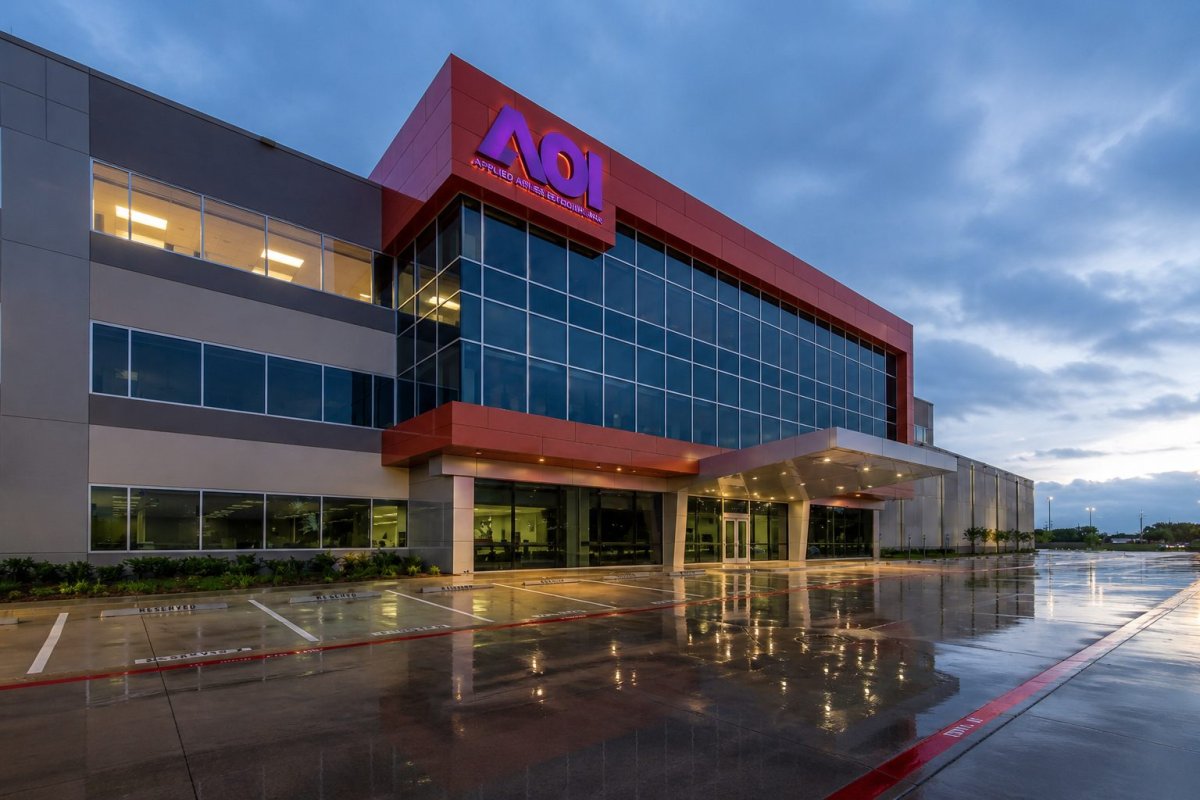
Applied Optoelectronics (AAOI) faced a sharp decline in after-hours trading on Thursday, with shares falling more than 10% after the optical-networking company reported first-quarter revenue and issued second-quarter guidance that both fell short of analyst expectations. The results tempered some of the enthusiasm surrounding the company as a key player in the AI infrastructure boom, though revenue still climbed 51% year-over-year to $151.1 million.
The company, which specializes in high-speed optical links critical for AI data centers, reported that it completed its first major volume shipment of 800G optical transceivers to a hyperscale customer during the quarter. These transceivers are designed to transmit data at 800 gigabits per second over fiber connections, a key technology for scaling AI workloads. Despite this milestone, investors focused on the miss: AAOI posted an adjusted loss of $0.07 per share, two cents worse than the consensus estimate, and revenue lagged the $156.98 million forecast. Second-quarter revenue guidance of $180 million to $198 million also came in below the $192.6 million midpoint of analyst expectations, while adjusted EPS guidance ranged from a loss of $0.03 to a gain of $0.03, versus the $0.07 profit analysts had anticipated.
On a GAAP basis, the company reported a net loss of $14.3 million, or $0.19 per share, widening from a loss of $9.2 million, or $0.18 per share, in the same period last year. Gross margin slipped to 29.1%, down from 30.6% a year ago and 31.2% in the fourth quarter of 2025. The margin compression added to concerns about profitability as the company scales production.
CEO Thompson Lin characterized the results as “in line with our expectations,” highlighting strength in both data-center and CATV (cable television) product lines. He noted that the volume ramp for 800G products is expected to begin in the second quarter, with sequential revenue growth anticipated throughout the year, and more significant gains from the third quarter onward as additional manufacturing capacity comes online.
Data-center revenue more than doubled to $81.4 million from $32.0 million a year ago, making it the company’s largest segment. CATV revenue edged up to $66.8 million from $64.5 million, while telecom and other lines remained minor contributors. CFO Stefan Murry highlighted that AOI delivered its “fourth consecutive quarter of record revenue,” ending the quarter with nearly 100,000 800G transceiver units of monthly capacity across its U.S. and Taiwan facilities. The company also nearly doubled its Houston-area footprint through new purchases and leases.
Analyst expectations had been elevated heading into the report. Needham’s Ryan Koontz previously described AAOI as a “direct beneficiary of soaring optical transceiver demand,” while Raymond James’ Simon Leopold called the company’s mid-2027 monthly revenue target “very optimistic.” The stock’s after-hours slide signals that even record revenue may not satisfy Wall Street’s appetite for growth and margin improvement.
AAOI competes with Coherent, Lumentum, and Ciena in the optical networking space, each exposed to the cyclical nature of data-center capital spending. In late trading Thursday, shares of both Coherent and Lumentum also slipped, reflecting broader sector caution. The company’s SEC filing flagged risks including potential order reductions, shipment delays, supply chain disruptions, customer concentration, pricing pressure, tariffs, and currency fluctuations. Second-quarter non-GAAP gross margin is projected at 29% to 30%, leaving little room for error if the 800G rollout encounters delays.
The earnings call is scheduled for Thursday afternoon, where investors will seek clarity on the pace of capacity expansion in Texas and Taiwan amid surging AI-driven demand. For now, the market has delivered a clear verdict: record revenue alone is no longer enough.