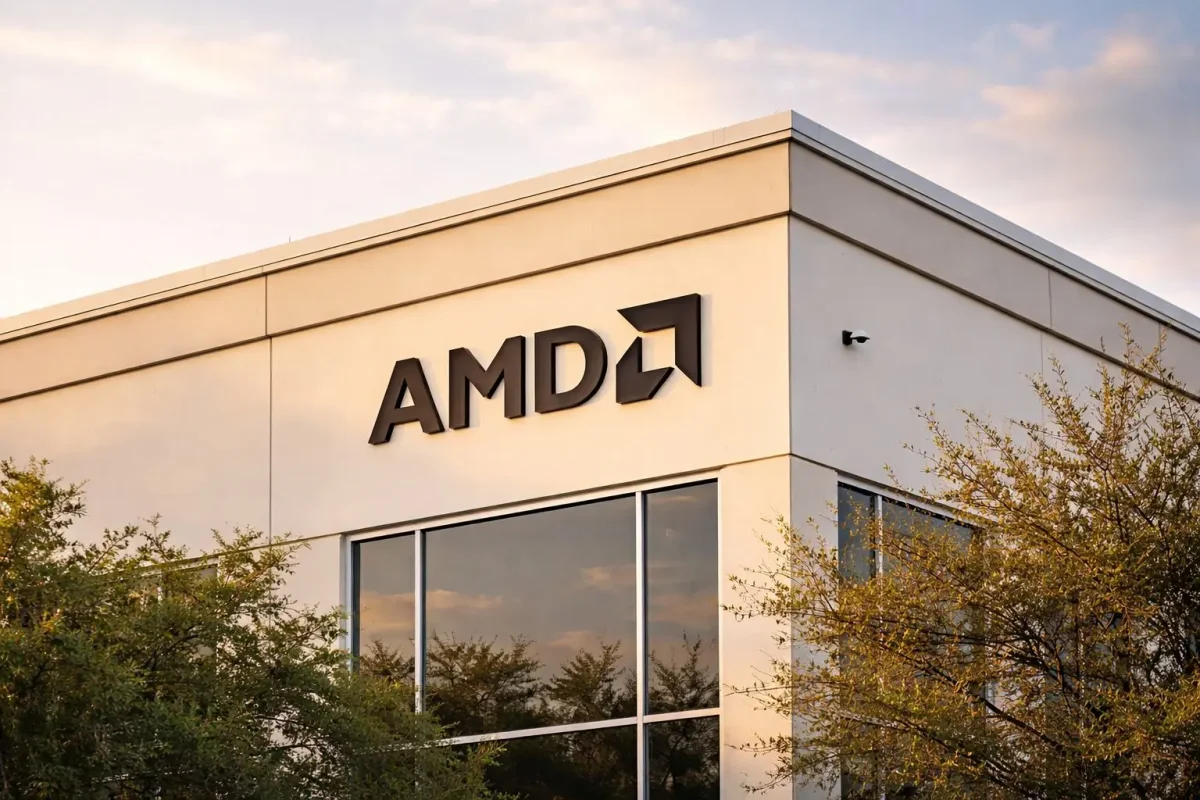
Advanced Micro Devices (AMD) has secured the necessary advanced packaging capacity to meet its ambitious timeline for scaling up artificial intelligence chip production, according to CEO Lisa Su. Speaking on Tuesday, Su indicated that the company's supply of CoWoS (Chip-on-Wafer-on-Substrate) technology will be sufficient to enable volume shipments of rack-scale AI systems starting in the second half of 2026. This timeline aligns with the expected production ramp for AMD's next-generation MI450 accelerators. CoWoS is a critical packaging technology that connects processors to high-bandwidth memory, a key bottleneck in manufacturing advanced AI semiconductors.
Investors responded positively to the supply chain assurance, with AMD shares rising 3.1% to $196.91 during morning trading. The announcement comes as the semiconductor industry grapples with constraints shifting from front-end fabrication to back-end packaging and testing. Taiwan's ASE Technology Holding, the world's largest chip packaging and testing firm, forecast last month that its advanced packaging segment would reach $3.2 billion in 2026, doubling from current levels, highlighting the strategic importance and growth of this sector.
Despite progress on the supply side, AMD faces the significant challenge of converting booming demand for AI hardware into consistent financial performance. The company's stock fell 13% on February 4 after it provided quarterly sales guidance that fell short of market expectations. This disappointment fueled existing investor skepticism about AMD's ability to compete effectively against Nvidia, the established leader in the AI chip market, which commands a dominant market share.
The stakes for AMD's AI ambitions have been raised substantially through recent landmark supply agreements. According to reports, the chipmaker signed a deal potentially worth up to $60 billion to supply AI chips to Meta Platforms over a five-year period. This agreement notably includes an option for Meta to acquire up to 10% of AMD's stock. Analysts interpreted the move as Meta seeking to lock in supply and diversify its vendor base away from a single source. "Meta is locking in supply, diversifying away from a single vendor," commented Matt Britzman, a senior equity analyst at Hargreaves Lansdown, at the time of the deal.
In a similar strategic move last October, AMD secured a supply agreement with OpenAI. This pact also included a warrant granting OpenAI the option to purchase nearly 10% of AMD. Company executives hailed the deal as transformative for its data center business. "We view this deal as certainly transformative," AMD executive vice president Forrest Norrod told Reuters following the announcement.
AMD's strategy extends beyond data center servers into the personal computing market. The company is aggressively promoting its "AI PC" initiative, now bringing neural processing units (NPUs) to its mainstream desktop processor lineup. At the recent Mobile World Congress, AMD unveiled its Ryzen AI 400 series desktop processors, which boast NPU performance of up to 50 TOPS (trillion operations per second). Systems from PC manufacturers featuring these new chips are scheduled to launch starting in the second quarter. "The desktop PC is evolving from a tool you use to an intelligent assistant that works alongside you," said Jack Huynh, AMD's senior vice president.
The company is targeting both consumer and business segments with this push. Professional models are designed for corporate desktop users, offering standard NPU capabilities alongside enhanced management and security features that work across both desktops and laptops. Citing research from IDC, AMD has identified 2026 as a potential inflection point for AI PCs achieving mainstream adoption.
Competition in the AI-integrated processor space is intensifying rapidly, blurring the lines between traditional CPUs and AI-accelerated computing. Last month, Nvidia CEO Jensen Huang emphasized his company's broad focus, telling analysts, "We love CPUs as well as GPUs." He argued that AI "agents"—software designed for tasks like document sorting or code generation—could ultimately shift more computational workloads back onto central processors, a domain long dominated by Intel and AMD.
However, the success of AMD's desktop AI foray is not guaranteed. Initial reactions to the Ryzen AI 400 series have been mixed, according to industry observers. Some potential customers have expressed skepticism about trading stronger integrated graphics performance for a more powerful NPU. Others have pointed out that the ultimate adoption will hinge on AMD's pricing strategy for the new chips and whether the AI features deliver tangible, worthwhile benefits for everyday users.