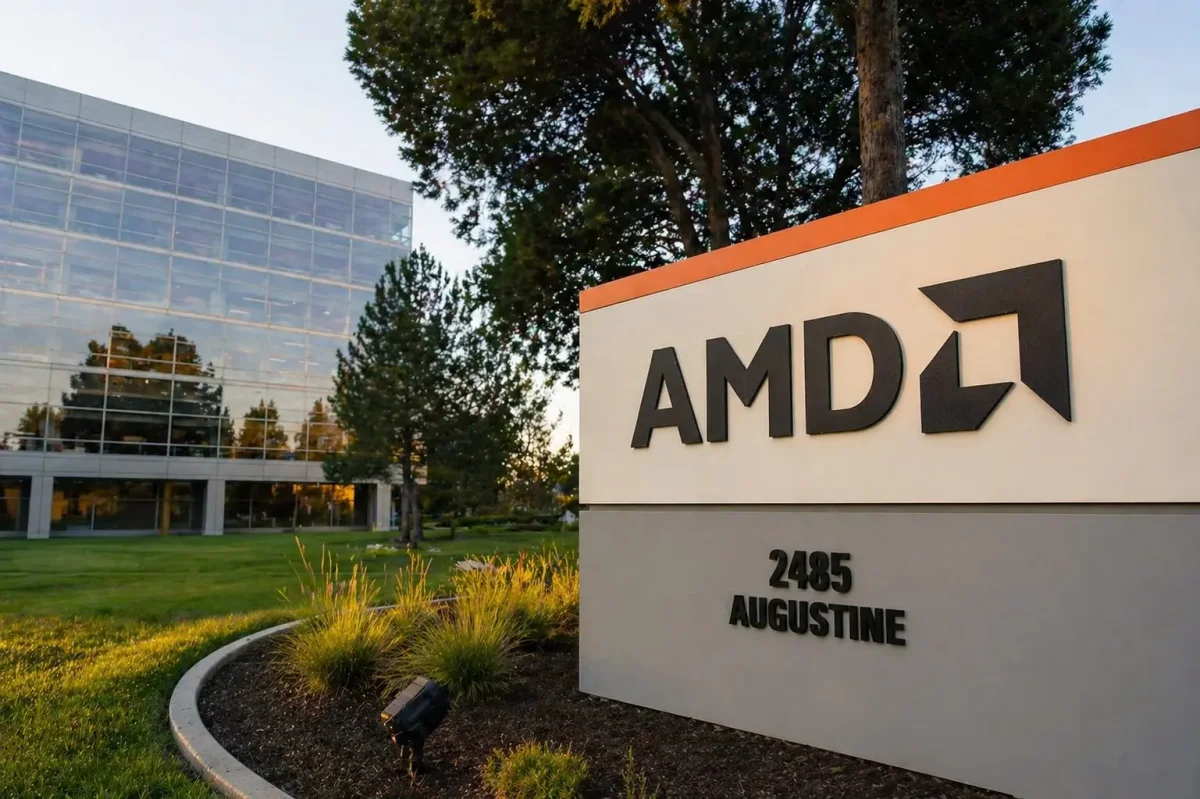
Advanced Micro Devices (AMD) saw its stock decline by approximately 3.8% on Monday, closing at $334.49, as a Wall Street downgrade cast doubt on the sustainability of the company's recent rally. The drop came despite gains from rivals Nvidia and Intel, highlighting a divergence within the semiconductor sector.
Northland Capital Markets downgraded AMD to Market Perform from Outperform, setting a price target of $260. The firm acknowledged AMD as a strong company but expressed concerns that consensus estimates for calendar year 2027 are overly optimistic. Increased competition in the AI chip market was also cited as a headwind for gross margin growth.
Trading volume for AMD exceeded 50 million shares, well above average. The stock reached an intraday high of $354.88 before falling to a low of $329.03. The downgrade comes as investors scrutinize whether the recent surge in AMD's share price is justified ahead of its upcoming earnings report.
In contrast, Nvidia (NVDA) rose 4.0% to $216.66, while Intel (INTC) gained 3.0% to close at $85.00. The mixed performance suggests rotation within the AI hardware trade rather than a broad pullback, as investors reassess which companies are best positioned to capitalize on growing demand for AI accelerators and server CPUs.
AMD's next major catalyst is its fiscal first-quarter earnings report, scheduled for release after the market closes on Tuesday, May 5. Management will hold a conference call at 5 p.m. ET. The company enters the report with strong momentum, having posted fourth-quarter revenue of $10.27 billion—a 34% year-over-year increase—and record data-center sales of $5.4 billion, up 39%.
CEO Lisa Su highlighted growth across EPYC, Ryzen, and data-center AI products as key drivers heading into 2026. However, the upcoming earnings will test whether AMD can deliver results that justify its valuation, particularly in the face of intensifying competition from Nvidia in graphics processors and Intel in server CPUs.
Bulls worry that even a solid quarter may not suffice unless guidance indicates sustained margin expansion from AI accelerators and server CPUs. Bears, on the other hand, fear that if AMD reports stronger pricing or a surprise uptick in data-center demand, Monday's decline could prove to be a temporary profit-taking opportunity rather than a shift in narrative.
Last week, DA Davidson analyst Gil Luria upgraded AMD to Buy from Neutral and raised the price target sharply to $375 from $220, arguing that the company could significantly raise prices if server CPU supply remains tight. This upgrade contrasted with the broader market's cautious stance.
Intel's recent quarterly results added further context to the sector dynamics. The company reported first-quarter revenue of $13.6 billion, a 7% increase from the prior year, with CFO David Zinsner citing unprecedented demand for silicon as CPUs play a larger role in AI systems.
As the AI chip race intensifies, AMD's ability to maintain its growth trajectory amid competitive pressures will be closely watched. The stock's recent volatility underscores the high stakes as investors weigh near-term execution against long-term potential.