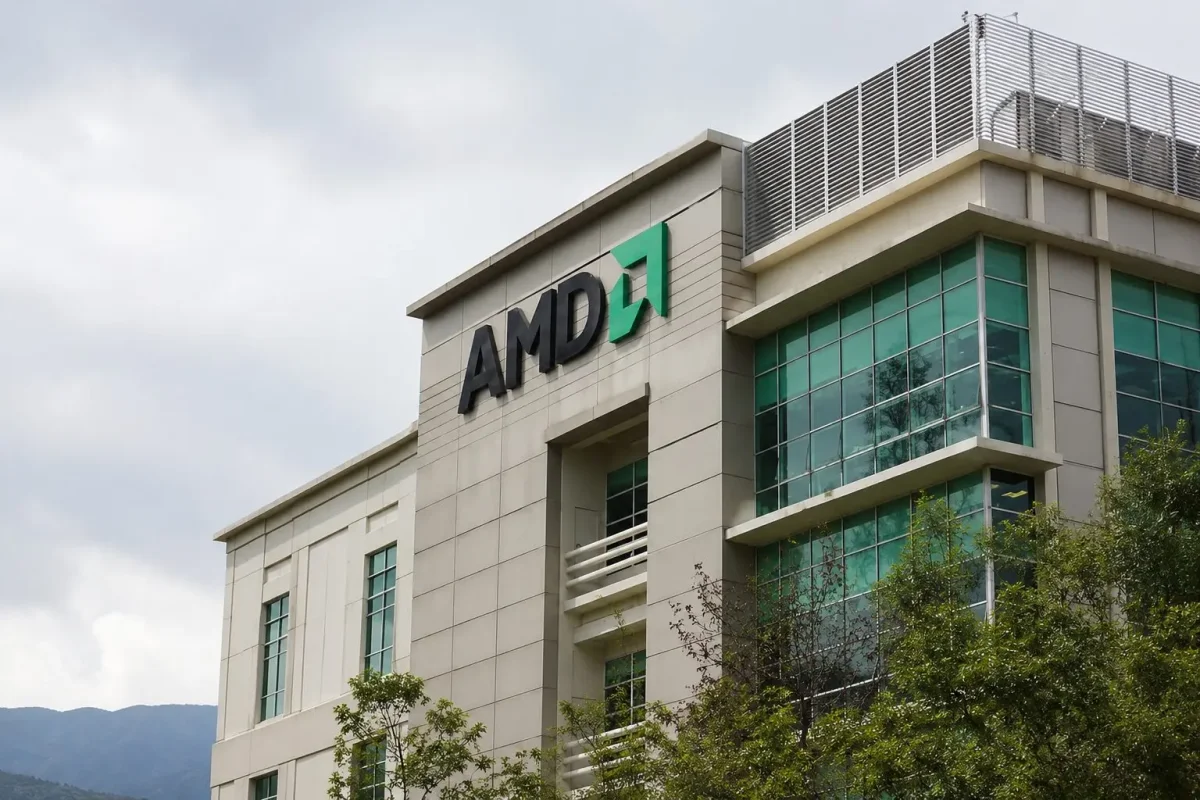
Advanced Micro Devices (AMD) saw its shares climb more than 5% during midday trading on Thursday, outperforming rivals Nvidia and Intel as investors rotated back into semiconductor names following a brief pause in the artificial intelligence rally. The stock reached $520.93, up 5.1%, with an intraday high of $526.90. In comparison, Nvidia edged up 0.5% while Intel slipped 0.4%. The broader iShares Semiconductor ETF (SOXX) gained 1.9%, and the Nasdaq-100 tracker QQQ rose 0.9%.
The move underscores a shift in AMD's narrative from a mere Nvidia catch-up trade to a broader bet on AI infrastructure. Investors are now closely watching whether demand for AI inference—running trained models to produce answers rather than training them from scratch—can boost both AMD's graphics processors and its central processing units (CPUs), the general-purpose chips that power servers.
This week provided a fresh test for that thesis. Wall Street had taken a step back on Wednesday after the Philadelphia Semiconductor Index fell 1.4% from a record high, with chip stocks pulling back following a strong run. Sean Clark, chief investment officer of Clark Capital Management Group, described it as "a little bit of a pause," while Adam Turnquist at LPL Financial cautioned that stretched momentum raised questions about the near-term durability of the advance.
AMD has plenty to defend. Earlier this month, the company reported first-quarter revenue of $10.3 billion and highlighted that its data-center unit had become the primary engine of growth. CEO Lisa Su stated that "Data Center" is now "the primary driver" of revenue and earnings growth, citing stronger demand for CPUs and accelerators used in AI systems.
The latest leg higher is also tied to capacity. On May 21, AMD announced it would invest more than $10 billion across Taiwan's chip ecosystem, including advanced packaging—a process that links multiple chip components closely so they function as a larger, faster system. The company confirmed that its Helios rack-scale AI platform, which uses Venice CPUs and MI450X GPUs, remains on track for deployments starting in the second half of 2026.
Speaking to Reuters in Taipei last week, Su noted that "the CPU market is tight" and said supply should increase every quarter this year, with more capacity planned for 2027 and beyond. She also revealed that AMD is co-investing with Taiwan partners to secure manufacturing and packaging capacity through 2029.
The pressure isn't just about getting more chips out the door. TSMC executive Kevin Zhang said on Thursday that surging electricity demand from AI has made energy efficiency the main constraint in future chip design. TSMC manufactures chips for both AMD and Nvidia, and Zhang noted that customers across phones, edge devices, and AI data centers are pushing for performance gains without adding more power consumption.
That gives AMD a clearer pitch, but it doesn't eliminate competition. Following AMD's May earnings, analysts and investors view the company as a leading challenger to Nvidia in AI chips, while Intel's production push could pressure AMD in CPUs. Jake Behan, head of capital markets at Direxion, said AMD is levered to "insatiable AI compute demand," but investors will focus on how effectively it converts that demand into higher-margin revenue. Michael O'Rourke, chief market strategist at JonesTrading, put it bluntly: "Success invites competition." Matt Britzman at Hargreaves Lansdown noted that AMD's story is increasingly about a "broader compute opportunity," with both CPUs and GPUs playing roles as AI workloads grow heavier.
Macro risks remain in the background. U.S. first-quarter growth was revised down to a 1.6% annualized pace on Thursday, while the personal consumption expenditures price index—a key Federal Reserve inflation gauge—rose 3.8% over the 12 months through April. Peter Cardillo, chief market economist at Spartan Capital Securities, said the numbers suggest "a stagflation problem," a mix of weaker growth and sticky inflation that can hurt richly valued growth stocks.
But the trade is not without risks. If big cloud customers slow AI spending, if power and cooling costs delay data-center builds, or if Nvidia and Intel defend more of the CPU and accelerator market than expected, AMD's rally could lose steam quickly. The stock is being priced for supply to expand and demand to stay hot—both have to happen.