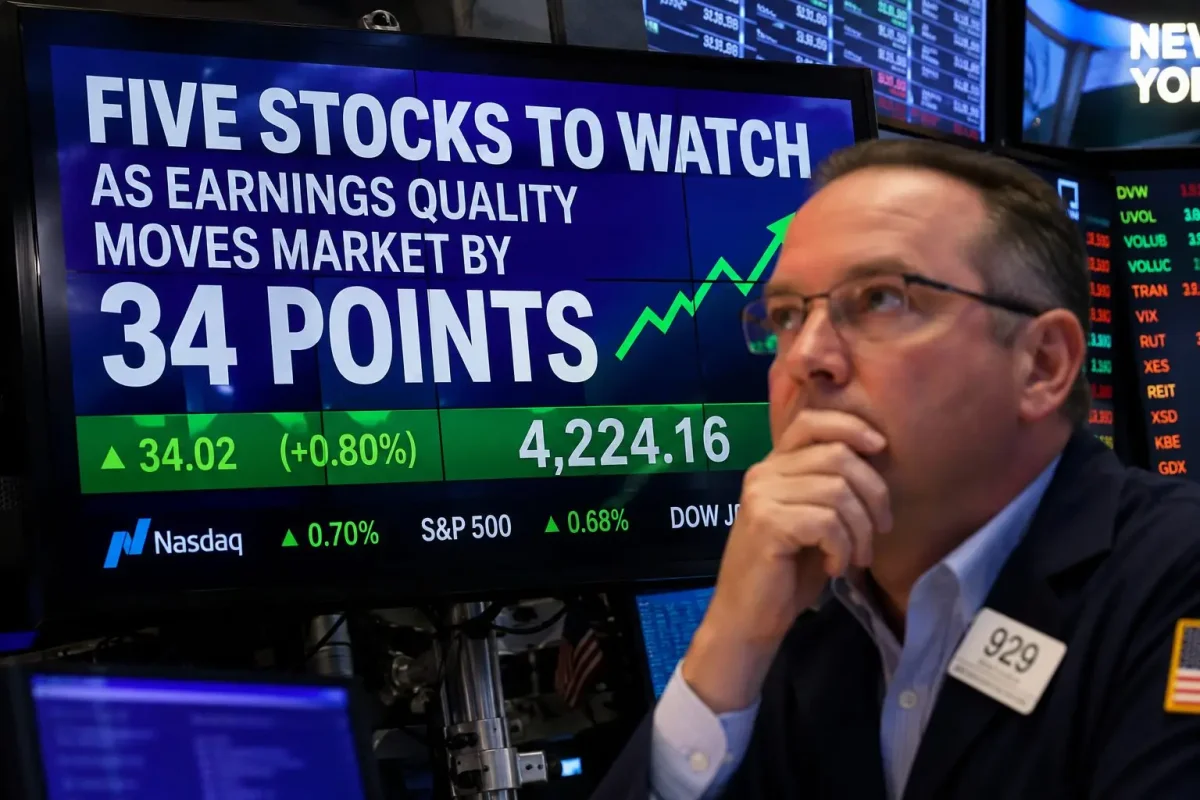
NEW YORK, July 14, 2026 – The start of big-cap earnings season has created a sharp divergence among leading stocks, with a 34.2-point gap separating the best and worst performers. Investors are increasingly prioritizing sustainable revenue streams over headline earnings beats, leading to varied market reactions for major financial and technology firms.
U.S. cash markets closed higher after June consumer prices fell 0.4% month-over-month on a seasonally adjusted basis. However, the broader market gains were overshadowed by company-level moves, underscoring that weak inflation alone cannot offset shaky guidance for the coming quarters.
Detailed Performance Breakdown
The following stocks are on the watchlist for Wednesday, based on Tuesday's closing price swings:
- International Business Machines Corp (IBM): Preliminary adjusted EPS of $2.93 missed the LSEG consensus of $3.02, a -3.0% surprise. Shares dropped 25.2%. The company reported preliminary revenue of $17.2 billion, up 1%, with software revenue rising 5% but infrastructure falling 7%. CEO Arvind Krishna noted a late-June customer shift toward servers, storage, and memory that "was not anticipated." Investors viewed the selloff as a budget allocation issue rather than a minor forecast miss.
- Goldman Sachs Group Inc (GS): Reported EPS of $20.98, a 44.9% beat over the $14.48 consensus. Shares gained 9.0%. Equities revenue surged 72% to a record $7.42 billion, and investment-banking fees rose 55% to $3.40 billion. CEO David Solomon cited "momentum has accelerated throughout our businesses." The key question is whether record trading revenue can be sustained.
- Citigroup Inc (C): EPS of $3.15 beat the $2.74 consensus by 15.0%, but shares fell 5.3%. Quarterly revenue hit $24.8 billion, the best in a decade, and preliminary return on tangible common equity was 13%. However, the bank maintained its 2026 target of 10%-11% and hinted at potentially accelerating investments. Analysts questioned whether this signals a softer second half.
- Wells Fargo & Co (WFC): EPS of $2.00 beat the $1.72 consensus by 16.3%, yet shares declined 2.7%. Average loans grew 12% and investment-banking fees jumped 35%. CEO Charlie Scharf highlighted "broad-based revenue growth." However, net interest margin narrowed to 2.43% from 2.47% in Q1, and the full-year outlook remained unchanged, raising concerns about lending margin pressure.
- JPMorgan Chase & Co (JPM): Adjusted EPS of $6.14 beat the $5.85 consensus by 5.0%, and shares rose 2.5%. The bank raised its 2026 net interest income forecast (ex-markets) to $96.5 billion from $95 billion but increased expense guidance to $107.5 billion from $105 billion. Markets revenue climbed 35% and investment-banking fees jumped 30%. CEO Jamie Dimon warned that "several risks are shifting below the surface like tectonic plates."
Market Context and Implications
The dispersion among these stocks highlights a market that is rewarding clarity and repeatable earnings while punishing uncertainty. IBM's preliminary numbers, not final until July 22, left investors cautious. Meanwhile, Goldman's strong quarter raises the bar for future performance, and the bank's ability to maintain elevated trading revenue remains in question.
For Citigroup and Wells Fargo, the earnings beats were overshadowed by concerns about cost control and margin pressure. JPMorgan's modest beat was enough to attract buyers, thanks to upgraded net interest income guidance, though higher expenses tempered enthusiasm.
Looking ahead, Wednesday will be critical for IBM as it may see follow-through selling or a rebound in software names. Citigroup and Wells Fargo could test for stabilization, while Goldman and JPMorgan will be watched to see if buyers extend gains. Bank of America (BAC), which rose 1.9% after a 7.1% earnings surprise and guidance for upper-end net interest income growth of 6%-8%, serves as a benchmark for clear communication.
The trade could reverse quickly: quieter markets might hit trading revenue, pipelines could slip, and bank margins face pressure from funding costs. The same dispersion that put these names on the watchlist is also the key risk. Investors are advised to monitor these stocks closely as earnings season progresses.