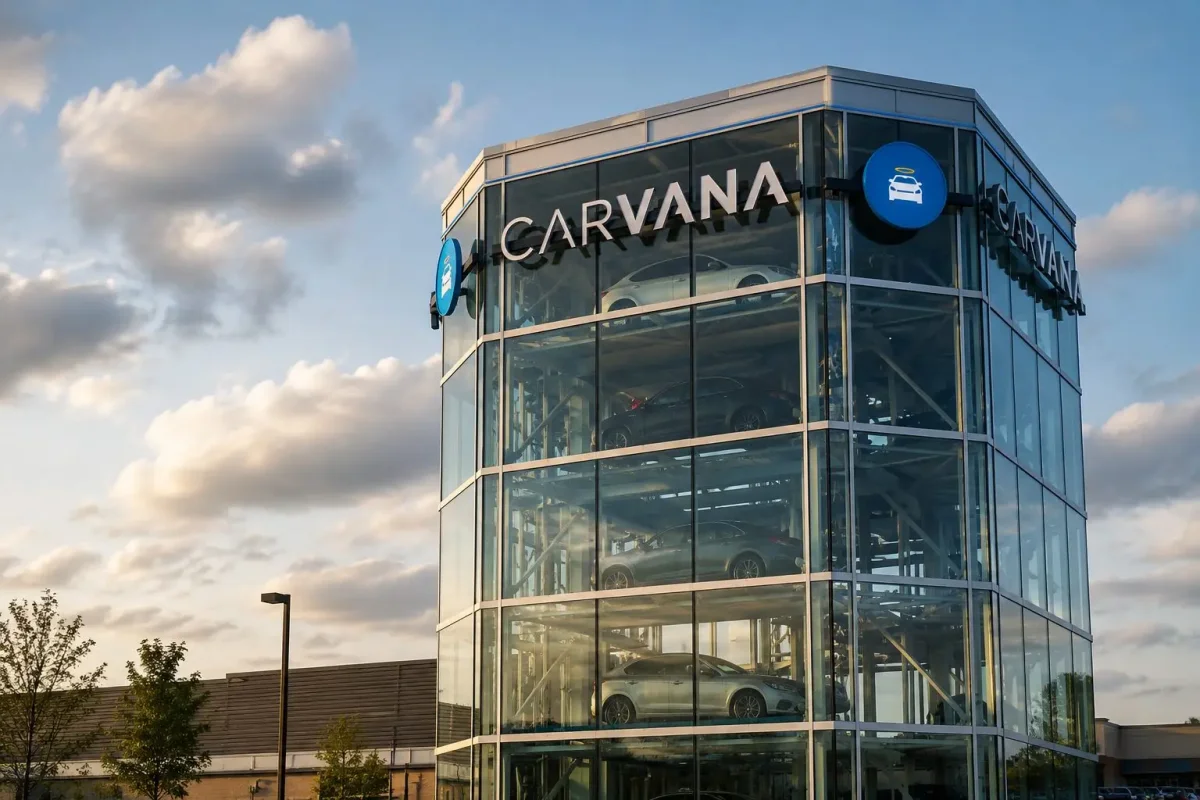
Shares of Carvana Co. (NYSE: CVNA) surged 8.29% to close at $70.38 on Tuesday, outperforming the broader market after a weaker-than-expected inflation report drove Treasury yields lower. The S&P 500 edged up just 0.38%, underscoring Carvana's outsized sensitivity to interest rate movements.
The catalyst was the June Consumer Price Index, which fell 0.4% month-over-month, a sharper decline than the 0.1% drop economists had anticipated. Core inflation remained flat, while the index for used cars and trucks slipped 0.2%. In response, the two-year Treasury yield fell seven basis points to 4.189%, and the 10-year note eased four basis points to 4.571%. “The inflation report seems to have weakened the argument that the Fed is going to raise rates,” noted Chuck Carlson of Horizon Investment Services.
Financing Takes Center Stage
Investor attention is increasingly fixed on Carvana's financing segment, which has become a critical growth driver. In the first quarter, the company originated $4.254 billion in finance receivables, a 59.9% increase from $2.660 billion a year earlier. Retail unit sales grew 40% to 187,393, while originations per retail unit climbed 14.3% to $22,701 from $19,866. These figures highlight Carvana's deepening reliance on in-house lending to fuel expansion.
However, the reported gain on loan sales rose 29.7% to $354 million, a slower pace than the growth in originations and vehicle sales. On a per-vehicle basis, the loan-sale gain slipped 7.3% to $1,889 from $2,039, signaling potential pressure on unit economics. The market appears to be betting that lower rates will alleviate this pressure before Carvana reports its next quarterly results.
Outperformance Versus Peers
Carvana's rally far exceeded that of other auto retailers. CarMax (NYSE: KMX) rose 1.41%, and AutoNation (NYSE: AN) gained 1.56%, both beating the S&P 500 but lagging Carvana by roughly 6.9 and 6.7 percentage points, respectively. This divergence underscores Carvana's heightened sensitivity to rate expectations, growth bets, and investor positioning rather than a broad revaluation of the used-car sector.
Notably, the rally occurred without any fresh operational update from the company. Jefferies Financial Group (NYSE: JEF) trimmed its price target on Carvana to $90 from $95, while maintaining a Buy rating. The new target still implies about 28% upside from Tuesday's close.
Mixed Margins and Market Context
Despite strong top-line growth, Carvana's first-quarter results revealed a more nuanced margin picture. Revenue jumped 52% to $6.432 billion, and adjusted EBITDA reached $672 million. However, gross profit per retail unit slipped 2.2% to $6,783, and the adjusted EBITDA margin contracted to 10.4% from 11.5% a year earlier. CEO Ernie Garcia III and CFO Mark Jenkins have touted Carvana as “the fastest growing and most profitable automotive retailer” for nine consecutive quarters, but the latest figures suggest some margin compression.
The used-car market remains challenging. Cox Automotive reported that wholesale used-vehicle values edged up 0.1% in June and are 2.1% higher year-over-year, but they remain about 1% below the March peak. Government data show the consumer price index for used cars fell 0.2% in June. While steady wholesale prices may support inventory values, softer retail inflation limits rapid gains, making vehicle sales a complex environment.
Risks and Outlook
The rate relief may prove temporary. Oil and gas prices have rebounded since June, and traders still price in about 60% odds of a Federal Reserve rate hike in September following the CPI data. Carvana carried $5.0 billion in principal debt as of March 31 and had $461 million available through its at-the-market equity program. Investors continue to monitor credit spreads, borrower trends, reconditioning costs, and potential dilution. Lower rates do not erase the debt burden.
Carvana is scheduled to report second-quarter results after the bell on July 29. Management has guided for back-to-back records in retail units and adjusted EBITDA, assuming market conditions remain stable. As the market digests Tuesday's optimism, attention will zero in on three key metrics: loan originations, loan-sale gains, and whether gross profit per unit rebounds as sales volumes climb. The market is looking for solid numbers to validate the rally.