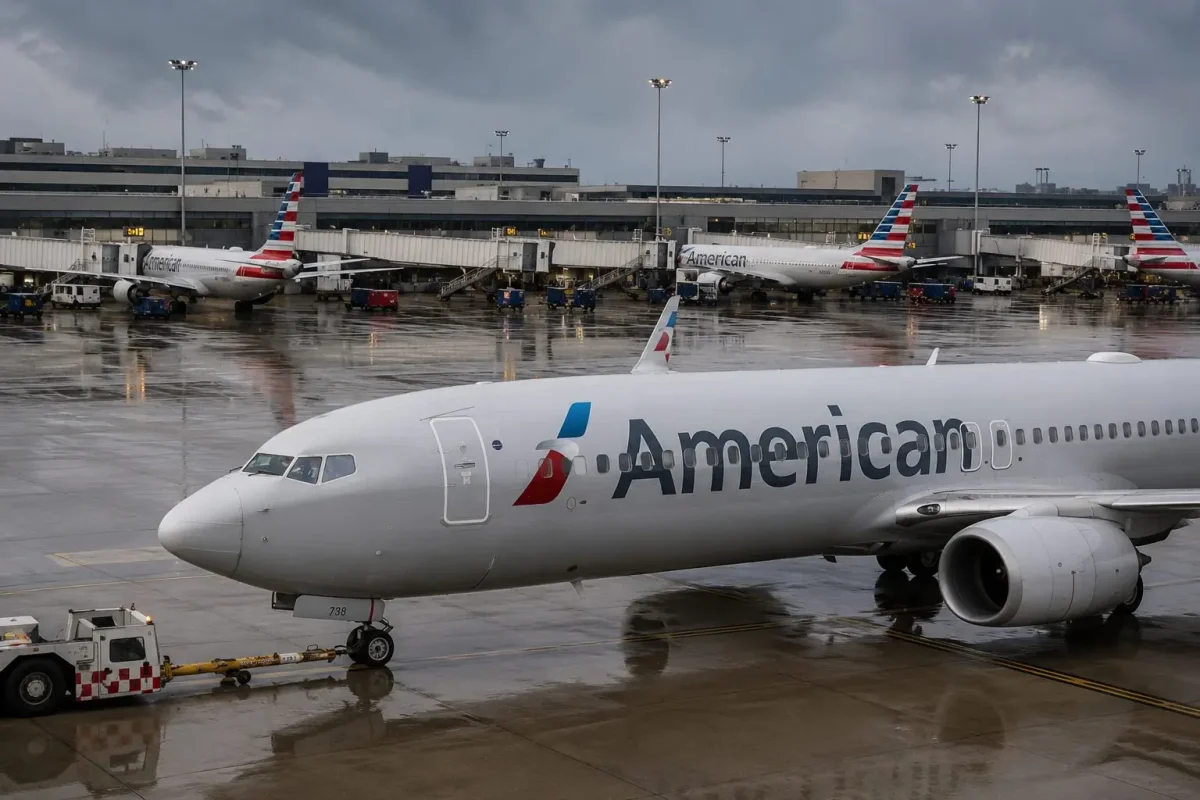
American Airlines Group Inc. (NASDAQ:AAL) shares dipped 0.9% to $16.92 on Friday afternoon, as the carrier's profit outlook tightens amid elevated jet fuel costs and a narrower revenue mix compared to peers. The stock's decline came as investors parsed the implications of Delta Air Lines' quarterly report, which provided an early benchmark for the industry's financial health.
American Airlines is set to release its second-quarter results on July 23, with a conference call scheduled for 7:30 a.m. CT. Delta's report, due 13 days earlier, will offer investors an early read on key metrics such as revenue per available seat mile (unit revenue), fuel costs, and non-fuel expenses. American's April guidance assumed fuel at roughly $4.00 per gallon, a level that now appears prescient after Delta reported adjusted fuel costs of $3.93 per gallon—just below that threshold. However, Delta CEO Ed Bastian noted that the quarter represented the airline's highest fuel expense in its history.
The comparison between the two carriers extends beyond fuel. Delta's revenue streams from non-ticket sources, including premium seating and loyalty programs, accounted for 61% of total sales. Premium revenue surged 17% year-over-year, while loyalty revenue climbed 19%. This diversified model has helped Delta offset cost pressures and deliver stronger profitability. In contrast, American's revenue remains more heavily weighted toward basic seat sales, leaving it more exposed to fuel price swings and competitive fare pressures.
American's guidance for the second quarter projects total revenue growth of 13.5% to 16.5%, with capacity (available seat miles) expanding 4% to 6%. At the midpoint, this implies unit revenue growth of approximately 9.5%—nearly three percentage points below Delta's reported 12.4% adjusted unit revenue growth. The gap in unit revenue could weigh more heavily on earnings than the seven-cent difference in fuel costs between the two airlines.
On the cost side, American expects non-fuel unit costs, excluding fuel and special items, to rise 2% to 4%. Combined with the fuel outlook, this suggests that American will need to achieve unit revenue near the high end of its guidance—or find additional cost savings—to exceed its barely positive adjusted earnings per share forecast of a loss of $0.20 to a profit of $0.20. Delta, by contrast, reported adjusted EPS of $1.56.
Market reaction was mixed across the sector. American's 0.9% decline was milder than Delta's 1.2% drop and United Airlines' 1.3% loss, though all three carriers traded below their intraday highs. TD Cowen analyst Tom Fitzgerald characterized Delta's selloff as a buying opportunity, citing strengths in corporate travel, cargo, loyalty programs, and maintenance operations. For American, the challenge is to broaden its revenue mix beyond seat sales and develop higher-margin ancillary businesses.
American CEO Robert Isom stated in May that the company aims to repeat the profitability achieved last year. He pointed to second-quarter revenue growth near 15% with capacity up about 5%, implying roughly 10% unit revenue growth. However, American has consistently lagged Delta and United in profitability over the past several years.
The key question for American's July 23 report is whether top-line growth will translate into bottom-line gains. A 15% revenue increase driven by 5% more capacity tells a different story than Delta's 14% rise with only 1% capacity expansion. The outcome hinges on where fuel costs and non-fuel expenses ultimately land. Raymond James analyst Savanthi Syth noted that Delta's 2026 guidance used an older fuel forward curve, set before recent U.S.-Iran tensions pushed spot jet fuel to $3.10 per gallon. If travel demand softens after Labor Day or airlines add significant fourth-quarter capacity, fares could weaken, putting American's breakeven target at risk.
In a best-case scenario, American would achieve unit revenue near Delta's 12.4%, fuel at $4 per gallon, and non-fuel costs within guidance. However, if results come in closer to the 9.5% midpoint with higher expenses, the carrier will need stronger fare pricing for the rest of the year—a concern that weighed on airline stocks on Friday.