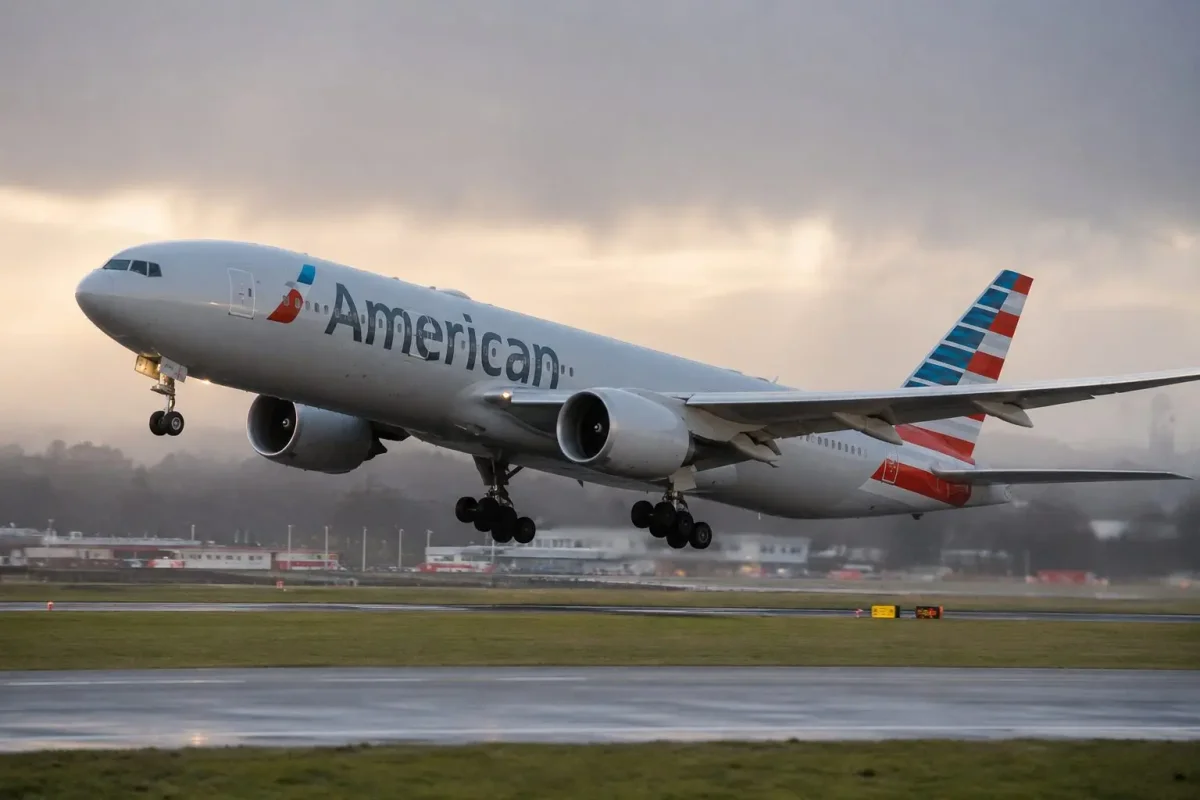
American Airlines Group Inc. (NASDAQ:AAL) edged lower in premarket trading Tuesday, with shares last seen at $17.75, down about 0.9%. The move diverged from the broader airline sector, as the U.S. Global Jets ETF (NYSEARCA:JETS) gained 0.4% in the same period.
The divergence highlights a key tension for investors ahead of the carrier's second-quarter earnings report scheduled for July 16. At current levels, American Airlines trades at roughly 57 times trailing earnings, a valuation that far exceeds those of larger network peers. Delta Air Lines (NYSE:DAL) trades at a trailing P/E of about 13.4, while United Airlines (NASDAQ:UAL) commands a multiple of 11.9. Southwest Airlines (NYSE:LUV) sits at 33.9 times earnings.
The elevated multiple reflects the market's focus on near-term earnings challenges. According to Barron's data, analysts project American's 2026 earnings per share at just $0.36, but the 2027 consensus jumps to $2.47. That forward-looking estimate drops the price-to-earnings ratio to roughly 7.2, a level that bulls argue makes the stock undervalued.
The fuel cost dynamic is central to this earnings trajectory. Jet fuel prices have fallen approximately 40% from their April peak, as reported by The Wall Street Journal. However, airlines may not pass these savings to consumers quickly, given still-elevated ticket prices. Jefferies analysts estimate that a 5% reduction in their $3 per gallon 2027 fuel cost assumption could boost American's forecast EPS by up to 50%, compared with a 10% to 15% impact for Delta, Southwest, and United.
American's own guidance for the second quarter reflects cautious optimism. The company expects adjusted EPS between a loss of $0.20 and a gain of $0.20, with revenue growth of 13.5% to 16.5%. Analysts currently forecast a break-even quarter on average, sitting near the midpoint of that range. For the full year, American's adjusted EPS guidance spans from a $0.40 loss to a $1.10 gain, a wide range that underscores the uncertainty around fuel costs and demand.
Debt remains a significant overhang. American ended the first quarter with $34.7 billion in total debt, nearly three times its equity market capitalization of $11.74 billion. This high leverage means that even modest swings in fuel prices, ticket prices, or demand can have outsized effects on the stock.
Dudley Shanley at Goodbody noted to Reuters that fare cuts will depend on consumer strength. American CEO Robert Isom expressed confidence in demand during the company's April earnings call, stating, "Demand for our product is growing." However, the company's outlook assumed fuel costs near $4.00 per gallon in the second quarter, with only partial offset from higher fares.
On Monday, airline stocks mostly declined even as the S&P 500 rose 0.72%. American fell 0.95%, while Delta and United lost 1.15% and 0.62%, respectively. Southwest bucked the trend with a 1.11% gain.
With the average analyst price target for American at $18.63, roughly 5% above the current price, the stock appears to be trading near fair value based on near-term estimates. However, if the company's second-quarter results come in at the top end of guidance or show improved fuel cost recapture, investors may begin to price in the more favorable 2027 earnings outlook.