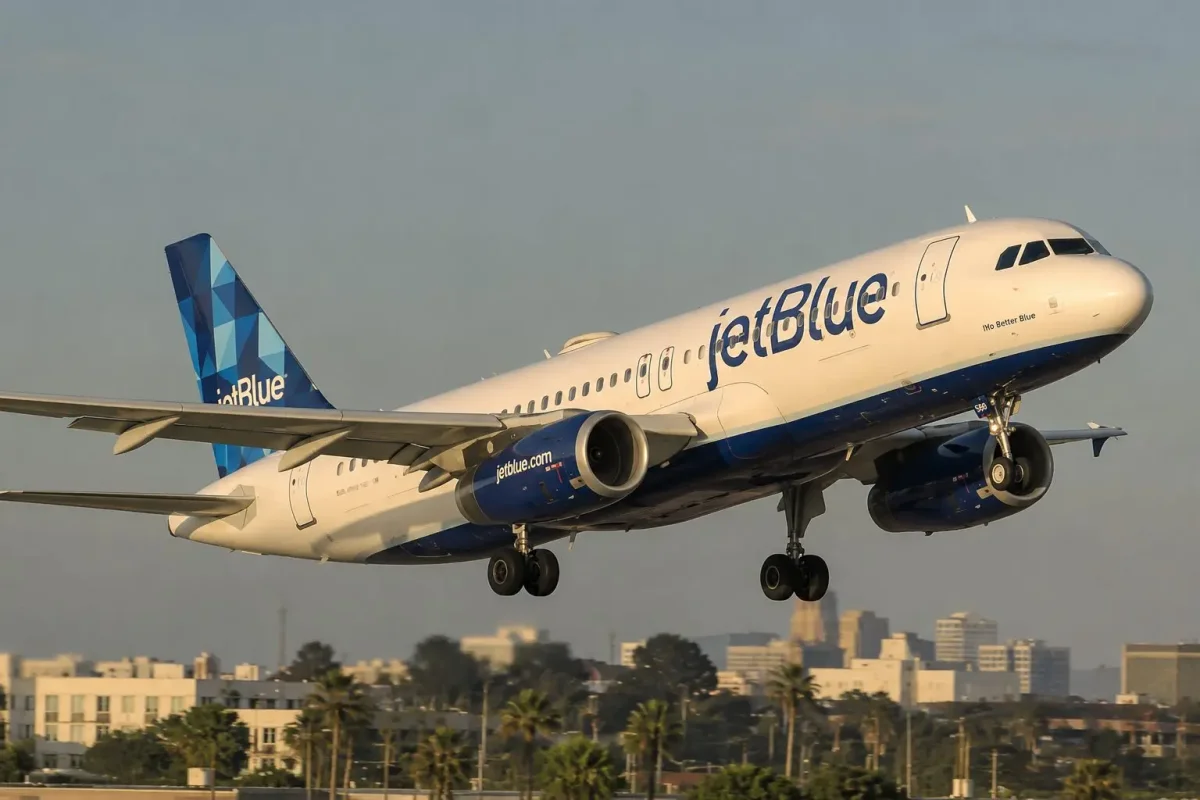
JetBlue Airways Corporation (NASDAQ:JBLU) saw its shares climb 0.7% to $6.07 on Monday afternoon, despite a downgrade from Raymond James (NYSE:RJF) that shifted the stock's rating to Underperform. The move comes as the stock now trades above both the average analyst target of $5.24 and the median target of $5.00, leaving some market participants questioning the sustainability of the rally given the company's financial pressures.
Raymond James analyst Savanthi Syth noted that while JetBlue and Frontier Group Holdings (NASDAQ:ULCC) both stand to benefit from Spirit Airlines' exit from the market, Frontier appears better positioned for near-term gains in fares and margins. Syth described JetBlue as "a more valuable long-term strategic asset" but cautioned that upside potential is "limited" following the recent price jump, according to Investing.com. The firm does not anticipate liquidity issues for JetBlue in 2026 absent a major macroeconomic shock, though it suggested that a Chapter 11 restructuring would be a "more prudent course of action"—a scenario that would be unfavorable for current equity holders.
The stock's performance stands in contrast to its analyst coverage. At Monday's close, the average analyst target sits roughly 14% below the current price, while the median target is about 18% lower. The range of analyst estimates is wide, with a high target of $8.00 and a low of $2.00, reflecting significant uncertainty about the company's trajectory. Earnings estimates remain negative, with a projected second-quarter EPS of -$0.72 and a full-year 2026 EPS forecast of -$2.39, though losses are expected to narrow to -$0.61 by 2027.
On the operational front, JetBlue raised its second-quarter revenue per available seat mile (RASM) guidance to 9%–12% from the prior range of 7%–11%, as detailed in its June 1 8-K filing. The company now expects capacity growth of 2%–4%, narrowing from the previous 1.5%–4.5% range. However, fuel costs have been revised upward to $4.26–$4.36 per gallon from $4.13–$4.28, adding pressure on margins. JetBlue reported a 99.8% completion factor for the quarter so far and noted steady demand, with particular strength on routes inherited from Spirit Airlines after that carrier's shutdown. The airline expects to recover at least 40% of higher fuel costs during the quarter.
JetBlue's balance sheet remains a key concern. As of March 31, the company reported $8.49 billion in debt and finance lease obligations, with $8.44 billion in scheduled maturities after debt issuance costs. Unrestricted cash, cash equivalents, and investment securities totaled $2.4 billion, supplemented by a $600 million undrawn credit line with Citibank. The debt load is roughly 3.8 times the company's market capitalization, underscoring the leverage risk. S&P Global Ratings (NYSE:SPGI) downgraded JetBlue to CCC+ from B- on June 8, citing expectations that operating performance will remain "significantly pressured" for at least the next year and that positive free cash flow is unlikely before 2028.
Company executives have maintained a cautiously optimistic tone. CEO Joanna Geraghty stated in April that "demand trends strengthened as the quarter progressed," while President Marty St. George highlighted "continued strength across the booking curve." CFO Ursula Hurley acknowledged the volatility in the operating environment, with fuel prices remaining elevated.
In the broader airline sector, the U.S. Global Jets ETF (NYSEARCA:JETS) was up 0.6% on Monday. Frontier Group Holdings led gains with a 3.8% rise, while Delta Air Lines (NYSE:DAL) slipped 0.6%. United Airlines Holdings (NASDAQ:UAL) added 0.5%, and Southwest Airlines (NYSE:LUV) edged up 0.7%. The mixed performance reflects ongoing adjustments to market dynamics and fuel cost pressures across the industry.