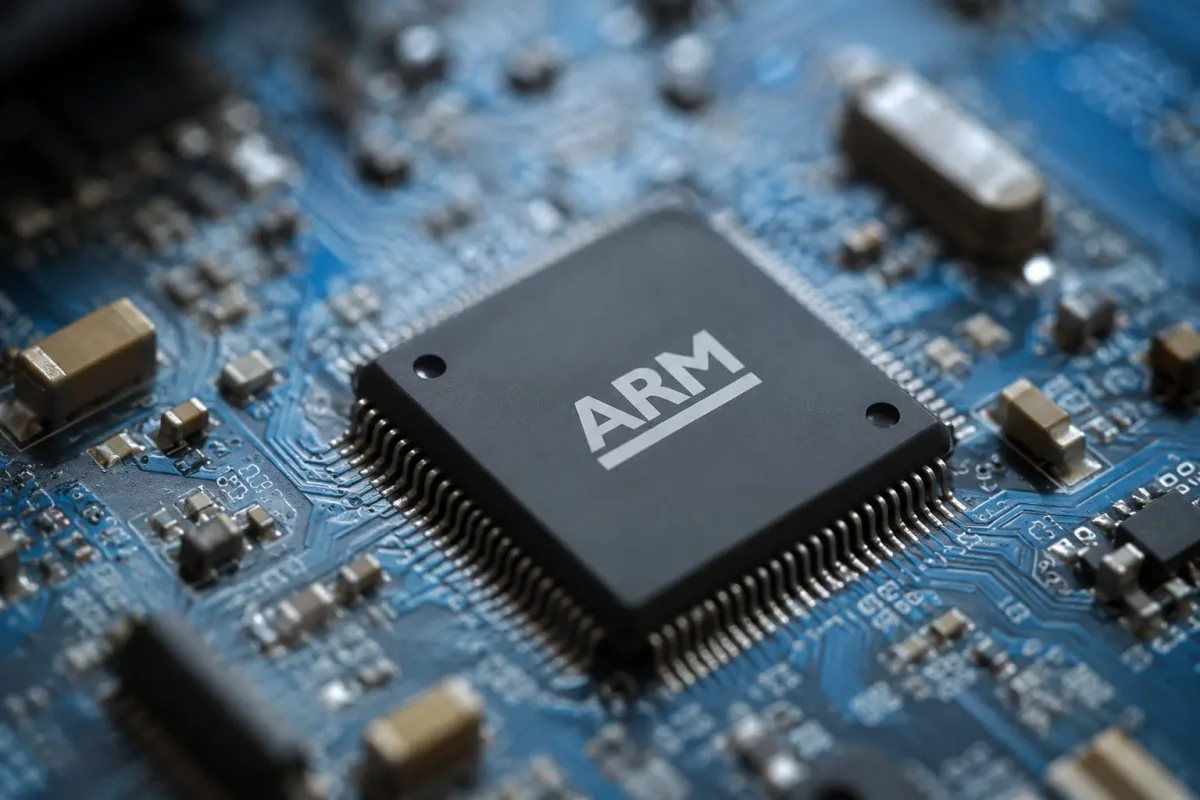
Arm Holdings plc (NASDAQ:ARM) ended the U.S. trading week on a sour note, sliding 6.58% to $315.28 in Thursday's session, the last before Nasdaq closed for the Independence Day holiday. The decline, however, came on unusually light volume, signaling a lack of conviction behind the move.
Volume for the session was just 7.58 million shares, only 69% of the stock's 65-day average of 10.92 million shares. The intraday range was notably wide, spanning from a high of $358.49 to a low of $309.74, a band of roughly $48.75, or about 15.5% of the closing price. Analysts viewed the narrow participation as a thin pre-holiday warning rather than a high-volume washout.
Over the two-day period ending Thursday, Arm's cumulative decline of 11.1% nearly matched the iShares Semiconductor ETF (NASDAQ:SOXX), which fell 11.6%. Meanwhile, the Invesco QQQ Trust (NASDAQ:QQQ) dropped only 3.2%, underlining the chip sector's relative weakness. For the holiday week, Arm underperformed QQQ by 6.5 percentage points.
The valuation remains a key concern. Despite the pullback, Arm's market capitalization stands at approximately $330 billion against fiscal 2026 revenue of $4.92 billion, translating to a price-to-sales multiple of roughly 67 times. This lofty multiple implies that investors are still betting heavily on future data-center revenue growth, even as near-term headwinds emerge.
From its June 18 high of $452.70, the stock has now fallen 30.4%, yet it still trades 12.7% above the average analyst price target of $279.83. Among 27 analysts tracked by MarketBeat, the consensus is bullish: 19 rate it a buy, seven a hold, and only one a sell. Price targets range from $140 to $500.
Arm, the UK-based chip designer, licenses CPU architectures and compute platforms. Its cloud and data-center portfolio includes the Arm AGI CPU and Arm Neoverse Compute Subsystems. CEO Rene Haas told analysts in May that AGI CPU customer demand had surpassed $2 billion across fiscal 2027 and 2028, emphasizing that "customers want Arm at the center of the AI data center."
However, CFO Jason Child tempered expectations by maintaining the company's supply-chain capacity outlook of $1 billion. For the fiscal first quarter, Arm guided for revenue of $1.26 billion, plus or minus $50 million, and non-GAAP EPS of $0.40, plus or minus 4 cents. The supply issue remains a live concern: Reuters reported in May that Arm shares slid after the company warned of softness in the smartphone market and challenges securing supply for its new AI chip.
The broader market offered little relief for chip bulls on Thursday. The Nasdaq Composite fell 0.8%, dragged by semiconductor names, while the Dow Jones Industrial Average hit a record. SOXX tumbled 5.6% on the day and nearly 12% over two days, according to Kiplinger. The labor market data, however, were less alarming: U.S. payrolls rose by just 57,000 in June, below forecasts, leading Brian Jacobsen, chief economist at Annex Wealth Management, to comment that "the labor market isn't overheating."
Looking ahead, Arm's next key event is the tentatively scheduled fiscal 2027 first-quarter earnings report on July 29. For the upcoming trading week, the first reference levels will be Thursday's low of $309.74 and the close at $315.28. Investors will be watching closely to see if the recent slide deepens or stabilizes.